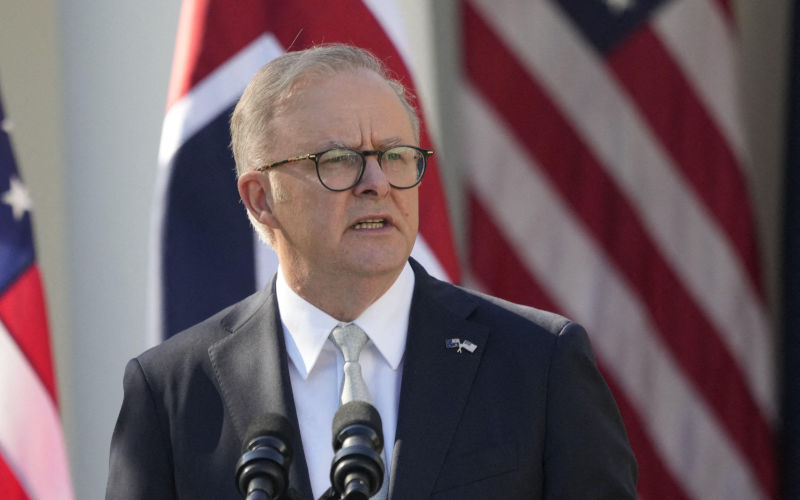
Australia’s push on AI and social media regulation has put it at odds with Washington. The disagreement offers a rare glimpse of a foreign policy willing to put Australian interests ahead of automatic alignment with the US.
America has been a particularly annoying notional ally and former friend over recent months. But what would be the point of complaining? President Trump has been doing exactly as he promised last year. He is acting only out of America’s interests, narrowly defined, and does not give a toss about what allies, notional members of the western alliance or even foreign heads of state with whom he has any sort of personal relationship think. He is not carefully nurturing alliance relationships or promoting any sense of security that the US is the ultimate reliable friend and guarantor of western commerce, stable relationships under the rule of law, or promoter of peace.
Indeed, it appears that he is at that stage of his presidency where he is more concerned with physical monuments to his greatness, such as triumphal arches, presidential ballrooms and, perhaps, a place on Mount Rushmore than any international legacy of peace, growth and prosperity, and confidence in the future.
Over recent weeks, Australians have become used to a running negative commentary from Trump about a few items that Anthony Albanese seems to want to make his legacy. Australia, it will be remembered, took an international lead in attempting to restrict access to social media for children. Skilful public relations efforts have inspired imitation from other countries, and some praise for Australia, or for at least the idea it contains.
As it happens, the scheme doesn’t work, because the ones it was supposed to restrain have found a million ways to bypass the controls, while a tiny minority of dutiful kids find themselves constrained. But many parents are quite reasonably concerned at the material available to children on social media and would like to have it thought that there were something in the way of controls, so there has been some praise coming in Albanese’s direction.
As things stand, it may prove to be the only ‘achievement’ so far for which Albanese might be remembered in Australian history books.
Albanese has extended his efforts to control the flow and type of material available online. His legislation imposes a duty of care on social media providers and gives users more control over the algorithms that shape their feeds. He argues that the reforms return control over content to individuals, while big tech companies see them as enabling government censorship and restrictions on free speech. Trump and his administration have echoed those concerns, although Albanese has aimed his proposals less at the United States, Trump or big tech than at other countries and the United Nations.
In the long term, strident opposition from vested interests, including Trump, may even help him, as public opinion appears to be turning against a wholly libertarian approach to internet content.
Albanese is also assisted by an international debate now in motion about the future of AI, and the economic opportunities available with data centres. Australia has a limited opportunity for getting a privileged place on the data centre boat, but it is happening just as consumers, particularly in the US, have realised that data centres could prove a two-edged sword, and are arguing for community input and controls over where they are located, under what regulation, and how their virtually unlimited demand for water and energy is going to be satisfied.
Trump’s unconvincing ‘trust me’ on AI development
At the same time there are fears that uncontrolled AI investment may lead to systems able to autonomously break into other systems, destroy privacy, override human instructions and perhaps cause some sort of AI apocalypse. Even high-tech moguls have warned of the need for care, perhaps for a pause in development, and for the placement of limits within systems.
Albanese, initially a complete enthusiast for data centres, has been clever enough to see the consumer pushback and the doubts, and has made a considerable investment in trying to reassure the public that Australia will have checks and balances in the system. In this, if by an independent route, he has reached the position that American governors and mayors are moving to.
But Donald Trump is entirely opposed to any form of regulation and control, and has been critical of the Australian approach as much as to the reaction in the US itself. He argues that the cost of a regulation route will be Chinese domination of AI, and a massive advantage to China in the rivalry between the superpowers.
The Albanese visit to the United Nations, and to high-tech chiefs in Silicon Valley, proved timely in terms of publicity, as did an incident of AI hacking of a government health database by a rogue system. Albanese’s contributions were far from the only ones urging some care and some calm during international debates involving many world leaders. But he certainly became a part of the focus of Trump’s resistance to any idea of regulating a transnational framework ultimately owned by very benevolent and public-spirited (and largely non-tax-paying) US capitalists.
It may prove to have been an occasion when Australia independently perceived what its national interests required, discovered them to be quite different from those of the US, and decided, for a change, to promote its view of the world rather than America’s. A limited experiment, perhaps, for Australia still assiduously avoids criticising the US on Israel, on the Iranian catastrophes and, largely, on China, even when the interests are obviously different.
And, in more recent times, Australia may prove to be the most significant non-combatant, or moral coward, over America’s attempt to coerce Canada. Given all that Canada and Australia have in common, not least in proximity to the US, the silence from Australia, whether in Canberra or at the United Nations meeting in New York, is shameful.
In any event, the open argument between Australia and the US over AI is yet another reminder that our interests often diverge, and that we gain no benefit from mere cheering of the Richard Marles type, when the US puts its own interests forward.
Australia is on its own, and it must be from its own interests, short, medium and long term, that it makes its decisions about its place in the world. No one else will promote those interests, and the overlap between the interests of the US and Australia is getting smaller, even in terms of the military alliance.
Like most other countries which used to speak reverently about our great and powerful friend, which allegedly saved our arses 85 years ago, we have not been expelled from the alliance as such. At the military level indeed, Australia is probably more closely engaged with the United States than all but a tiny number of old allies, other than Israel.
A withering alliance with a much more indifferent USA
But the alliance structure is withered, and so is its old rationale. So far as the American commitment to the common defence of Europe against attack from Russia is concerned, it is virtually moribund. Trump does not seem to care much about the containment of Russia, or the protection of European countries against Russian aggression. Increasingly, he regards assistance to Ukraine as Europe’s (and Britain’s) responsibility, and he and the political administration do not seem to care much whether Ukraine wins.
He remains still very attached to Israel but is becoming a tad more critical. His intervention in Iran, largely at Israel’s insistence, has damaged American prestige, caused enormous damage to US military resources and caused international inflation with rising petrol and diesel prices. America is trying to censor media coverage of significant military damage to its Middle Eastern bases. It has been given little help from old allies, in part because it did not consult them before taking action.
For the time being he seems trapped until he can find solutions involving retreat with as much dignity as he can muster. There isn’t much to be found – yet another significant defeat for US arms from a smaller power. As in Iraq, in Afghanistan, Vietnam and Korea.
On China, Trump’s military and trade belligerence waxes and wanes. There is definitely an appetite for war among the American military (and among their Australian defence and intelligence vassals). But Trump no longer seems as keen. Just in case, the US hopes to maintain a force of Asian allies willing to fight a war against China, possibly over Taiwan or North Korea. It now seems that Japan is becoming more interested in advancing from its shores for the first time in 81 years.
Yet Trump has a strange way of binding his allies. He abuses and derides them, including for their lack of success and usefulness to the US in American military defeats in Asia since WWII. He berates them for failing to come to US aid in mad adventures such as in Iran and the Strait of Hormuz, even though such countries were not consulted, and have thought US tactics and strategy stupid.
The civilian leadership of the US military does not inspire confidence. Any general sense of alliance, friendship or US benevolence is undermined by aggressive US trade tactics, including by illegal tariffs and sanctions, and an avowed US aim of using aggressive protectionism to evenly balance trade relationships. Australia, which actually has a balance of trade deficit with the US, is treated as badly as if it were China, or Europe, both areas in serious competition with American business and enjoying large trade surpluses by selling more than they buy.
But Australia does not even have the satisfaction of feeling that it is being victimised for something it has done, even after masochistic efforts to put America’s interests ahead of Australia’s. The fact is that the US is indifferent to Australia. We are not being singled out.
Trump and his administration feel no particular fraternal sense for Australia or Australians and lump it with all of the other nations (allies or not) who are seen to be lacking in serving US interests. If we have had some relative privileges, such as by an inside chance with data centres and AI, it has not been because Australians are such wonderful friends or especially deserving of an inside run. It is because Australia is a stable nation well removed from regional tensions and wars, is readily subject to American economic coercion in the name of free trade rhetoric and has a long record of subservience.
It is still, of course, open house for the American military
A few nations, such as Australia, of course, have been entirely willing to put the national landscape at America’s disposal. They allow American bases, sometimes with the pretence of joint management. They have created American stockpiles of munitions and military equipment, and landing fields for bombing expeditions, even for adventures in which Australia is not (yet) committed. Strictly speaking, Australia has not declared that it would be an ally of the US in any defence of Taiwan. But if there were to be such a war, the US would not hesitate to use assets deployed in Australia, with or without Australian permission.
If it comes to shooting, the US will make full use of Australian defence resources, including submarine bases, satellite intelligence and military stockpiles. That use may make Australia a natural target and perhaps surrogate for any conflict which develops. (Where, for example, China uses its power to squash the Australian gnat, rather than the risks, including of nuclear escalation, if it directly attacks the US.)
That does not seem to win Australia any privileges, whether in military or trade terms. Nor does it produce much in the way of respect. The US is used enough to dealing with sycophantic leaders, and Anthony Albanese, Richard Marles and Penny Wong give more of that for less benefit than any other country. But it does not give Australia any place in US councils, either in terms of its defence and foreign policy, its trade and economic policy, or even in recognition of some history in common, once similar traditions and cultural, and social ideas or ideals.
American politics and political culture have changed so much beyond recognition over recent decades that many Australians deny that we have much in the way of shared values, or any sense of international citizenship. Certainly, we have far more in common with the history, the culture and the values of Canada. Thank heavens that Albanese has discovered that action in his own interests can also be in Australia’s interest.
Republished from The Canberra Times

John Waterford AM, better known as Jack Waterford, is an Australian journalist and commentator.