The Albanese government may be adept at negotiating with insiders, but its failure to explain decisions and engage voters is deepening public distrust.
It’s about time that the government stopped telling citizens that it feels and understands their pain. Like all originally empathetic statements that had some meaning when original and sincere, it has become a cliché, and most voters don’t believe it anyway. They don’t believe that the government knows what is happening in Australian households and they don’t think it cares much, except potentially later at the ballot box. Not many of the inner circle are doing it tough. Nor do they believe that the government knows what is happening with the economy, with inflation, and with the cost of living. It is by no means evident that the government is acting in accordance with a plan. Or that it is focused on minimising the pain or evenly distributing the pain people are experiencing.
That doesn’t necessarily mean that most voters support a particular alternative economy strategy – even less the one that the opposition is preaching. But there’s a deep unease about the doldrums into which the economy seems to have fallen and the lack of an obvious pathway out. And about the lack of discussion about what to do.
The treasurer, Jim Chalmers, gives a competent daily commentary on the statistics of the day. But they do not inspire listeners with the idea that he is anything but an observer of events over which he has little control. Nor does he, or any other government spokesman (from the prime minister down) spend time explaining to the community just how and why the government expects that circumstances will improve, interest rates will fall, inflation will ease, and that the economy is preparing for a transition to one offering higher economic growth, better wages and an improved standard of living and higher economic security.
Of course, anything that includes the word ‘productivity’ is not cutting through to voters. There are ways of describing attempts to improve economic efficiency. But ones that blame workers for not working hard enough, or which hold that jobs in health care, childcare, aged care or community services cannot have outputs measured and thus do not count are not a way of mobilising community support. Even less so when most of those given to using the word show little interest in training and retraining, in investment and reinvestment or in providing the sort of community and society in which people share in the rewards of greater production. Perhaps the missing extra wealth is in the pockets of the new billionaires, the financial sector and the big consultancy firms.
Big, bold presentations from the billionaire lobbies are treated with suspicion.
Voters are interested in ideas for change in the economy, in new types of production and new ways of generating wealth. But a thicket of clichés about data centres, whether coming from spivs or government ministers, is not quite the same thing, any more than apparent assumptions that questions about energy and water are important but bound to be solved.
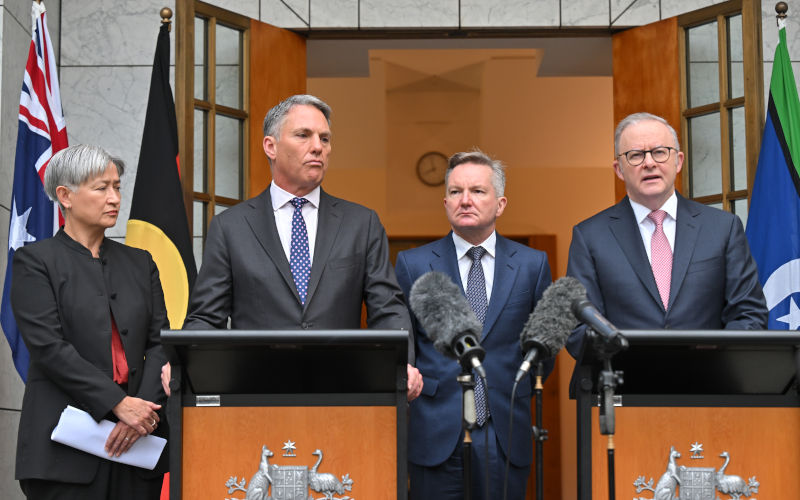
One can take it that the public is also interested in how new jobs and wealth are going to be created, how they are going to be distributed around the community and what the potential detriments as well as the potential benefits might be. Whatever the place for such a conversation between the voters and their representatives might be, it already seems plain that Defence Minister Richard Marles is not the person to hector voters, to do the dirty deals behind the scenes, to explain, and to answer, and to persuade. His interventions invariably seem to send support plummeting because of incoherence, incapacity to inspire trust or even to seem sincere or humble. It always seems safer to be against anything he cannot, or will not, explain.
Albanese and the Labor Party are not, by themselves, responsible for the rise of populist and nationalist movements and associated mistrust of government. But they have contributed mightily to their problems because of their failure to communicate with voters and their unwillingness to explain and engage.
It might not be Albanese’s fault that he lacks the popular touch, or any gift for communication, even any ready facility with words of feeling, of passion or of emotion. But he is the leader of a government with hundreds of public relations advisers on the payroll, hundreds of millions in advertising budgets and any number of political players with an actual gift of the gab, understanding of how people think, and capacity to reach people on their wavelength.
It may well be that some of the messages would anyway fail because they are bad messages and false solutions. But all too often the political message fails because no one much is even trying to explain, trying to debate, trying to keep issues on the boil, and trying to win the argument. Trying to keep the public in the loop.
The chasm is the greater, and perhaps the more politically dangerous for Labor, because Albanese is adept in governing behind the scenes. He consults with most of the major lobbies and listens carefully to what they have to say. He adjusts his position according to what he hears, at times negotiating positions with which different parties can feel comfortable. He listens to his own advisers, who are doing much the same. He gives them the respect he is denying to the population at large, including interest groups lacking easy access.
Albanese may not be a brilliant synthesiser, the man with the ear for the telling argument or slogan, nor the sort of chairman that, say, Bob Hawke or John Howard were. But he is across the argument, with some skill for binding the ministry, and the ‘stakeholders’ to an agreed solution. He knows how to reward those who live up to deals, and to freeze out those who won’t deal or deliver.
Behind-the-scenes talks ought to be the starting point for success, not the finish line.
All of this is very well, and these days essential preconditions for political success. But they are by no means all. They do not substitute for continuous engagement with and a continuing conversation with voters. That conversation implies a mind open to new ideas, and a willingness to modify ideas after the argument. It involves openness, including a willingness to put forward for public testing ideas or assertions made by the lobbies and the vested interests. When, as is almost always inevitable in the rationing processes of politics, it is necessary to prune big proposals, and drop some altogether, the public should be a part of that conversation too.
Even before a formal consultation voters should have a feel of what their leader thinks, an instinct for how important the idea is for him, and a sense of the right arguments to use. That is what John Howard meant when he said of his hapless voters that “they know me”, and “they know what I think”. Anthony Albanese would be very surprised to discover how little most voters know about him. Even less do they have instincts for what matters to him.
The most obvious example of this involves the complete failure of Labor in government to explain its thinking on AUKUS, what it understands it all to mean, and the reasoning which has gone into progressively greater degrees of engagement with it. It has encouraged no parliamentary debate. It may have held hundreds of seminars with members of the military and intelligence community, and with miscellaneous urgers standing to make billions from the projects. But it has not shared its thinking with the public at large.
Even if national security considerations limit some of the things which can be said, they do not prevent the power of ministers to discuss, explain and reassure. Albanese and Wong, it should be remembered, threw themselves enthusiastically into AUKUS without national security briefings, and without much in the way of detailed ideas of what was involved. The fear of being wedged was enough. But even if the idea has matured, the ministers have been less than frank about the nature of arrangements made, and the shared understandings these involve. An obvious example involves any precommitments about what would happen if there were to be a Chinese invasion of Taiwan. It is by no means clear that Australian public opinion would support any such commitment.
The same secrecy and lack of willingness to publicly engage or to explain one’s thinking has been evident around the prime minister’s decisions over minor bans on gambling advertising. He has negotiated, if almost entirely with the big vested gambling interests and television moguls rather than with those, including his own backbenchers, wanting to see controls and limits. He has treated the wider public as being entitled to know his mind only after he has decided, which is to say behind closed doors sitting with the money changers, all of whom by no means coincidentally are big party donors. This is not a case of listening to the public and engaging with them about what is appropriate. (If there was any listening done, it was not by open conversation but by public opinion polling, where the government does not have to answer back, or even, necessarily, to listen.) It was not a decision made in any sort of partnership with the public, but a decision to be imposed upon them, after discussions with those who stood most to benefit financially from the greatest inaction.
A government resistant to outside ideas, and phones turned to mute.
One gets the impression that this is the working model, whether on AUKUS, on gambling, on housing policy or on artificial intelligence. For the government, all wisdom lies among those who have privileged insider access to the prime minister’s door. No one else has a right of entry. Indeed, no one else even has the right to know who is blowing into the prime minister’s ear. After the grand council of insiders come to a decision, it is promulgated to the public. By now it contains all received wisdom and has the coercive force of law.
Small wonder that so many Australian voters have a fundamental distrust of government, a doubt, indeed, that ministers are trying to respond to public need and public opinion, and trying to bring together all the information, the wisdom and the policy experience available. Small wonder that they fear that decisions are being made by insiders, for insiders, with public interest a casualty on the way. Small wonder that some voters wonder if some decisions are inspired by self-interest rather than the best thing in the known circumstances. Or see legislation not as ideas given the sanction of law after measured debates and processes, but as arbitrary exercises of power where no one has bothered much about the consent of the governed.
At a time when Pauline Hanson’s One Nation party is undermining trust in democratic institutions, governments should be taking care to ensure that what is put into the sausage machine is done in the open, without the appearance of special deals, backroom deals, sweetheart deals, and favours. They should give the appearance of treating all citizens, and all involved in the political process equally. Otherwise even routine legislation, or social legislation, comes to lack the legitimacy and authority they ought to enjoy.
Anthony Albanese would like it to be thought that the government is going through a calm mid-term period, bedding down its ‘reforms’ before politics suddenly become frenetic and events become unpredictable, here and abroad. If it doesn’t all settle down in the way he would like, he can blame only his shortcuts and remoteness from the community he is supposed to be leading.
Republished from The Canberra Times

John Waterford AM, better known as Jack Waterford, is an Australian journalist and commentator.