Australia is campaigning for a UN Security Council seat on a promise to uphold international law and defend middle powers. Its record on Gaza, Indigenous rights, military alliances and international rulings tells a far less consistent story.
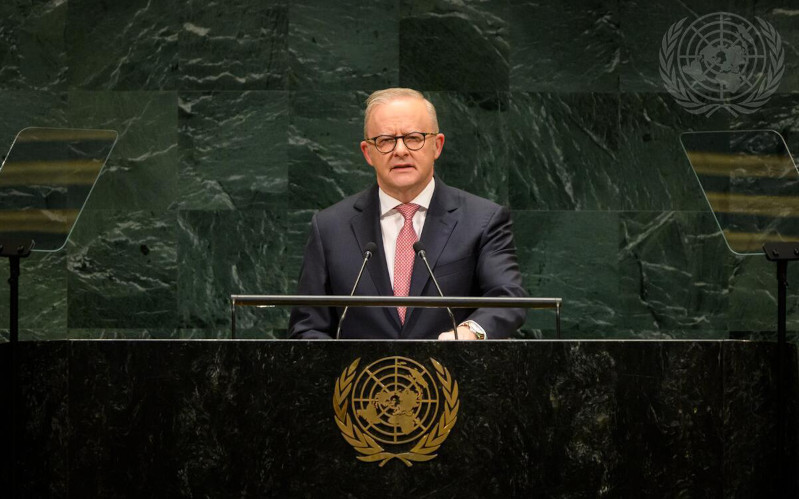
At the United Nations General Assembly, Anthony Albanese warned about the collapse of the international rules-based order. He said that Australia would be speaking up for middle powers and for that system of international order if Australia won a seat on the UN Security Council in 2029/30.
Anthony Albanese told us that “a safer world is one governed by rules, not by power and force alone”. Foreign Minister Wong added her enthusiasm. She said that Australia depended on such rules on free trade and the international rule of law. We would rather live in a world governed by rules than power alone, she said. She suggested political constraints on the Security Council veto be adopted by suspending the veto in cases of crimes against humanity, such as mass atrocities and genocide. Yet Penny Wong and Anthony Albanese have been the two ministers who have consistently refused to name genocide in Gaza because it might have legal consequences for Australia. At the ALP federal conference, ministers did handsprings to avoid uttering the word ‘genocide’.
The one minister missing in this current preaching about an international rules-based order is of course our defence minister, Richard Marles. He talks about international rules-based order even in his sleep.
We have a shameful record on international rules and conventions.
Australia is a party to the 1948 Genocide Convention. The convention imposes clear and binding duties on all parties, including Australia. We have a duty to prevent genocide. We have a duty to prevent genocide and punish those responsible for it. The International Court of Justice (ICJ) confirmed in January 2024 that the risk of genocide in Gaza was plausible and ordered provisional measures. The UNHRC Commission of Inquiry in September 2025 concluded that Israel was committing genocide.
What could be clearer? But our foreign minister squibs it in saying that “questions relating to genocide are matters where we respect the independence of international courts and tribunals”. The fact is it does not show respect at all. Genocide is not challenged and opposed. Is there a worse crime than genocide?
In September 2025, Australia recognised the State of Palestine. But the Australian Centre for International Justice was clear that mere recognition of Palestine does not discharge Australia’s obligations under the Genocide Convention to prevent, to punish and to refrain from complicity in genocide. We have failed on each count.
The government has disclosed the existence of military export permits to Israel but has refused to disclose sufficient detail about many of them. Palestinian human rights organisations are now seeking that information through the Federal Court. States that are complying with the Genocide Convention obligations do not need to conceal what arms they are supplying to the parties involved.
In early 2024, Australia suspended its funding to the United Nations Relief and Works Agency for Palestine Refugees (UNRWA) following Israeli government allegations that UNRWA staff had participated in the 7 October attacks. Australia was among the first countries to suspend funding without waiting for independent verification of the allegations.
In November 2024, the International Criminal Court (ICC) issued arrest warrants for Benjamin Netanyahu and his defence minister Yoav Gallant for alleged war crimes and crimes against humanity. As a member of the ICC, Australia is bound by the Rome Statute, under which parties are required to cooperate with the ICC in these investigations and proceedings by executing arrest warrants on their territory.
Incantations about the international rules-based order are repeated endlessly, but we defy the intent of rule after rule on genocide, war crimes and crimes against humanity, relief funding to alleviate starvation, arms exports and welcoming the president of Israel despite the possibility that he has breached the Genocide Convention.
In January 2025, the UN Human Rights Committee found that Australia remained responsible under international human rights law by transferring asylum seekers to Nauru. Australia rejected the committee’s findings.
Henry Reynolds, in his article in P&I on 4 August this year, wrote: “Australia champions Indigenous rights internationally yet the militarisation of Northern Australia raises urgent questions about consultation, consent and the use of Indigenous land for defence purposes… from Cape York in the east to the Kimberley in the West vast areas of land are now occupied by traditional owners. In the territory around half the landmass and about 80 per cent of the coastline is now owned in perpetuity by traditional owners.”
In 2007, the UN General Assembly overwhelmingly adopted a UN Declaration on the Rights of Indigenous People. More recently, Penny Wong has taken up the banner declaring that First Nations perspectives should be embedded in Australian foreign policy. She appointed Australia’s inaugural ambassador for First Nations people to carry that work internationally.
But it is window dressing again. Indigenous land is being used extensively for defence purposes, including Pine Gap. The 2007 UN Declaration on the Rights of Indigenous People is ignored. There have been no discussions, let alone agreement by Indigenous people, on more and more of their land being made available to the US for defence purposes.
The government preaches to other countries, particularly China, about human rights. Yet we do not have a Human Rights Act whereby people can challenge injustice when rights are abused. The government received a parliamentary committee report on a Human Rights Act two years ago but has taken no action.
In canvassing support for a non-permanent position on the Security Council, the government must hope that other countries are not fooled by our record of breaching numerous international norms, conventions and rules. It may be that the government is even fooling itself.
In 2019, the UN General Assembly voted on a resolution endorsing the ICJ’s advisory opinion that the UK’s continued administration of the Chagos Archipelago, including Diego Garcia, was illegal under international law, and demanded that the UK withdraw within six months. The vote was 116 in favour and six against – Australia, Hungary, Israel, the Maldives, the UK and the US. We continue to defy the UN General Assembly’s clear resolution.
Diego Garcia is one of the most important American military bases in the world. It was used for long-range bombing missions against Afghanistan and Iraq, a CIA interrogation centre and a critical logistics hub for US power across the Indian Ocean and Western Pacific. The US B52 bombers that operate through Tindal rely on Diego Garcia as a regional hub. Pine Gap’s operations are integrated with Diego Garcia’s communications and logistics infrastructure. Once again, Australia is on the side of the United States, UK and Israel.
The UK is reviewing its deal to hand over the Chagos Islands to Mauritius but leasing back Diego Garcia for 99 years. At the UN General Assembly on 23 September, Donald Trump called it a terrible deal for the US.
Once again, we reject the international rules-based order, when necessary, to accommodate the US from Gaza to Diego Garcia and ports in between.
Albanese launched Australia’s pitch for a seat on the UN Security Council under the tag line ‘We listen. We partner. We protect’. One could be forgiven for asking who really is it that we listen to, partner with and protect. It is certainly not Palestinians in Gaza, subjected to genocide, supported by the Australian government.
What was that nonsense of Australia combining with other middle powers to avoid being pushed around by the two global powers? Our record is clear. Alongside the US, we pick and choose the rules that suit us. It’s called hypocrisy.

John Menadue is the Founder of Pearls and Irritations and a board member. He was formerly the Editor-in-Chief. John was the Secretary of the Department of Prime Minister and Cabinet under Gough Whitlam and Malcolm Fraser, Ambassador to Japan, Secretary of the Department of Immigration and CEO of Qantas.