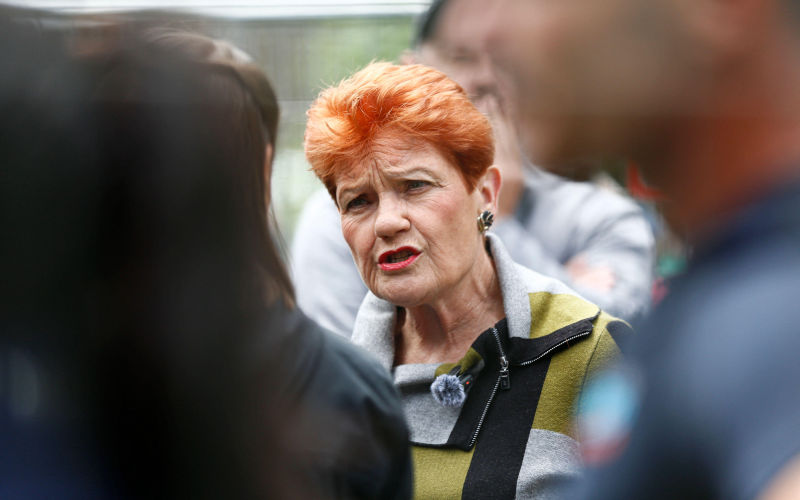
In the first of a two-part series, falling trust in institutions and a growing sense of political alienation help explain One Nation’s rise, particularly in outer-suburban and regional Australia.
We are losing trust in our institutions. A Labor government is probably the only party that can find solutions. If it is prepared to listen!
Democracy is not only about free and fair elections. We need well-functioning institutions that are responsive to and serve all our citizens.
Freedom of speech is under challenge. Zionists want to close debate and discussion about the genocide of Palestinians. Our legacy media and governments follow. The right to protest is challenged by the premier of NSW. Foreign influence is rife, but governments have a very selective view on the subject. Foreign residents Rupert Murdoch, Donald Trump and Benjamin Netanyahu presumably don’t exercise influence!
Governments behave in ways that suggest they are only interested in us at election time. They fail to engage us in a serious ongoing conversation. Populist parties feed on a growing feeling that governments and politicians cannot be trusted.
Take AUKUS. The Morrison government announced AUKUS before there had been meaningful public debate. And Albanese meekly agreed despite the history of the ALP opposing both the Vietnam and Iraq wars. Subsequent parliamentary scrutiny occurred but only after the strategic decision had effectively been made. Voters are dismissed as too dumb to understand or be taken seriously.
Wider causes of the decline in trust in institutions include Robodebt, the revolving door between politics and lobbying, looking after donors and mates, a lack of transparency and a political class out of touch with voters.
Research by the Centre for Policy Development shows that:
- 58 per cent of Australians believe their elected representatives do not serve their interests
- 68 per cent believe that in politics there is more concern with short-term gains than long-term challenges
- 37 per cent believe that parliamentarians are effective in tackling the country’s major challenges
- 65 per cent believe that citizens should have a much greater say in setting policy priorities
- 75 per cent of Australians believe that governments should focus on preventing problems early rather than relying on reactive measures
- 80 per cent believe that health, education and childcare must be universally affordable
- 84 per cent believe that governments must have the capability to deliver services directly rather than rely on ‘not for profit’ or private enterprises.
Democratic systems, almost everywhere, are under great challenge, although we are in better shape than most, particularly the United States. Our judiciary is in good shape, unlike in the Dismissal of 1975, but our parliaments and cabinets are poorly regarded.
The DEMOS AU poll in April this year showed low institutional trust among One Nation supporters, low-income groups, non-university educated persons and those living in outer suburban and rural areas.
Trust is lower in low-income groups (42 per cent) than higher income groups (63 per cent). Trust is lower in regional and rural Australia (43 per cent) compared with inner metropolitan (60 per cent). Trust is lower for persons with school education (44 per cent) and TAFE education (42 per cent) than persons with university education (61 per cent). And trust by voting intention is much lower for One Nation voters (28 per cent) than ALP voters (72 per cent), LNP voters (58 per cent) and Green voters (52 per cent).
Those figures tell a very clear story about the characteristics of One Nation supporters and their concerns.
There is partly an economic story to explain One Nation support. Over two million Australians live in poverty. While income inequality has plateaued, wealth inequality in Australia is at historic highs. Driven by inheritance and surging property and asset values, the net worth of Australia’s wealthiest households is racing away from the rest of the country. The remuneration of much of our business elite is offensive, like the lifestyle of the Murdochs and Packers with their inherited wealth, luxury yachts and private aeroplanes. The media publish “rich lists”, in apparent approval. Or in what suburbs real estate prices have most increased. Or how the social set are entertaining and who is best dressed.
Amongst some One Nation supporters there are clear elements of racism, Islamophobia and nostalgia for the good old days of white Australia. But the main driver, as Kos Samaras has pointed out, is frustration with the major parties that are out of touch and patronising. Some just want to “pull the whole joint down”.
But there is far more to the rise of One Nation than just the economic issues.
The more important story, as in the United States – although in no way as intense – is that the elites are not listening, that people feel no longer respected. Employment in manufacturing that gave social status is gone. The union, church, political party or civic organisation that gave a sense of belonging is also gone. The white Anglo-Saxon, Christian community is being replaced.
Trump’s supporters were described by Hillary Clinton as racist, sexist, homophobic, xenophobic and Islamophobic. She described them as “a basket case of deplorables”. That elitist comment probably cost her the presidential election.
Yet the charlatan Donald Trump pretends that he understands and listens to his MAGA supporters. It is a con, because in power he has impoverished the poor and vulnerable across the country for the benefit of his tax-avoiding, billionaire tech allies.
In the same way Pauline Hanson supporters believe that she understands and is listening to them. She doesn’t have tech billionaires supporting her but instead she has the wealthiest person in the country at her side.
One Nation will do little to advance the interests of her new supporters and working people in Australia. But they feel that she is listening and understands their resentment and anger … too many Asians, too many Muslims.
One Nation focuses on migration. But migration is the weapon and not the real story. Human history is littered with attempts to blame the foreigner, the outsider, the person that’s different and the migrant.
The problem with migration in Australia is mainly that it is badly managed. Abbott, Morrison and Dutton told us a political lie that they stopped the boats. They didn’t. The boats were stopped by Kevin Rudd. When Operation Sovereign Borders was introduced boat arrivals had reduced to a trickle. With boats stopped, asylum seekers began pouring into Australia by air. They came on valid visas and almost immediately after arrival sought refugee status. Peter Dutton, the minister, didn’t seem to know or care. The legacy media also chose not to notice. Most of these asylum seekers are now seeking permanent residence. Working holiday programs were initially about reciprocal short-term stays and cultural exchanges but they have become large cheap labour schemes. They are also in the almost three million temporary residents in Australia. Most tourists will leave but not all.
The migration failure has been due in part to burying the migration and multicultural functions into a large, unsympathetic and badly managed Department of Home Affairs with its focus on border security and control.
But the real story is not migration but housing failure, inequality, declining living standards, powerful and unaccountable elites and most importantly a sense of being left behind, that no one is listening – except Pauline Hanson. So we blame the migrant.
Members of parliament are seen as “insiders”, whose pre-parliamentary careers were spent primarily within the political system as political staffers, ministerial advisors, electorate officers, party officials, trade union officials, lobbyists, or professional advocates. They may have university degrees but little real-life experience.
The ALP no longer represents the people who vote for it. It is controlled by an unrepresentative coterie of factional controllers and officials. Internal politics is conducted almost entirely within an elite class.
This has produced a timid, managerial poll-driven approach to politics. Raising money and the compromises that go with it, including gambling interests, have supplanted party membership. By refusing to take the community seriously, and by hiding from public discussion, Labor has disenfranchised its natural constituency.
Another feature of the alienation is the mass closure of media in outer suburban and rural Australia. Between January 2019 and March 2024, 161 Australian news outlets closed. This followed a decline of more than 200 regional and community newspapers over the preceding decade. By 2024, 29 Australian local government areas lacked a single local news outlet in either print or digital form.
Australia also has one of the highest media concentrations in the world. With this concentration and the decline in media outlets it is not surprising that people feel alienated.
Tomorrow I will focus on the need for policies for the community at large but also the concerns of those that feel alienated in outer suburban and rural areas.

John Menadue is the Founder of Pearls and Irritations and a board member. He was formerly the Editor-in-Chief. John was the Secretary of the Department of Prime Minister and Cabinet under Gough Whitlam and Malcolm Fraser, Ambassador to Japan, Secretary of the Department of Immigration and CEO of Qantas.