
A major new Lancet commission identifies nuclear war and malicious AI among threats capable of causing human extinction this century, with climate breakdown posing an escalating longer-term danger.
Obliteration of the entire human species is now a distinct possibility, according to the latest medical report card on our state of health worldwide.
The latest diagnosis from The Lancet Commission on 21st century global threats to health identifies 17 immediate threats, two of which could end in human extinction within the present century and a third not long after.
It is the first international scientific study to project, based on current data, the likelihood of a human wipeout within the present century. Others, so far, have mainly treated it as a dangerous risk, though many scientists had sounded personal warnings based on their own research.
The threats referred to by the Lancet Commission include nuclear war, malicious use of AI and biological weapons, pandemics, obesity, child malnutrition, antimicrobial resistance, conflict, inequality, bad education and cuts to international health aid. Nuclear war and malicious AI could wipe out humanity before 2100, while climate breakdown constitutes a real extinction risk in subsequent centuries.
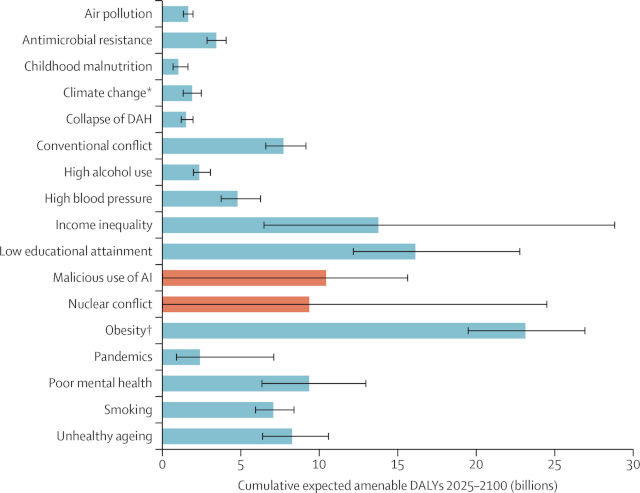
The commission warned that all these threats will interact and magnify one another over time, meaning they must be tackled collectively, rather than singly.
Moreover, it looked not only at how many people are likely to die as a result of the 17 threats, but also at the crippling cost of mass disability resulting from all causes.
“Potential causes of human extinction can be loosely grouped into exogenous threats such as an asteroid impact – and anthropogenic (i.e. man-made) threats such as war or a catastrophic physics accident. In all cases, an outcome as extreme as human extinction would require events or developments that either have been of very low probability historically or are entirely unprecedented,” said the commission, explaining why, previously, it has been extremely difficult to predict such a dire event with any confidence.
Now, however, from a predominantly medical perspective, the commission has given firm voice to humanity’s deepest fear – annihilation – and with higher confidence. It characterised the COVID-19 pandemic as a wake-up call for unexpected catastrophes that can strike humanity without warning.
It said that most governments focus on the local and the short-term, meaning they tend to ignore threats that could be far greater and more devastating. “The cycles of concern and neglect about pandemics are a classic example of how short-termism adversely affects governments’ ability to anticipate, prepare and prevent,” the commission said.
The new timeframe for the commission’s threat assessment is the 75 years from 2025 to 2100. This new assessment of future human health problems includes nuclear war and malicious use of AI for the first time.
Its forecast for the human population peaks at 9.5 billion in 2064, by which time 36 per cent of all people will come from Africa. While most humans will continue to live longer lives, more years of those lives will be lived in poor health due to mental disorders, musculoskeletal disorders and diabetes, leading to a global increase in disability.
The largest future health risks globally will be from diabetes, obesity, high blood pressure and poor diet.
Between now and the end of the century, the 15 major catastrophic health risks will not only kill tens of millions but also cause the loss of more than one billion years of healthy life by those who suffer from them, The Lancet group said. A further 99 diseases will inflict the loss of 500 million years of healthy life.
It warned that certain threats, such as exposure to plastics, pesticides and heavy metals, were not yet sufficiently quantified to make reliable health predictions – but there is an urgent need to do so.
The commission’s modelling suggests that, under normal circumstances, there will be 81 million deaths due to conventional wars between now and 2100, chiefly in Africa.
According to nuclear experts and forecasters, the nuclear war health risk ranges from zero deaths (in the event of no conflict) to complete extinction due to nuclear war and the resulting global famine, with fewer than 5,000 humans left alive, depending on the scale of the conflict – which is not easy to predict.
“Nuclear famine would affect all regions of the world, including those far from the conflict itself, through reduced caloric availability and cascading food-system failures. The devastation that could result from nuclear war cannot be overstated. Nuclear conflict is accordingly recognised by superforecasters as one of the few threats with extinction potential to humanity, alongside malicious AI. The risk is not hypothetical: we found that between 1948 and 2010, 22 nuclear weapon accidents and 21 close calls were recorded,” The Lancet team said.
Coupled with the nuclear threat is the even larger risk of a human wipeout resulting from malicious use of artificial intelligence, they said.
This could take the form of the use of AI to deliberately design and manufacture deadly plague organisms capable of starting new pandemics, the malicious use of AI to collapse governmental and societal systems, the incorporation of AI-generated mass-hallucinations into medicine, politics, food and other critical areas and the intentional destruction of financial systems.
“The final pathway is loss of control through the emergence of agentic, unaligned artificial general intelligence. This loss of control includes AI systems creating subgoals that lead to human disempowerment or elimination, particularly if such agents autonomously gain access to financial networks, key infrastructure, or physical tools in the real world.”
Since most AI is developed in the private sector, governments are almost powerless to understand and regulate its advancement, making the likelihood of a catastrophe even greater.
Views of the danger it poses vary, with AI experts tending to be more pessimistic than other forecasters. Collectively they put the extinction risk at 10 per cent – but some AI experts rate it far higher.
For both nuclear war and malignant AI, the group concluded the risk of catastrophe “combines a potentially immense consequence with a probability that is much less than one”. However, it acknowledged that this conclusion was ‘tenuous’.
The third of the extinction risks is climate change, which is not expected to reach human wipeout proportions before the 22nd century.
However, The Lancet group agreed the rising risk makes it colossal. If fossil fuel emissions continue to grow, the commission concluded, humanity will lose around 1.89 billion more years of useful human life to climate death and disability than under a low emissions scenario. These losses stem from extreme heat, air pollution, malnutrition, floods and storms, with the world’s poorest and most vulnerable populations suffering worst. However, this prediction does not allow for the additional devastation unlocked by climate tipping points, mass refugeeism, famine and cascading societal disruption.
The importance of The Lancet Commission’s report lies less in the specific human health predictions it makes – massive in themselves – than in the fact it is the first global scientific study to articulate a clear warning of humanity’s potential extinction.
This comes at a time when the nuclear, AI and climate threats are all seen to be rising sharply – and being equally widely ignored by governments, by private industry and by much of society.

Julian Cribb AM is an Australian science writer and author of six books on the human existential emergency. His latest book is “How to Fix a Broken Planet” (Cambridge University Press, 2023)