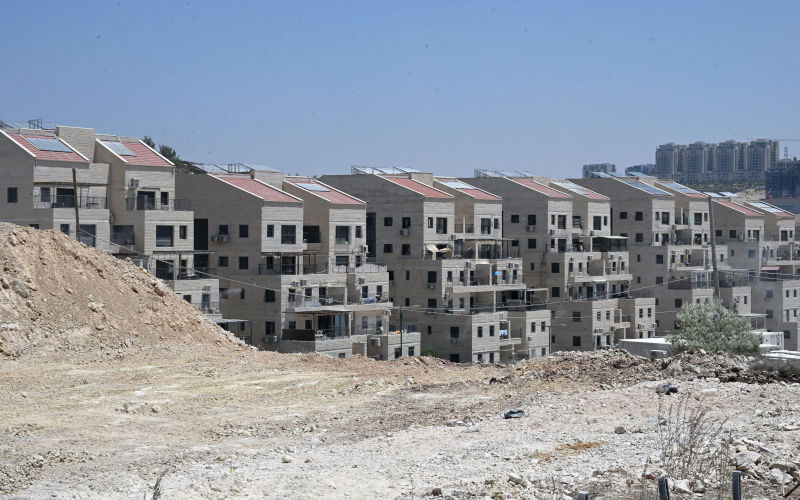
In the final part of a four-part series, expanding Israeli settlements and land acquisition reveal how security, law and political power are reshaping Palestinian life across the occupied West Bank.
For a visitor, you soon find out from inhabitants of West Bank ‘settlements’ (as they are called, with generous ambiguity) that land acquired by Jewish settlers is anything but an inhumane act. Greater Israel is their biblically bequeathed homeland: acquiring or expanding a settlement is thus not theft but a right.
At Gush Etzion, a showcase West Bank settlement visited (tree-lined streets, rolling lawns and large, well-kept houses), the centrepiece is a million-dollar cultural centre. The one-hour presentation contains not a single reference to Palestine, with Judea and Samaria being the biblical replacements. The talk extensively refers to their original residents who arrived in their ‘homeland’ – a desolate landscape – with the aim of turning it into a Garden of Eden.
That there is a newly energised effort in this direction is well in view in drives between West Bank cities in the form of hilltop huts sprouting Jewish flags dotting the landscape. Such illegal acquisitions, in apartheid terms, clearly represent sustained acts and policies. They have openly been carried out for almost 60 years and increasingly so since 7 October.
In discussion with urban Israelis, they also cling to the notion of greater Israel as their homeland, although with justification using legal and historical grounds. Their level of distrust of Palestinians has been clearly elevated since 7 October, with no attempt to distinguish between those in Gaza and those in the West Bank. That is particularly hard to justify given 7 October was a Hamas-planned and led incursion from Gaza and did not involve the PA nor West Bank Palestinians. 7 October was therefore clearly different to the first and second Intifadas, which involved Palestinians from both Gaza and the West Bank.
For many non-settler Israelis, the issue of land acquisition in the West Bank does cause some discomfort and, for many, admission of it being ‘a problem’. But given their professed security concerns, there is no sense of urgency about how to deal with it. Others simply justify land acquisition as necessary for security. Following the Israeli Government’s lead, the broad umbrella under which actions are justified on security grounds has become a well-used means of rejecting charges of apartheid.
That this evident lack of concern over rampant aggressive attacks on Palestinians and dispossession of their land is widespread and growing post 7 October shows up in recent polling. One survey has support for expanding settlements rising from 34 per cent in October 2024 to 47 per cent in March 2025. A 2025 Pew survey shows 44 per cent of Israelis believing that continued expansion of settlements helped security, with only 35 per cent of the view it hurt security. A 2026 survey has 38 per cent of Israelis supporting the full annexation of the West Bank.
It’s therefore no surprise that in visiting Jewish West Bank settlements, the perceived need for security has been largely generated by Jewish settlers, not West Bank Palestinians. In other words, the security regime in the West Bank is principally deployed to protect and facilitate the expansion of settlements.
More generally, there is now the widely acknowledged aim, including by members of the Israeli Government, that the extensive body of security measures has been applied to so bifurcate Palestinian communities that an independent Palestinian state will be an unmanageable proposition.
Current estimates are that by the end of 2024, settler outposts controlled 13 per cent of the entire West Bank area and 22 per cent of Area C, which is fully administered by Israel, and which accounts for 60 per cent of the West Bank’s area. Human rights organisations’ research indicates that land acquisition has accelerated through the 3,000 settler attacks since January last year and the destruction of some 870 Palestinian buildings since the beginning of this year.
It is also well known that Israeli civil authorities governing Area C have persistently obstructed Palestinians on issues of land ownership and building permits. That power was greatly enhanced in February this year when laws were passed to expand overall Israeli governmental authority in Area C and, in particular, in relation to Israeli/Jewish acquisition of privately held land.
Palestinians also harbour deep resentment against the legal apartheid to which they are subject. They point to the well-known bias in Israeli courts, which routinely favour Israelis in disputes with Palestinians and where settlers have attacked Palestinian landowners. No less hated is the widely used legal device of charging Palestinians under military law to evade Israeli courts and hold them without charges being laid.
The Israeli Government is thus directly challenged by the Rome Statute, which states that apartheid is present when measures are taken “…. to prevent a racial group from participating in the political, social, economic and cultural life of the country…”.
The Australian Government should equally be challenged by the avalanche of clear empirical evidence of apartheid in all its variety of forms. But the background to its refusal reveals an inexcusable lack of courage by an Israel lobby-intimidated Government seeking cover. Penny Wong’s most direct explanation dates back to 2022 when she insisted a finding of apartheid by the Government would “.… not [be] helpful in progressing the meaningful dialogue and negotiation necessary to achieve a just and enduring peace”. Wong went on to reveal further legalistic cover was being taken through the lack of a finding of apartheid by an international court. Since then, however, that cover has been punctured by the ICJ’s advisory opinion in July 2024, which found that in relation to the West Bank, Israel had breached the international prohibition on racial segregation and apartheid.
So almost four years later, while we sheltered under spin and legal gymnastics, Israel with welcomed impunity and brutality has been able to substantially reinforce its apartheid state. What more evidence does the Government and its mainstream media handmaidens need to end their forensic eradication of references to apartheid?

Dr Webb is a former diplomat with postings in Indonesia, South Korea, Paris and New Zealand. In a former career as a journalist he was the economics writer for the Bulletin Magasine and Assistant Editor of Rydges Business Journal. He currently carries out research in the field of environmental economics at the Queensland University of Technology.