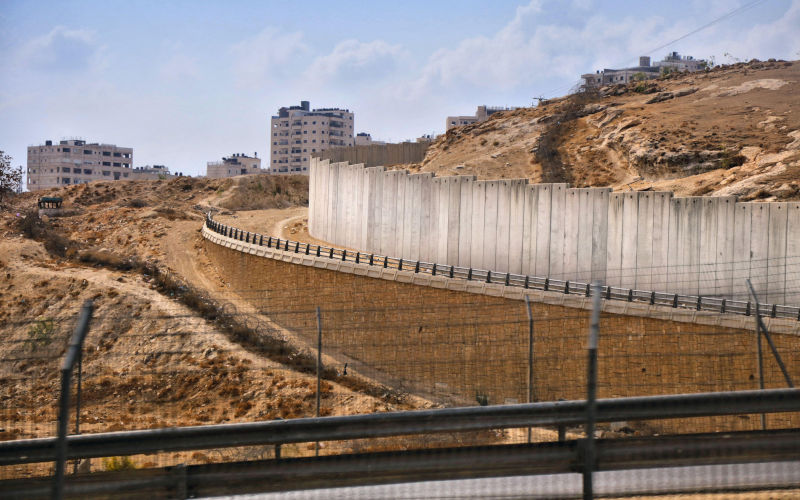
Israel’s expanding security regime across the West Bank is reshaping Palestinian life. In part three of a four-part series, Jeremy Webb considers whether these measures amount to institutionalised apartheid.
That Israel is openly flooding the West Bank with acts that can be judged as inhumane indicates the impunity with which they are being carried out. Witness the recent destruction of a UNHCR training facility and the televised settler attacks on Palestinians and their houses near Qusra. Such impunity is all the more brazen given members of the Israeli parliament are openly supporting the annexation of the West Bank and thus lend support to actions which are designed to separate and subjugate West Bank Palestinians. But when publicly pressed on whether these acts are not part of a regime of apartheid or genocide, the issue of security is used as a form of universal justification.
How security is in fact applied tells a different story. The threat of criticism looms large. That’s immediately clear even before entering Israel. While it’s surprisingly easy to get an Israeli tourist visa online (24 hours), there is a major catch in the small print: it does not guarantee entry and can be refused on arrival for any of a catch-all of security reasons with no financial recompense. As a public critic of Israel, that risk created a strong disincentive to visit.
While my entry at Ben Gurion airport involved only a perfunctory visa check, a sense of unease is transmitted by the barely civil, brusque manner in which it was performed. That unease turned into what appeared to be insecurity when the subject of Palestine was raised. Asking Israelis how to get to Bethlehem by bus proved an exercise in futility in the face of a strange mental apartheid. Enquiries at the airport’s bus information centres and in Jerusalem were rudely rebuffed: such information, I was told, was none of their business.
As soon as you travel outside Jerusalem to other West Bank cities, mental apartheid is transformed into security apartheid. Immediately in view are parts of the US$3.4 billion, 240km network of walls and fences which separate Jewish settlements from Palestinians and Palestinian land. To what extent they are designed for security against Palestinians is hard to fathom, given that only 18 per cent are along the Green Line which divides the Jewish state and Palestine. Moreover, the intentions are further clouded by the planned ongoing extension to over 720km, which will continue to further separate Jewish settlements but from no obvious direct threat.
In full view to visitors is the extensive manning by the IDF of the 900-plus permanent and intermittently staffed checkpoints, gates and barriers strewn across the West Bank. On almost any day, a visitor will find bus stations crowded with IDF soldiers on their way to man them.
In visiting the West Bank, then, it’s immediately evident that security is a dominant factor in everyday life. In Hebron and Ramallah, students speak bitterly of a prison-like environment due to the constant travel restrictions imposed by the walls and gates and the threat of arrest by the IDF day or night. The reasons for arrests, the students say, are almost always for minor infractions, which are implausibly related to the security of Israelis. That fate befell my 22-year-old driver, recently arrested late at night. He was incarcerated under Israel’s military law for three months without charge after posting on Facebook a video of the Israeli bombing of a hospital in Gaza. Torture in the form of attacks by dogs, sleepless, noise-filled nights in brightly lit cells, and degrading acts in front of female IDF soldiers were, he said, the order of the day.
Palestinian prisoner organisations’ estimates indicate how much company he had: 23,000 West Bank Palestinians had been arrested by the IDF since 7 October, with 8,000 remaining in gaol, more than 3,000 of whom are being held in administrative detention without charge. They further count 1,200 children under the age of 18 as having been arrested. There is also extensive evidence that these arrests have been systematic and sustained: prior to 7 October, some 500-700 children were being arrested each year, a rate found to have dramatically increased after 7 October.
For the future, the students were increasingly apprehensive and angry at new security measures which were unjustifiably wholly directed at Palestinians and were, in their view, a reaction to no particular threat posed by the Palestinian community.
The measures included:
- New gun laws introduced after 7 October which gave Israelis, but not Palestinians, greater access (student concerns would seem justified: Amnesty International estimates that more than 240,000 firearm licences have been issued to Israelis).
- The introduction of the death penalty, which will apply exclusively to non-Israelis in the West Bank who are convicted of terrorism-related murder.
A key test of the presence of apartheid is whether the enforcement of security involves inhumane acts which are systematic and institutionalised. One obvious indication of institutionalisation is the IDF’s open accompaniment and protection of settlers in their attacks on Palestinians. Of the recent 3,000 attacks since the beginning of last year, the IDF is said to have accompanied or provided protection for half of them.
There is considerable further data indicating the extraordinary extent of systematically imposed acts under the guise of security which can be judged as inhumane.
- Last year alone, there were 1,800 settler attacks in the West Bank; 240 Palestinians were killed (of whom 16 were children), and of the total, 225 were killed by the IDF.
- In the same year, 36,000 Palestinians were displaced.
- So far this year, 1,300 West Bank attacks have occurred (an average of six a day), and 10,000 Palestinians have been displaced from their homes.
- Overall, in the years since 2022, there has been a doubling of new settlements in the West Bank.

Dr Webb is a former diplomat with postings in Indonesia, South Korea, Paris and New Zealand. In a former career as a journalist he was the economics writer for the Bulletin Magasine and Assistant Editor of Rydges Business Journal. He currently carries out research in the field of environmental economics at the Queensland University of Technology.