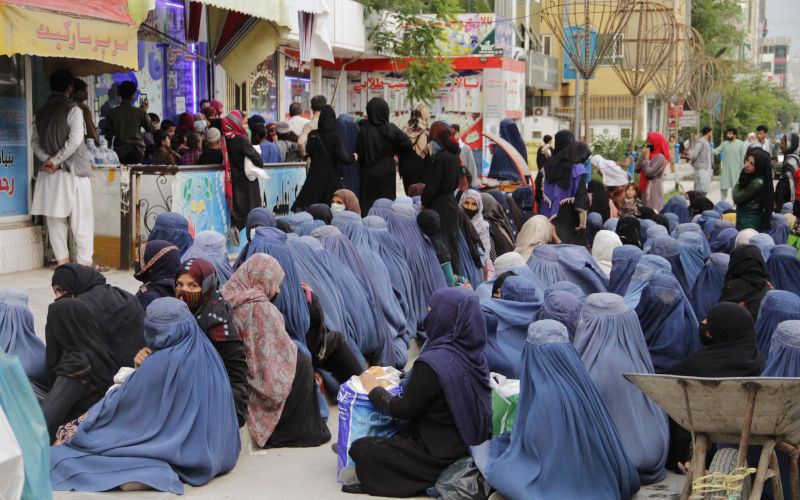
Five years into renewed Taliban rule, Afghanistan’s future remains uncertain. What went wrong with two decades of peacebuilding – and what can be done now?
My first experience of Afghanistan was enchanting, as a backpacking student on the hippy trail nearly six decades ago – with that memory sustained in my closet for years by an irredeemably smelly, yellow-dyed sheepskin jacket. Looking back at its tormented history since, my own subsequent engagement with the country and its people, and at the state of play now with the horrific consequences for women and girls of the resumption of Taliban rule, it is with a rather tumultuous mix of emotions: curiosity, fascination, delight in its people, disgust with all too many of its leaders, sometimes optimism, but more often despair. It’s hard to be confident about the country’s future.
I watched from afar as, ten years after my first visit, a communist coup in 1978 established a socialist state, subsequent infighting prompted the Soviet Union to invade Afghanistan in 1979, and the US-backed mujahideen forced its withdrawal ten years later. My watch then became much closer as the Islamists fought amongst themselves in the government with which I came to deal directly after becoming Foreign Minister in 1988.
One encounter in that role I particularly remember was with Gulbuddin Hekmatyar, the mujahideen leader who came to Canberra to drum up some support from us at a time when he was enjoying some favourable attention as a Western as well as Pakistan ally. There is no one I have ever met, with the possible exception only of a couple of my interlocutors from the Khmer Rouge during the Cambodian peace process in which I was engaged around that time, who struck me as more comprehensively evil. Perhaps not surprising when one learned, as I later did, that he began his activist career throwing acid at unveiled women on the Kabul University campus.
Infinitely more pleasurable than that encounter was the many I had, both as a government minister, and later in the mid-1990s during my short period in Opposition based in Dandenong as the Member for Holt, with the many wonderful Afghan men, women and children who came to Australia from the 1980s onward as refugees or migrants, and who quickly started making a major contribution to our economy, and socially and culturally enriching our society.
The Taliban had come to control most of the country by the time I and the Keating Government lost office in 1996, but I again came to seriously engage with Afghanistan after it was overthrown in the 2001 US intervention, defensible after 9/11 – and I had overcome my relevance deprivation syndrome by moving to Brussels to head the International Crisis Group, which I did for the next ten years. We soon had representatives on the ground in Kabul, analysing and advocating the peacebuilding steps that would be necessary to create a viable and sustainable human rights-respecting and terrorism-opposing democracy. I visited the country several times during that period, meeting most of the key military and political players, trying to advance that agenda.
The story after 2001 is sadly all too well-known. The US, after a highly problematic period of peacebuilding stewardship, finally withdrew all its military forces from the country in 2021, in a chaotically botched enterprise, leaving the Taliban to return to power after capturing Kabul and overthrowing the US-installed government of the Islamic Republic of Afghanistan. The Taliban’s government was made up entirely of its own members, determined to re-establish an extreme Islamist regime, in which dissent would be completely suppressed and the total subordination of women and girls tragically asserted.
And that, five years later, is where we remain. True it is that renewed fears, though fully justified, of the re-emergence of Afghanistan as terrorist central have not been realised. The economy, though fragile and with much of the population in severe economic distress, is surviving. More and more countries are beginning to, if not formally recognise, at least engage, diplomatically and otherwise with the Taliban regime. The security situation nationwide is more stable than expected, and will remain so as long as the militias opposed to the government remain fragmented and uncoordinated. Pakistan has turned from friend to foe, with its rage at the continuing activities of the TTP, but hostilities have not yet careered completely out of control. Things could change, but practically no-one is prepared to predict the Taliban’s collapse any time soon.
Yet so long as the Taliban continues to treat women and girls as it does – barring girls from higher education, women from most jobs, and enforcing harsh rules regarding their movement and dress – however many of its Central Asian and Middle Eastern neighbours are prepared to treat with it, and however much Russia and China in the UN Security Council remain willing to accommodate it, there is little appetite anywhere else in the world to recognise its legitimacy, and its future is uncertain.
There are many questions arising from all of this. In particular, looking back, could anything have been done differently to avert the successive catastrophes that have befallen the country, particularly during the post–2001 peacebuilding period, when there were at least initially some grounds for optimism? And looking forward, who needs to do what to improve the current situation: what are the strategies that might break the impasse?
Failed peacebuilding
With respect to peacebuilding, I have identified in other writing from my time as Foreign Minister and at the International Crisis Group, five main criteria for success. And the unhappy reality is that practically none of them were satisfied in Afghanistan.
The first and overwhelmingly most important requirement in getting peacebuilding right is to study, understand and respect the local political dynamics – and the cultural and other limits within which outsiders must operate. As with Iraq after 2003, and Libya after 2011, Afghanistan after 2001 is the poster-child for how much can go wrong when that understanding is lacking. Peacebuilding cannot be template-driven and technocratic, assuming too much universality in the nature of war-to-peace transition: every local context will be different. And peacebuilding which is insufficiently attentive to the complex mosaic of ethnicities in a country, and which is prepared to accommodate governments as corrupt and insensitive to that reality, as those of Hamid Karzai and Ashraf Ghani, is destined to ultimate failure.
Second, peacebuilders must sort out who should do what and when – immediately, over a medium transition period and in the longer term – allocating roles and coordinating them effectively both at headquarters and on the ground. Of all the things that went wrong in Afghanistan for so long, among the most serious were weaknesses on this front – poor coordination between all the relevant players, too much top-down administration and poor implementation in the field.
Third, multiple objectives have to be pursued simultaneously. Physical security may always be the first priority, but it cannot be the only one, and rule of law and justice issues, and economic governance and anti-corruption measures, deserve much higher priority than they have usually been given. Afghanistan is one of the clearest recent examples, where the international efforts to help create an effective police and court system proved hopelessly and lamentably inadequate. And the consuming preoccupation of the US for the first decade of its occupation in hunting down Osama bin Laden constantly distracted attention from the nation-building enterprise.
Fourth, it is necessary to commit the necessary resources, and sustain that commitment for as long as it takes. In Afghanistan, when it came to economic support, it is probably fair to say that sufficient development assistance was made available throughout the two post-2001 decades, but there were problems with distribution, as a result of poor coordination between all the relevant players, too much top-down administration, accompanied by poor implementation in the field.
As to the commitment of military resources by the US and others there was, overall, no obvious shortage of personnel for most of the occupation period, but there was constant questioning of its deployment priorities, constant concern about the effectiveness of its building and training a viable national military, and little visible coherence in the drawdown strategy as time dragged on. And the final unwillingness of the Biden administration to maintain even the 2,500-strong deterrent presence strongly recommended by its own military advisers was the door finally unlocked for the Taliban’s reclamation of power.
Finally, it has to be recognised that all intrusive peace operations need an exit strategy, if not an exit timetable. Some of the worst peacebuilding mistakes of the past have had more to do with leaving too soon, or doing too little – focusing too much on early elections, giving civil society too little time to find its feet and simply giving plebiscitary legitimacy to the same old divisive leadership thugs – than staying too long or doing too much. The Afghanistan occupation is the only peacebuilding enterprise I can recall which managed the double triumph of both staying too long and leaving too early.
Where now?
Looking forward, as to the kind of strategies which might make a difference for Afghanistan’s women and girls and restore the country’s international credibility, it is hard to be confidently prescriptive. Essentially, it’s a choice between hard and soft: on the one hand, applying maximum coercive pressure, and on the other trying to persuade through engagement.
A hard strategy would involve maintenance of heavy targeted sanctions; refusing to seat or treat with Taliban diplomatic representatives (even if like Australia, recognition is given to states, not governments); delivery of humanitarian and other international aid only through the UN and other external institutions; threats of international court action against the Taliban (of the kind FM Penny Wong floated a willingness to join in 2024, although we haven’t heard more on that subject since); and – most provocatively – political, financial and military support for the various militias opposed to the regime, aimed above all at achieving effective cooperation and coordination between them.
A soft strategy, of the kind which many countries not only in Afghanistan’s neighbourhood and the global South, but the West as well, seem to be now embracing, would be to focus on dialogue and persuasion, accompanied by generous economic and humanitarian financial support, essentially on the premise that the Taliban is not a monolithic entity, and that there is a real chance that over time, more moderate non-Kandahar voices are capable of prevailing.
My own instincts would be to primarily follow the path of engagement, but certainly not abandoning pressure – especially by supporting continuing tough scrutiny of the country’s human rights failings through the UN Human Rights Council and other agencies, and by making clear that acceptance of Taliban diplomatic credentials is conditional on significant improvement in its human rights record. Sceptics will say that that has essentially been the course that has been followed over the last five years, with – if anything – the situation for women and girls getting worse. But I’m not sure that there is any realistic alternative.
Australia’s role
What should not be subject to debate is the necessity for Australia to stay on the case, ignoring those who will always say that whatever happens in countries far from our shores is none of our business. We owe that to the large number of Afghans now resident here, and contributing so much to our country, who remain desperately troubled by the plight of those close to them back home. We owe it also to the maintenance of our own international credibility.
Since my first days as Foreign Minister I have been arguing that ‘being and being seen to be a good international citizen’ should be seen as a national interest of equivalent weight to the traditional duo of security and prosperity. Not just because this is morally the right thing to do, but because there are hard-headed advantages, particularly in reputational ‘soft power’, in so acting. To be a good international citizen I believe means contributing actively to peacemaking, peacekeeping and peacebuilding, and to atrocity prevention and response; to welcoming refugees and helping resettle the displaced; to being generous aid donors; to actively advocating for human rights protection worldwide; and to strongly working for the solution of massive global and regional public goods problems like pandemics, climate change and nuclear arms control. And doing all that even if there seems to be no immediate or obvious economic or security national advantage in doing so.
Against these benchmarks Australia has a mixed record: sometimes proud, especially in peacemaking and peacekeeping, and disaster relief, but sometimes lamentable, as with the cruelty of our treatment of asylum seekers arriving by boat ever since the confected Tampa crisis of 2001. Successive governments since my time have waxed and waned in the enthusiasm with which they have embraced in principle the concept of good international citizenship, and acted in accordance with it – with the Albanese Government better than its Coalition predecessors, but more cautious, both rhetorically and practically, than I would ideally like.
My bottom line is that a country with Australia’s general record and reputation as an energetic, creative middle power which has many times in the past played a world-leading role in international diplomacy, should be setting its sights high. We have just one planet, we are a global community, and our political leaders should give more weight than too many of them have done to what Abraham Lincoln famously called ‘the better angels of our nature’.
There are few countries in the world today where the intervention of those better angels is more desperately needed than Afghanistan. Australia cannot hope to be a central player there, but we do have a role, and we should be doing everything we can to exercise it, in achieving the change that our common humanity cries out for.
Drawn from a keynote address to the 2026 Afghanistan Conference, Five Years of Taliban Rule, co-hosted by the ARC Centre of Excellence for the Elimination of Violence Against Women (CEVAW), Monash University, and the University of Melbourne Initiative for Peacebuilding, Melbourne, 21 August 2026.

Gareth Evans was a Cabinet Minister throughout the Hawke-Keating governments, including as as Attorney-General from 1983-84 and Foreign Minister from 1988-96; led the Brussels-based International Crisis Group from 2000-09; and was Chancellor of the Australian National University from 2010-19, where he is now Distinguished Honorary Professor. He co-chaired major international commissions on mass atrocity crimes and nuclear weapons, and has written or edited fourteen books, most recently Good International Citizenship: The Case for Decency and Incorrigible Optimist: A Political Memoir.