In the latest of our Foreign Policy Rethink series, Gareth Evans argues that Australia’s foreign policy must give greater weight to being, and being seen as, a good international citizen.
Australian foreign policy is understandably preoccupied right now with protecting and advancing our geopolitical security and economic prosperity. In today’s fragile, volatile and increasingly demented Trumpian world, there is every reason – in the kind of policy rethink to which this Pearls & Irritations series is devoted – to focus on these two traditional core national interests. But I believe there is also the need – and the space – for our foreign policy to devote more time and attention to advancing what I have long argued to be the third pillar of our (and indeed every country’s) national interest – being, and being seen to be, a good international citizen.
To be a good international citizen is, essentially, to be seen to be a decent country – not just wholly inward-looking and self-interested, but a country that others respect, trust, are happy to deal with and want to emulate. One that genuinely cares about poverty, peacekeeping, human rights atrocities, health epidemics, environmental catastrophes, weapons proliferation and other problems afflicting people very often in places far from our own shores, and very often having little or no direct or immediate impact on our own security or prosperity. What the great Australian international relations scholar, Hedley Bull, described as “purposes beyond ourselves”.
For those hard-headed cynics who view all this as just boy-scout stuff – optional extras, not the real business of national government – my answer has always been that it is not just a moral imperative to so act. The national interest returns are harder than just warm inner glows. There is a clear “soft power” reputational return. There is a reciprocity benefit: in diplomacy, as in life generally, if I take your problems and interests seriously, you are that much more likely to help me solve and advance mine. And the third return is simply helping get difficult stuff done. On global public goods issues like climate change, where the whole world, including us, ultimately benefits from effective collective action, but where the national costs for many players might seem for a long time to outweigh the benefits, the more states that have a cooperative, collective, good-international-citizenship mindset, the better the chance of success.
Against the benchmarks that matter most, Australia’s overall record as a good international citizen has been patchy at best, lamentable at worst, and presently not what it could and should be.
On overseas aid, we have been the worst-performed of any rich-country donor in terms of the decline in our generosity over the last five decades, with a current official development assistance (ODA) commitment of just 0.19 per cent gross national income (GNI), against the OECD target level of 0.7 per cent. Of course we have budgetary stress, but one can’t help but be wistful about the difference that would be made by the diversion to this quintessential soft power enterprise of just a tiny proportion of the eye-watering hundreds of billions being devoted to the wholly misconceived AUKUS submarine project.
In meeting our responsibilities to refugees and asylum seekers, our record has been at times in the past a very proud one, but in recent years, on both sides of politics since Tampa, little short of shameful. On human rights generally, where what happens at home very much matters abroad – nobody likes a hypocrite – our record remains at best mixed, and is seen as such internationally.
In peacemaking diplomacy, and responding to mass-atrocity crimes, opportunities to play the kind of creative diplomatic role we were able to in ending the Cambodian conflict do not often arise, but we can certainly do better than we have done in recent years in commitment to UN blue-helmet and other peacekeeping operations, where our boots-on-the-ground contributions have fallen to the lowest level for decades.
And as to helping meet the three great existential risks to life on this planet as we know it, our international performance has been underwhelming. With respect to pandemic response, including support for struggling countries in our own region, we can maybe claim a narrow pass. In the case of climate change, barely that. Chris Bowen’s leadership brief for the next COP gives Australia the chance of redeeming our well-earned international reputation as a grudging, minimalist, climate laggard. But managing effective transition to a genuinely low-carbon economy still faces huge obstacles in the absence of across-the-board political and industry buy-in.
On nuclear weapons, arguably the most serious global risk of all in the present environment, Australia has played a useful role in the past, in multiple international forums, in advancing both risk reduction and the ultimate goal of elimination. We can again, but in recent years our contribution has, while energetic, been risk averse. My highest priority here would be to support the struggling but still growing international movement for the universal adoption of No First Use doctrine by all the nuclear-armed states. It should not be a matter of pride for us that when both President Obama and President Biden were attracted to going down this path (or at least to its “sole purpose” functional equivalent), Australia was one of those nervous Asia-Pacific and East European allies who failed to support them. And our current government is still showing no appetite at all for pursuing this brief.
My strong view is that a country with Australia’s general record and reputation as an energetic, creative middle power which has many times in the past played a world-leading role in international diplomacy, should be setting its sights higher. The bottom line is that we have just one planet, we are a global community, and our political leaders should give more weight than too many of them have done to what Abraham Lincoln famously called ‘the better angels of our nature’.
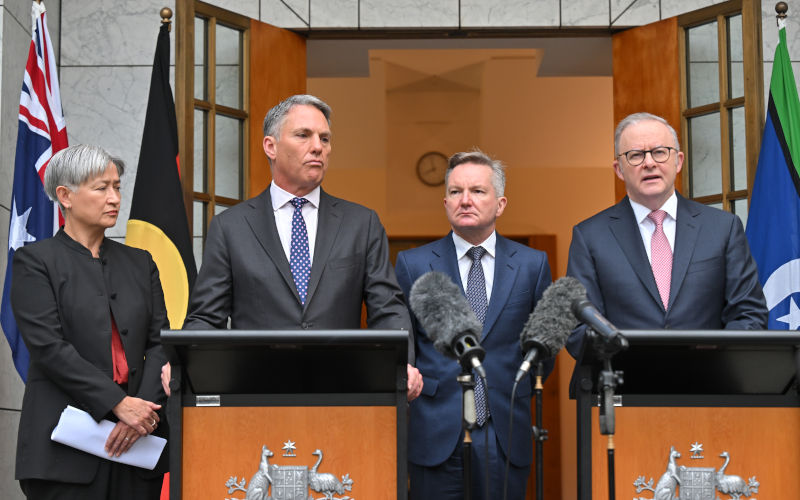
Neither our Prime Minister nor Foreign Minister are given to making big, visionary conceptual statements, but they could do better than they have done so far in this space. Penny Wong says she doesn’t disagree with the concept of good international citizenship, as specifically embraced by the Hawke-Keating and Rudd-Gillard Labor governments in the past, but prefers to use the language of “constructive internationalism”. That phrase, however, implies little more than a commitment to multilateral institutional process, without any real hint as to the ends to which that process should be directed. Anthony Albanese’s own preferred shtick of “progressive patriotism”, while no doubt undeserving of Samuel Johnson’s famous riposte to a more cynical earlier user of the second p-word, clearly conveys no sense of commitment to any particular international causes or values.
My pitch to them both, in conceptualising and articulating their approach to Australian foreign policy, is to play to their perceived, and real, personal strengths as thoroughly decent human beings leading a government which is itself basically decency-driven. Albanese has often spoken of “kindness” as the quintessential virtue, and “looking after each other” as the “Australian way”. It is not a big step from there to say that we hugely value being perceived internationally as a decent country, and that we rank as a core national interest in its own right, ranking alongside physical security and material prosperity, being and being seen to be a good international citizen.

Gareth Evans was a Cabinet Minister throughout the Hawke-Keating governments, including as as Attorney-General from 1983-84 and Foreign Minister from 1988-96; led the Brussels-based International Crisis Group from 2000-09; and was Chancellor of the Australian National University from 2010-19, where he is now Distinguished Honorary Professor. He co-chaired major international commissions on mass atrocity crimes and nuclear weapons, and has written or edited fourteen books, most recently Good International Citizenship: The Case for Decency and Incorrigible Optimist: A Political Memoir.