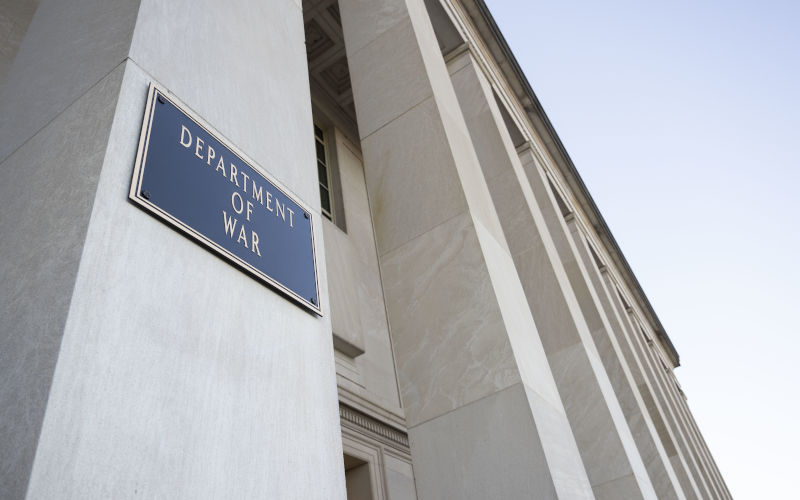
The US is worried about dependence on Chinese critical minerals, but its rushed deadline ignores the years of investment, infrastructure and allied cooperation needed to rebuild industrial capacity.
When ancient Greek commanders burned their own bridges and ships after marching into hostile territory, the psychological calculus was brilliantly simple. By making retreat physically impossible, they forced their soldiers to commit entirely to winning the battle ahead. It is a legendary tactic for generating absolute resolve.
But military historians will quickly point out a crucial caveat: forcing a confrontation only works if your army actually possesses the weapons, training, and capability to fight.
Washington’s latest defence industrial policy embraces the aggressive commitment of the ancient Greeks but completely ignores the requisite capability.
On July 20, President Trump signed an executive order titled “Securing America’s Defense Supply Chains and Ensuring Domestic Acquisition of Critical Materials.” The directive establishes an unforgiving January 1, 2027 deadline that sharply restricts the waivers allowing defence contractors to purchase critical minerals from China, Russia, Iran, and North Korea.
Moving forward, prime contractors (tier-1 suppliers holding direct US Department of Defense contracts) must prove they are actively funding domestic or allied alternatives to receive an exemption.
The underlying diagnosis of this mandate is entirely correct. A Government Accountability Office review previously warned that the Defense Department cannot reliably track where Chinese-sourced inputs enter its weapons programs. Reinforcing this alarm, research firm Govini found Chinese suppliers embedded in thousands of components across major US military platforms.
Yet, as a supply chain researcher analysing these systems for over three decades, I view the administration’s prescription as deeply flawed.
The executive order confuses a legal mandate with an industrial capability.
The structural vulnerability facing the United States goes far beyond raw ore. Over the past 30 years, America lost its metallurgy. We surrendered the critical mid-stream processes of smelting, refining, and chemical separation that transform dirt into aerospace-grade material.
Titanium serves as the primary backbone of modern airframes, yet the US Geological Survey confirms that America produced zero titanium sponge in 2025. Today, the nation imports roughly 44,000 tons annually, mostly from Japan. The country’s last major titanium sponge plant in Henderson, Nevada, was shuttered in 2020. That closure proceeded even after a Commerce Department Section 232 investigation concluded that losing the facility would strip the country of surge capacity during a national emergency.
We saw the cliff approaching and drove over it anyway.
The narrative repeats itself with rare earth minerals. The Mountain Pass mine in California successfully produces rare earth concentrate, but China controls roughly 90 per cent of the global refining capacity required to turn those oxides into usable metal. Beijing has deliberately weaponised this chokehold over the past two years by restricting exports of critical materials like gallium and dysprosium during periods of elevated trade tension.
The executive order ignores the physical reality of how these materials are actually made.
The Kroll process for manufacturing titanium sponge is an intensive batch operation inside sealed reactors at 1,000 degrees Celsius, and scaling it requires building entirely new reactor infrastructure. A high-purity smelter for jet-engine superalloys requires billions in capital and nearly a decade to permit and build. Meanwhile, achieving the 99.9 per cent purity necessary for rare earth magnets demands hundreds of sequential solvent-extraction stages.
Industrial physics simply cannot be accelerated by a presidential signature.
Because harbouring an unreliable foreign supplier will soon carry massive fraud exposure and the risk of contract termination, prime contractors face a brutal interim period.
These prime contractors will be forced to push aggressive audit rights and open-book requirements down onto their Tier 2 and Tier 3 sub-tier suppliers. These smaller, non-traditional firms have historically guarded their sourcing data as vital trade secrets. Faced with overwhelming compliance costs and legal exposure, many of the specialised suppliers this order intends to protect will simply exit the defence market.
The inevitable result will be a heavily consolidated, vertically integrated, and vastly more expensive defence industrial base. Primes will acquire upstream processors merely to control their own compliance data, driving up the cost of weapons systems exactly when US stockpiles are dangerously stretched.
Furthermore, this aggressive timeline hands Beijing a powerful incentive to tighten its own export controls while American alternatives remain years away. China holds the scarce asset, and asymmetric dependence guarantees asymmetric pain during the transition.
To preserve the strategic intent of the executive order without crippling defence production, policymakers must match their ambition to industrial arithmetic through four synchronised solutions.
First, the administration should replace the January 1, 2027 deadline with a phased waiver system tied directly to verifiable domestic and allied processing milestones. Rather than enforcing an arbitrary calendar date, waivers should automatically extend until domestic output achieves specified tonnage thresholds for each critical mineral category.
Second, international cooperation must transition from a diplomatic secondary thought to a primary operational pillar. Granting immediate, automatic regulatory safe-harbour exemptions under International Traffic in Arms Regulations to trusted allies, including Japan, Australia, and Canada, would instantly integrate their specialised smelting and refining facilities into the American defence base.
Third, government must de-risk private capital investment by providing long-term demand certainty. Utilising Defense Production Act funding to guarantee multi-year purchase contracts and floor prices will insulate private investors from deliberate foreign price manipulation and make billion-dollar domestic smelter projects bankable.
Finally, Washington must solve the supply chain data deadlock by creating a secure, third-party government repository. Allowing sub-tier suppliers to upload proprietary sourcing data directly to Department of Defense auditors under strict confidentiality guarantees protects trade secrets while providing total supply chain transparency.
Ancient Greek commanders burned their bridges to compel absolute victory. But if Washington sets the fire before domestic industry can deliver, it won’t forge resolve. Instead, it will burn its own forces.

Christopher Tang
Christopher Tang is a distinguished professor at the UCLA Anderson School of Management