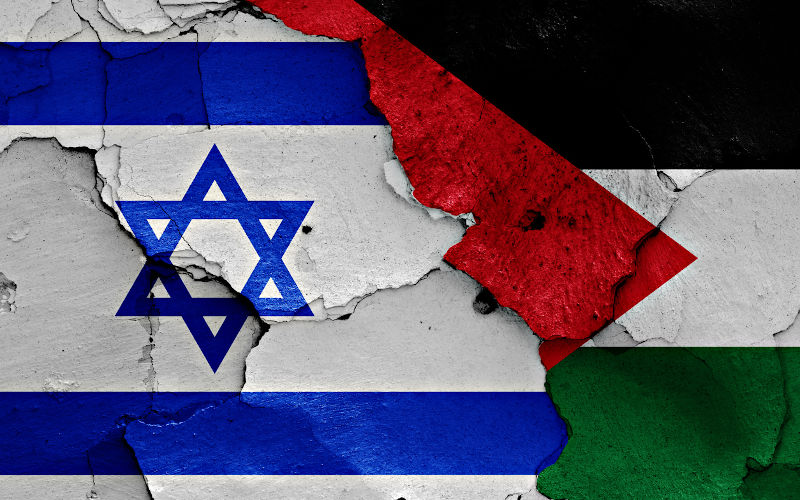
South Africa’s transition from apartheid to multiracial democracy suggests that a single secular, non-racist state may offer a more hopeful future for Israel–Palestine than a fragmented two-state settlement.
Many critics of Israel’s policies have described it as an “apartheid state”. The model of a two-state solution could bring the region closer to the historical model of apartheid. An eventual development of a single, unified, secular and non-racist democracy would not.
“Apartheid” may appear strong as a term of censure but not of analysis. Like other overused terms such as fascism, extremism or fundamentalism, these are most useful when held in reserve for accurate application. “Apartheid”, meaning separateness, described legally enforced structural racism in South Africa after 1948. Just as in Australia settler colonialism expressed institutional racism against an Indigenous minority in culture, economy and society, so for three centuries settler colonialism in South Africa practised institutional racism against an Indigenous majority. The National Party victory in 1948 moved practice into a structured apartheid program of legal constraints based upon racial classification of each individual. This implemented formal job reservation, controls over movement and residence, and “petty apartheid” relating to numerous aspects of everyday life. It went alongside suppression of political opposition and restriction of voting rights.
In a subsequent development, a single large nation of four provinces was re-categorised from 1970 into a white-run state and ten African homelands or “Bantustans” that were expected to develop their own level of self-government, within which each African would hold citizenship. Some were consolidated areas with their own boundaries such as Transkei, others scattered pieces of land such as Ciskei: two areas with whose history I engaged half a century ago. Here was an eleven-state solution!
It would take another quarter century for apartheid to fall apart. The move of South Africa to a democratic election in 1994, and a new constitution, was not the result of a military victory by the disfranchised majority, or of United Nations resolutions. Economic pressures on South Africa, the realities of a changing world, and the increasing ungovernability of the townships where African workers lived, all contributed to a pragmatic recognition by the white minority. This allowed for political change, while maintaining much of the minority’s economic power.
How does this apartheid era compare with the histories of Palestine and the state of Israel? Israel has remained a parliamentary democracy even if the outcome of their elections might be far from what many of us would have wished.
The Palestinian/Arab communities of Israel share rights of employment, residence, parliamentary representation and more, despite the pressures that have ensured relative silence during the regional conflicts of the last two and a half years. Parties specifically identifying as representing Arab citizens of Israel achieved 8 per cent of the seats in the Knesset in 2022, although as part of Israeli citizenship they are approximately 17 per cent (plus 4 per cent in East Jerusalem, who are essentially stateless). On this basis, it seems hard to describe the internal social structure of Israel as that of an apartheid nation. But before the current Gaza conflict, many tens of thousands of Palestinian residents of Gaza and of the West Bank worked as temporary workers in Israel without residential or citizenship rights, which is closer to the analogy with apartheid South Africa.
The United Nations resolutions of 1947 recommended (with the exclusion of Jerusalem) the division of Britain’s mandated territory into a Palestine state and a Jewish state (within which half the population was then Arab). Over 80 per cent of the members of the UN, now including Australia, already claim to recognise a Palestinian state, while autocratic and democratic states alike have declared their support for an imagined “two-state solution”.
To the annoyance of Western (and other) nations, the citizens of Gaza in 2006 elected a Hamas government. It has not ceded power since, and there are suggestions that it would still have large support in any further election today. The West Bank government led by Mahmoud Abbas for Fatah has decreasing support among its own population, reflecting perceptions of corruption and incompetence. The failure of Fatah to call an election since its win in 2006 was not challenged by their western supporters because of the expectation that Hamas might gain a majority there too.
What might be the boundaries of a Palestine state? Israel have defined the part of the Gaza Strip where it expects to maintain control. In the West Bank, the patchwork agreed in the Oslo accords of 1993-5 set a small area (A) of scattered lands, just 18 per cent, directly under the control of the Palestine authority, a larger part (B) under Palestinian administration and Israeli military control, and over half (C) directly controlled by Israel.
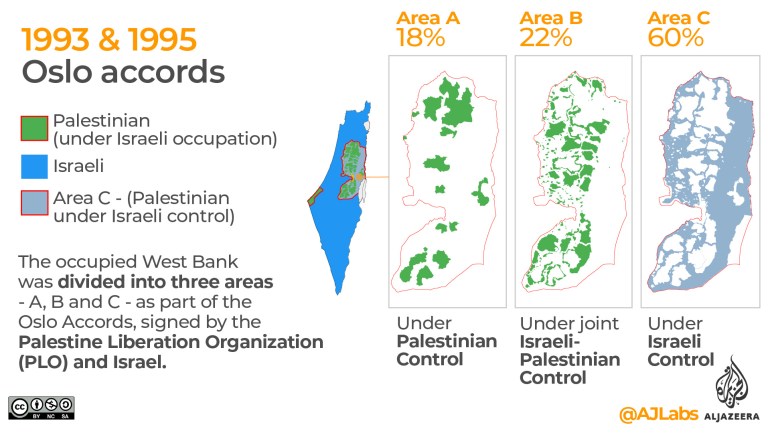
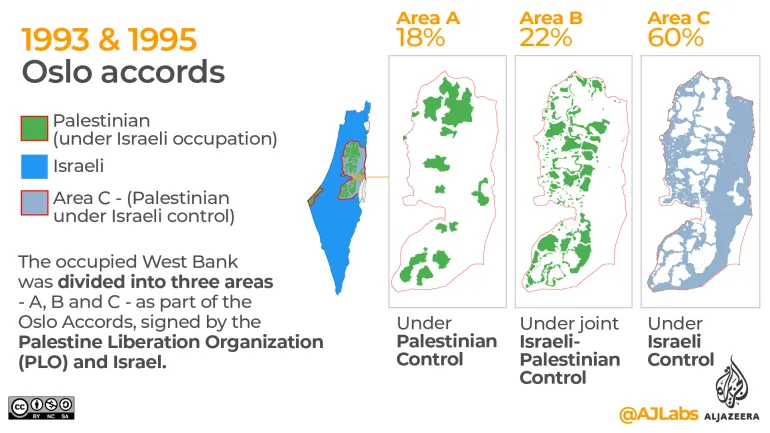
Since then, Israel’s investment in Area C in industrial, agricultural, educational and public works has been accompanied by a massive increase in Jewish settlement, estimated now as half a million in the West Bank in addition to those in East Jerusalem. If the UN and Western nations stopped talking about a two-state solution (assuming they have some belief in it, not just as rhetoric) and negotiated with Israel for a Palestinian state, that state would be the equivalent of South Africa’s Bantustans under apartheid, or worse.
Is there an alternative? History can point to the past in search of at least a partial analogy for the future. We can look at how South Africa ended its apartheid regime.
Contrary to the confident assumptions of the ruling racial minority, South Africa did change to a multiracial democracy over time. A rejection of the present of Israel and Palestine, and a scepticism about the practicality even desirability of a supposed two-state future, could point – yes, at an uncertain date – to new generations who see the advantage of a unified state, peace over war, independence over reliability on American money and armaments, and a focus on their own future. This is not going to be achieved by the actions of psychopathic Islamists from Gaza, nor the resistance of elderly olive farmers in the West Bank and their stone-throwing grandchildren, nor UN resolutions. But South Africa has shown that a new society can be created if the prejudices of race and religion are replaced by the advantages of an integrated single nation of people who can overcome the curses of the past.

Robin Derricourt is a writer, publisher, archaeologist and an Honorary Professor of History at the University of New South Wales