The Coalition’s plan to strip welfare access from non-citizens could accelerate a surge in citizenship and voter enrolment across migrant-heavy suburban seats critical to the Liberal Party’s electoral future.
The trick at the heart of Angus Taylor’s budget reply is that it punishes a group that cannot vote. Strip the NDIS, Jobseeker, Youth Allowance and Family Tax Benefit from non-citizens, including permanent residents and you have, on paper, a free political hit. No retaliation at the ballot box. Just the warm applause of a One Nation primary you have decided to chase.
I have written about the household mechanism that makes this miscalculation severe even on its own terms. The citizen daughter who does her parents’ Services Australia paperwork. The citizen nephew watching his cousin lose a therapist. Mixed-status households vote for the people in their family who cannot, and they have done so in this country since the 1950s.
But there is a second mechanism, and it is the one Liberal strategists appear to have entirely failed to model. Threaten a population large enough and concretely enough, and a significant share of that population will respond by becoming voters.
There are roughly 4.5 to 5 million non-citizen residents in Australia in 2026. Around 1.5 to 2 million of those are permanent residents (PR) who have not yet taken citizenship, eligible, in most cases, but deferring. ABS settlement data showed that even by 2021, only 59 per cent of permanent migrants had taken citizenship. The rest are sitting on the question, often for years.
That deferral is the door Taylor has just kicked open.
The 2021 Census provides the cleanest national-origin breakdown of the non-citizen pool. Scaled to 2026 using known growth patterns, India, Nepal and the Philippines expanding fastest, the UK and Vietnam slowest, the top ten national-origin groups currently account for around 2.5 million non-citizens.
The question is how many of those people, under direct policy threat, would actually push through citizenship and onto the electoral roll inside an 18-month window.
The model below applies two filters. First, an eligibility share: what proportion of each nationality’s non-citizen pool is already on a path that can deliver citizenship within 18 months, overwhelmingly permanent residents past the four-year residency threshold, plus the New Zealand SCV cohort made eligible by the 2023 reform. Second, an activation rate: of those eligible, what share rushes through citizenship and enrols under fear of losing welfare access, family payments and disability support for relatives.
I model three scenarios, low (30 per cent), mid (45 per cent), high (60 per cent), calibrated against what we know about citizenship surges in comparable political moments overseas (California after Proposition 187, the United Kingdom after Brexit).
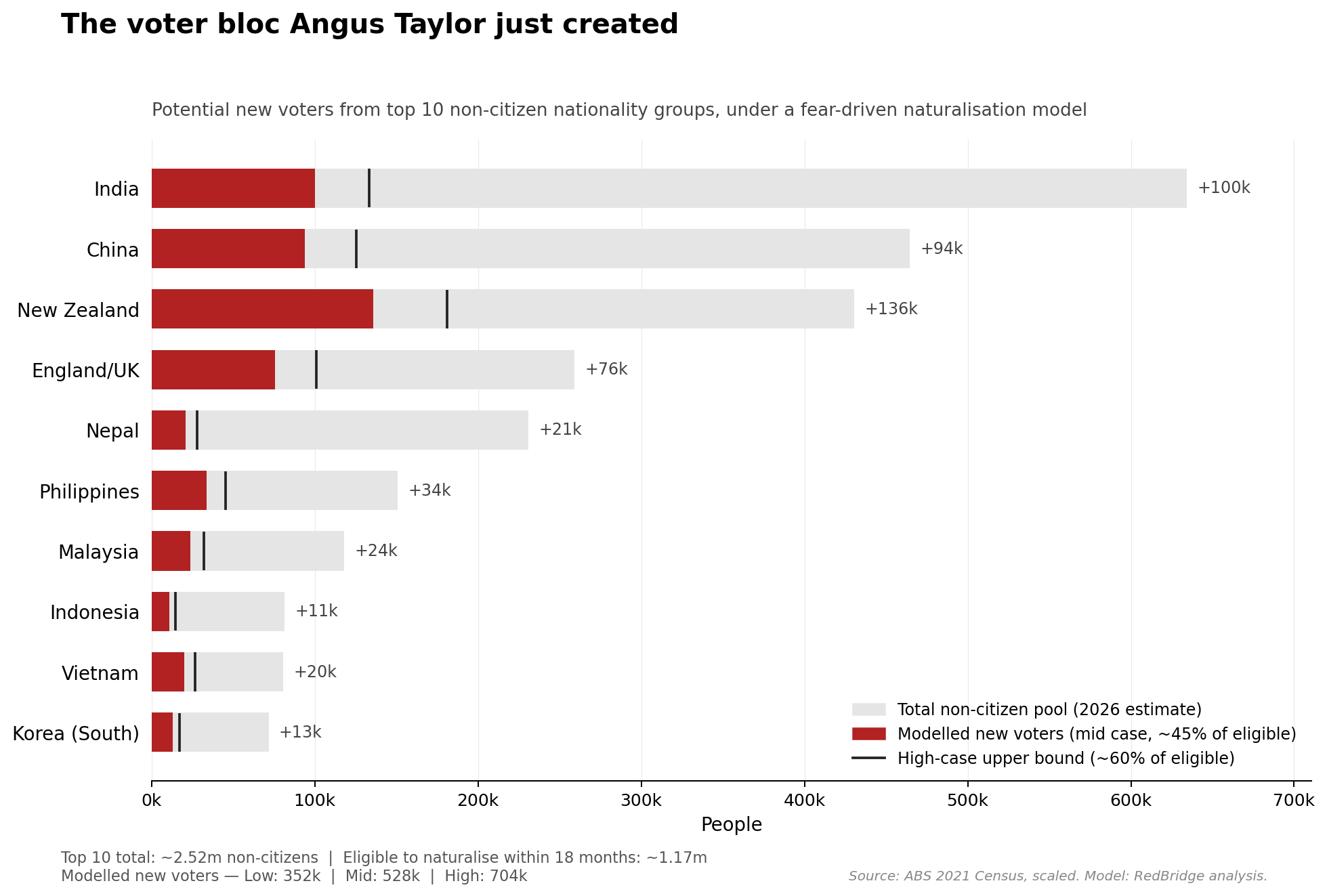
The mid case alone produces roughly 528,000 new voters from the top ten nationality groups. The low case still produces 352,000. The high case approaches 704,000 and that is before you count the smaller national groups outside the top ten.
The single largest activated bloc is New Zealand-born residents, who sit on a uniquely large pool of long-tenured SCV holders and now have a much shorter path to citizenship. Indian-born and Chinese-born Australians sit close behind, both because their pools are very large and because their PR cohorts are increasingly mature. The English-born pool is older, deeply embedded, heavily on PR, and politically attentive in a way that should worry the Coalition more than any other single number in this chart.
Half a million new voters distributed evenly across 151 seats would change very little. But these voters are not distributed evenly. They are concentrated, often heavily, in seats the Liberal Party either holds on a thread or needs to win to form government.
Look at the 2025 boundary data. The seats with the highest non-citizen shares of their population are a roll call of the Liberal target list: Menzies, Chisholm, Bennelong, Reid, Banks, Bradfield, Berowra, Mitchell, Deakin, and Aston. Add the Labor-held seats the Coalition theoretically need to flip, seats like Parramatta and you have, in a single category, the spine of the Liberal Party’s road back into metropolitan government.
In Menzies, more than 13 per cent of the population is Chinese-born and a clear majority of that group are not yet citizens. In Reid, over 11 per cent. In Bennelong, more than 10 per cent. Activate even a third of the eligible PRs in those three seats and you have moved the median voter several percentage points to the left in seats that determine election results in this country.
This is the bit that makes the policy not just bad but historically self-defeating. The voters the Coalition needs are inside the pool it has just threatened. There is no path back to government for the Liberal Party that does not run through Box Hill, Wentworthville, Doncaster and Glen Waverley. And every household in those suburbs now has a direct, concrete, recurring reason to walk to a citizenship ceremony and complete AEC enrolment form.
There is a name for this mistake. It is California in 1994. Pete Wilson’s Proposition 187 stripped public services from undocumented residents and was sold to a frightened Republican base as a free political hit. Within a decade, Latino naturalisation rates in California doubled, Latino enrolment surged, and the Republican Party stopped winning statewide elections. It has not won the California governorship in 20 years.
The structural mechanism was identical. A party in long-term metropolitan decline reached for a policy that punished a politically inert group, and discovered the group was only inert because nobody had previously bothered to weaponise it.
Australia in 2026 is not California in 1994. The proportions differ, the politics differ, the visa architecture differs. What is identical is the strategic stupidity of mistaking cannot currently vote for will never vote.
Angus Taylor has not just walked the Liberal Party into a tactical error. He has, in a single speech, accelerated the manufacture of half a million new Labor-leaning voters in precisely the seats the Coalition needs to ever govern again.
The budget replies after this one will be delivered in a country he helped redraw.

Kos Samaras
Kos Samaras is a director at RedBridge Group, a research and strategy firm specialising in public opinion, social trends, and behavioural insights. He works across industry, government, and media to help organisations understand community attitudes and navigate complex social and political environments.