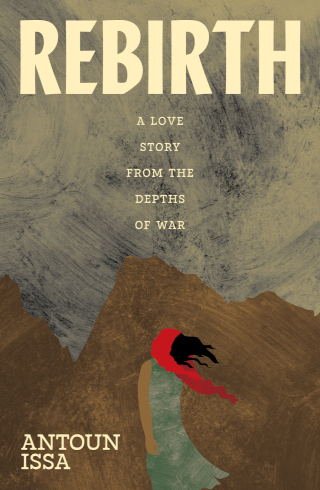
Deepcut News co-founder and journalist Antoun Issa captures his mother’s true experiences of love, heartbreak and new hope during the violence of civil war in Lebanon, in his new book Rebirth.
The story begins in Beirut in 1974. Laila Khalil has just come of age for marriage. The eldest of five in a poor Catholic family, Laila knows that she must fulfil her family’s expectations. But her heart is drawn to the handsome Nicolas, a coiffeur at a local hair salon. Dodging the watchful eyes in their patriarchal society, particularly those of Laila’s domineering father, the two young lovers begin a tender romance. Soon, they make plans for marriage. Laila’s dreams are dashed when the Lebanese Civil War breaks out.
The following is an extract from Rebirth.
On Friday evening, Laila sat with her siblings in their living room, struggling to face their sorrow. One by one, they embraced Laila, offering solemn farewells. Claire spoke only through her tears, her sadness preventing any words, with Claude clutched in her arms.
‘Don’t go,’ Charbel said brokenly, eyes streaming. His plea shattered Laila. It unleashed a downpour of guilt that her canopy of reason could not shield her from.
She cried, cried for the truth that she had long evaded – that her quest was a dangerous gamble with no guarantee of success. The gamble meant her family would have to survive alone until Laila carved a passage for them to Australia.
‘I love you,’ she said, covering his cheek with tearful kisses.
She came to Rabih, her comrade through all her young years. Their eyes alone understood the enormity of their bond.
‘Look after yourself first – before you look after anyone else over there,’ he said. ‘Learn the language. Get yourself a job. Sort yourself first.’
Laila smiled with renewed confidence. In her brother, she saw a man coming into his own – someone who could assume the place left by their father, and indeed by herself, to help Nour lead the household.
Later, in the final hours of the night, Laila sat alone with her mother on the terrace, under the moonlight where her father so often relaxed. The gentle mountain breeze sung his name like a lullaby, as though his spirit flew through the valleys and swirled around them.
Laila studied her mother, a woman who had aged beyond her years. She noticed the added creases that framed her eyes. The past few years had grown long for Nour, and with every peeling petal, the exquisite rose was wilting to leave a scoured stem.
A quiet tear trickled down Laila’s cheek. She mourned for her mother, for herself, for the world they lost.
‘It was never intended to be this way,’ Laila said.
‘None of it is as we intended. It is as God intended,’ Nour said.
Laila stared toward the mountains. ‘What did we do to deserve this?’
‘There’s no such thing as life without pain. That is our test, to carry our pain and survive.’
A long silence stretched between them. Nour did not look at her daughter.
‘Don’t forget me,’ Nour murmured at last.
‘How could I forget you?’ Laila cried. She rose from her seat and embraced her mother. ‘I will get you out, I promise. Give me time, I will get you out of here.’
Laila kissed her mother’s forehead as Nour gripped her tightly, afraid to let go.
‘I’m losing my right hand. Who will I confide in now?’ Nour whispered.
Laila pulled out of her mother’s embrace to look deep into her eyes. ‘I’m going to get you out,’ she said, her gaze shimmering in its resolve.
Nour nodded through her tears. They settled back into their seats and looked once more toward the mountains.
‘If it’s a bad marriage, I’ll come back,’ Laila said.
‘No,’ Nour replied swiftly. ‘We don’t divorce in this family. If it’s a bad marriage, you’ll have to find a way to cope. This is a wife’s duty.’
Laila sat quietly, considering her mother’s counsel. She saw no fault in it, having intimately observed the only example of marriage known to her – that of her parents. Even in his death, Nour adhered to the dutiful expectations of a wife. It was a model Laila saw worthy of veneration.
And there they sat, Laila and her mother, the minutes stretching into an infinity, as the mountain breeze billowed around them and whispered her father’s name. Together, in their home, the three spirits shared their final moment – a single yet precious flash in the endless stream of time.
Never again would Laila sit on this terrace with her mother, and gaze toward the mountains. Never again would she drink from Fida’s chipped cup.
Never again would she receive her grandmother’s affection. Like poplar seeds caught on the breeze, she would be carried far away, never to return.
October 1977
Dreary and arcane were Laila’s new surroundings. Harsh were the spoken words around her, their meanings inaccessible. Blank, distrustful glares scanned her from head to toe. The sun was foreboding, with no summit to welcome its rise nor bless its set. Instead, parched yellow fields enveloped her new standalone brick home on the outskirts of Melbourne.
Laila found herself drawn to the towering eucalypt in front of her home – splendid yet alone, lost without its forest. Like the tree, Laila was lost with no witness to her story, with no mountain to watch over her. To deprive a native of Lebanon of its mountain was to deny a riverbed its water.
Strangest of all was the silence of her new Melbourne suburb. Whereas billowing laughs and cries would ring out in the Jisr, only hushed sounds could be heard around their house. Hollow was her neatly paved street, devoid of clamour. Within their red- and yellow-bricked fortresses, nameless faces slept and crept.
Silence fed Laila’s despair. Not a day passed in the initial weeks without a stream of longing coursing through her heart.
An extract from REBIRTH by Antoun Issa