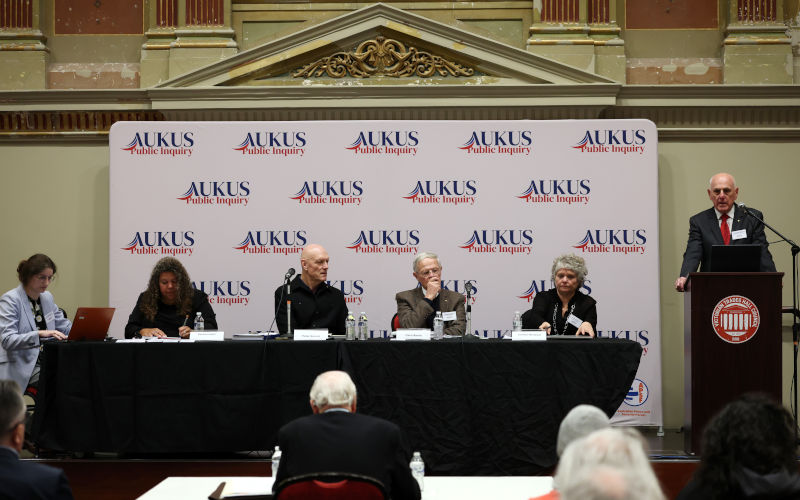
A Commissioner on the Public Inquiry into AUKUS responds to Waleed Aly’s view that the inquiry will have no impact.
Waleed Aly is spot on in his Sydney Morning Herald article (5 June) when he observes that AUKUS is crystallising into a contest of competing worldviews, with Labor caught between them. However, his ideas about how this debate should be conducted, and who should be included in it, miss the mark.
The suggestion that mechanisms such as a public inquiry would not change outcomes is problematic. It overlooks the role that public scrutiny can play in shaping policy and risks presenting as fact the assumption that governments determine defence policy entirely independent of public sentiment.
In the absence of a parliamentary inquiry to interrogate a policy of this scale, the Public Inquiry into AUKUS provides a platform for all Australians to ask questions, safe in the knowledge that they will be listened to. Every submission will be read; all information synthesised, written up and provided to government. This is what we can do and this is why I decided to serve as a commissioner. There are five commissioners contributing their time to the public inquiry. We all already participate in public policy debates.
Aly describes all the commissioners as ‘fierce critics of AUKUS’. If our only goal was a coordinated attack on AUKUS, there are far simpler and more direct ways for us to achieve this. It’s no surprise that all commissioners have opinions on various parts of AUKUS; it’s hard not to. But if an opinion makes you ineligible to participate, who could? If a former Chief of the Defence Force is to be excluded from what is effectively the ‘square of public ideas’, then the standard for participation in a debate on defence becomes unclear and, ultimately, self-defeating.
Aly’s speculation about the likely findings – that the United States will not deliver the submarines on time, that the costs are excessive, that alternative investments would yield greater strategic benefit and that AUKUS risks constraining Australia’s sovereignty – is not controversial or novel. These arguments are already part of the public record, advanced by former prime ministers, senior defence officials and analysts across Australia, the United States and the United Kingdom. The real question is not whether these views exist but whether they should not be subjected to further scrutiny in a formal, structured process designed precisely to test contested assumptions.
Furthermore, the commissioners are not clones; we bring distinct and often conflicting perspectives, particularly on nuclear policy. That diversity alone makes the notion of a scripted conclusion difficult to sustain.
Aly says there is ‘a sense that AUKUS was never properly examined’. This is not a ‘sense’ but an observable fact. No previous government decision of this scale has proceeded with so little public interrogation: a multi-decade, multi-hundreds of billion-dollar commitment that reshapes Australia’s strategic posture, deepens integration with allied forces, embeds secrecy obligations within public research institutions, and was effectively endorsed by a shadow cabinet after a brief closed-door briefing. This is precisely the kind of policy that demands sustained and transparent public scrutiny, not retrospective and evolving justification.
Aly relies upon a political analysis that has Teals starting on the left and ends with One Nation on the right. I’m not sure where he places the Greens. According to numerous published opinion polls, concerns with AUKUS cut across outdated and simplistic notions of political sides. Recent history makes clear, in Australia and around the world, that representatives, whether independent or party aligned, can only ignore the views of their constituents for a limited time.
The suggestion that the Commonwealth government will not entertain a parliamentary inquiry because it would look like prevarication doesn’t hold up. The government is no stranger to prevarication: gambling advertising reform, transparency standards and inland rail to name a few.
Finally, Aly saying that ‘the debate is almost too large for the public conversation to process’ is, well, difficult to process. Maybe I have a Pollyanna view of democracy and the wisdom of the collective, but I find this reason for not holding a parliamentary inquiry the heaviest/most concerning/hardest to comprehend? Surely the larger, the more consequential, and the more complex the problem, the more transparency and public engagement is required. The public response to our inquiry shows me I’m not the only genuine democrat out there. Submissions are flooding in and donations are growing.
While unpacking the politics of the week can be good intellectual sport, it does little to advance the deeper national debate. Journalistic commentary has its place but on an issue as significant as AUKUS, a structured forum such as a public inquiry – where experts can present evidence and citizens can ask questions – is essential for a healthy democracy.
For decades Australians have been told to stay out of debates about economic policy, and the result is declining productivity growth, rising inequality and declining trust in both major parties. Even the most enthusiastic supporters of AUKUS should see the risks of relying solely on the reputations of the major parties to keep the most expensive procurement policy in our history on track. Indeed, our allies in the US and the UK should be reassured that Australia’s democracy is strong enough to have debates about a project of this scale. And in the meantime, I’m sure our AUKUS allies will be less threatened by our public inquiry than many of Australia’s defence and media establishment seem to be.

Leanne Minshull
Leanne Minshull, is one of five independent Commissioners on the Public Inquiry into AUKUS and co-Chief Executive Officer, the Australia Institute.