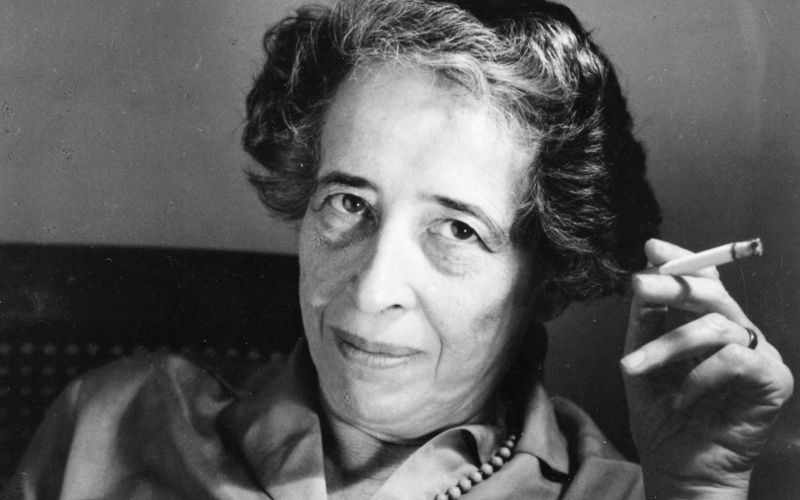
Hannah Arendt warned in 1948 that a Jewish state built without Jewish-Arab agreement would live by permanent war, fear and exclusion – a warning that now reads less like idealism than realism.
Throughout my rather unorthodox academic career I have researched and written books or essays not according to any specialty but on a wide variety of topics of overwhelming interest to me. The subjects have principally concerned current events either in my country, Australia, or with a direct or indirect connection to what happened in Europe to my grand-parents and my people. Because of ‘October 7’, the vicious Hamas-led mass murder of approximately a thousand Israeli Jews, the Israel Defence Forces began their pitiless destruction of Gazans and Gaza.
As a result of this IDF campaign, each day for me has begun with reading the analyses of the ongoing nightmare of the Gazan Palestinians, principally in the great Israeli newspaper, Haaretz. More deeply, however, beyond that, what I have been trying to understand, through historical reading, is why the Jewish people in Israel and the diaspora, who had suffered, arguably, the worst crime in the history of humankind, the Holocaust, have been willing some 80 years later to support a government and its armed forces that have systematically conducted a policy of genocide in Gaza.
Recently I returned to the essays about Israel of Hannah Arendt, now widely regarded as the most important political writer of the 20th century. Arendt was for a time a Zionist of a particular kind – a supporter not of a Jewish state in part of Palestine but of the Jewish right to a ‘homeland’ in Palestine following the catastrophe that had engulfed the Jewish people of Europe, which began in 1918 with the almost forgotten pogroms during the Russian civil war when at least 100,000 Jews were massacred and concluded in 1945 with Nazi Germany’s defeat in war after its murder of six million European Jews.
Arendt in the 1940s was part of the so-called Ihud group, a successor to an earlier movement called Brith Shalom. Both groups were part of the numerically small Zionist current of thought that included several of the Jewish intellectuals still worth reading: Ahad Ha’am, Martin Buber and Gershon Scholem. What united these people was an understanding that unless the Jews first made peace with the Arabs, the fulfilment of the Jewish claim to a homeland in historic Palestine, which the dispossessed Jews had for more than 2,000 years regarded as their Promised Land, would end in disaster.
In the collection, Hannah Arendt: The Jewish Writings, I came upon a short essay whose argument I thought was worth sharing with readers. The title of the essay was “To Save the Jewish Homeland”. The date was 1948, the year in which, following a vote of the United Nations in November 1947, historic Palestine was partitioned and the State of Israel created. Here are some of its central arguments.
For Arendt, Jewish unanimity of opinion about the creation of a Jewish state before any Jewish-Arab settlement had been accomplished was certain to spell disaster in the future. A war between the Jews and the Arabs over Palestine now loomed. If the Jewish state was “extinguished in another catastrophe…this would become the central fact of Jewish history and it might become the beginning of the self-dissolution of the Jewish people”.
Such a defeat would also destroy one of the great social experiments among the Jewish settlers in Palestine: the non-capitalist, collectivist kibbutz. “[T]his would be one of the severest blows to the hopes of all those, Jewish and non-Jewish, who have not and never will make their peace with present-day society and its standards.” It would also destroy the possibility “of close cooperation between two peoples, one embodying the most advanced ways of European civilisation, the other an erstwhile victim of colonial oppression and backwardness. The idea of Arab-Jewish cooperation…is not an idealistic daydream but a sober statement of the fact that without it the whole Jewish venture in Palestine is doomed.”
Arendt feared that after the Holocaust, “traditionally Zionist feeling…has by now seized all sections of the Jewish people: the cynical and deep-rooted conviction that all gentiles are antisemitic…” Universal gentile antisemitism “is now assumed by Zionists to be an unalterable, eternal fact of Jewish history that repeats itself under any circumstances, even in Palestine.” It is now almost unanimously agreed that “Jewish experience in the last decades – or over the last centuries, or over the last two thousand years – has finally awakened us and taught us to look out for ourselves…[E]verything else is stupid sentimentality.” This has led to the transformation of the Jewish national character: “After two thousand years of ‘Galuth mentality’ [the psychological and cultural adaptation of Jews in the diaspora to the conditions of life in foreign lands] the Jewish people have suddenly ceased to believe in survival as an ultimate good in itself and have gone over in a few years to the opposite extreme. Now Jews believe in fighting at any price…” Even to their death as a people.
At the extreme, Jews in Palestine had turned to terrorism. Arendt called for “the elimination of all [Jewish] terrorist groups…and swift punishment of them”. She was referring to the Irgun group, one of whose leaders, Menachem Begin, was to become Israel’s Prime Minister in 1977. As Arendt wrote, Irgun was responsible for “the massacre of Deir Yassin”, an Arab village where at least 100 men, women and children had been murdered. Deir Yassin had “struck fear of the Jews into the Arab population”, playing a role in the mass “evacuation” of what she soon came to believe to have involved 500,000 Palestinian Arabs, the event now known as the “Nakba”. (More recent scholarship puts the number of Palestinian Arabs who were killed or who fled their homes in 1948 at 700,000.) Irgun was also responsible for the bomb that had been thrown “into a line of Arab workers outside the Haifa refinery”. “The political implications of these acts…are all too clear in both instances: they were aimed at those places where neighbourly relations between Arabs and Jews had not been completely destroyed; they were intended to arouse the wrath of the Arab people in order to cut off the Jewish leadership from all temptations to negotiate.”
What was now certain was an Arab-Jewish war. “One can win many battles without winning a war…[E]ven if the Jews were to win the war…the ‘victorious’ Jews would live surrounded by an entirely hostile Arab population, secluded inside ever-threatened borders, absorbed with physical self-defence to a degree that would submerge all other interests and activities…[T]his would be the fate of a nation that – no matter how many immigrants it could absorb and how far it extended its boundaries (the whole of Palestine and Transjordan is the insane Revisionist* demand) – would still remain a very small people greatly outnumbered by hostile neighbours.”
Currently, Israel’s de facto borders extend beyond the area between the Jordan River and the Mediterranean Sea to include the Syrian Golan Heights; southern Lebanon beyond the Litani River and towards the Zahrani River; and three quarters of Gaza. Israel’s military campaigns are now commonly called in Israel ‘The War of Rebirth’, a description used by Netanyahu as early as March 2025. Arendt’s prophetic political imagination allowed her to foresee what has become of Israel over the past nearly 80 years.
Hannah Arendt went on to suggest an alternative to the virtually unopposed Jewish support throughout the world for the Zionist project of immediate Jewish ‘statehood’ in partitioned Palestine and not the mere ‘homeland’ of the Balfour Declaration of 1917. Her alternative was the gradual movement towards a binational Jewish-Arab federation in Palestine, building upon “local self-government and mixed Jewish-Arab municipal and rural councils, on a small scale and as…pseudo-sovereignty of a Jewish state” under a United Nations trusteeship over Palestine supported by the military power of the United States and the United Kingdom. “As long as Jewish and Arab leaders both claim that there is ‘no bridge’ between Jews and Arabs…the territory cannot be left to the political wisdom of its own inhabitants.”
“Unfortunately, in a hysterical atmosphere such proposals are only too liable to be dismissed as ‘stabs in the back’ or unrealistic. They are neither; they are, on the contrary, the only way of saving the reality of the Jewish homeland.” “It is still not too late.”
Alas, it was too late. And the idea of the stab in the back is still with us after 80 years.
Hannah Arendt for several years worked closely with the founder of Ihud, Judah Magnes, the American Jew who had been since 1925 President of the Hebrew University in Jerusalem. Magnes was the foremost Zionist voice, who had argued for decades that without a Jewish-Arab political agreement disaster was inevitable. He was also the leading advocate of a possible alternative future for Palestine, which Arendt supported: a bi-national Arab-Jewish federation that relied upon a period where Palestine would be placed under a United Nations-endorsed United States-led trusteeship. Magnes was so convinced of impending disaster that on 5 May 1948, with the support of the US Foreign Secretary, George Marshall, he was granted an interview with the US President, Harry Truman. Truman listened with sympathy to Magnes’s plea not to recognise Israel’s claim to statehood but to support the idea of a trusteeship over Palestine. A few days later, however, the United States agreed to the creation of the Jewish state of Israel in partitioned Palestine. One reason was the forthcoming Presidential election. With the creation of the state of Israel, the humanistic stream of Zionist thought that connected Ahad Ha’am to Judah Magnes and Hannah Arendt ceased to matter.
In 1952, Hannah Arendt published an article in which she described Judah Magnes as “the conscience of the Jewish people”. “The Arab problem is what it always has been, namely the only real political and moral issue of Israeli politics…Being a Jew and being a Zionist, he was simply ashamed of what Jews and Zionists were doing. (Arendt’s emphasis.) As it frequently happens with one’s conscience, the Jewish people heard him and chose not to listen to him…A people that for 2,000 years had made justice the cornerstone of its spiritual and communal existence has become emphatically hostile to all arguments of such a nature…We all know that this change has come about since Auschwitz but this is little consolation. The fact is that nobody among the Jewish people could succeed Magnes. This is a measure of his greatness; it is, by the same token, the measure of our failure.”
In many ways – not least the re-birth of the Old Testament’s Hebrew as the national language – the establishment in Israel, from nothing, of a vibrant, accomplished and (for all Jews at least) boisterous democratic country, was a miracle.
In 1948 Israel expelled or killed 700,000 Palestinians inside the Israeli state in what Palestinians and their sympathisers call the Catastrophe (Nakba). Israel has experienced and survived several existential wars, most significantly in 1948,1956, 1967 and 1973. It has treated the remaining Arab population inside its initial 1948 borders as second-class citizens. It has occupied territories on the West Bank, Gaza and the Syrian Golan Heights following the 1967 Six-Day War and treated the Arabs living there as rightless subjects. It has experienced several bloody Palestinian Arab uprisings inside its borders known as ‘intifadas’. It has either looked away or openly supported the hundreds of thousand Jews who have settled illegally inside the occupied West Bank. It has spent several years as an occupation force in southern Lebanon and also in Beirut, without ever overcoming the permanent threat that the missiles of the anti-Israel militant group, Hezbollah, pose to the Israeli northern settlements.
Israel turned Gaza, after its withdrawal in 2005, into what has been described as “an open-air prison” regularly killing members and supporters of the Gazan anti-Israel resistance terrorist movement, Hamas, as well as innocent bystanders. Israel described these short military campaigns in revealingly callous language, as “mowing the lawn”. In response to the Hamas-led murders of Israeli Jews on October 7 2023, it has slaughtered some 100,000 Gazan Palestinians, reduced the urban and rural landscape in Gaza to rubble, and seizing the opportunity, begun to turn the occupation of the West Bank, that Israel calls by the biblical names, Judea and Samaria, from a de facto to a de jure annexation.
Finally, to try to prevent an Iranian nuclear weapon, Israel has, perhaps fatefully, talked an ignorant and potentially vengeful US President, who suffers from an astonishing narcissistic personality disorder and on whom Israel depends for munitions and diplomatic protection, into a lost war – “sounds great to me”– and a humiliating peace, wherein the United States is much weaker in the Middle East and beyond than it was when the American-Israeli ‘war of choice’ began in 28 February 2026. A narcissist who is shown to be a fool in the eyes of the world is a very dangerous beast. As I write, Israel is preparing actions in Lebanon that might even destroy Donald Trump’s face-saving deal with Tehran. God only knows what will become of Israel and its people.
Intellectuals like Hannah Arendt are commonly, and often accurately, regarded as hopeless, idealistic dreamers. However, in the case of the creation of the Israeli state in 1948, compared to Israel’s first President, Chaim Weizmann, or its first Prime Minister, David Ben-Gurion, let alone the leader of the Irgun terrorist group and future Prime Minister, Menachem Begin, it was Hannah Arendt who was the realist.
[*The Revisionists were the party of the right-wing Zionists formed in the 1920s by one of the most interesting figures in the history of Zionism, Vladimir Jabotinsky. The Revisionists later became the Herut and then the Likud Party, that have led most of Israel’s governments since the late 1970s. Its present leader is the Prime Minister of Israel, Benjamin Netanyahu.]
Republished from Thermidor: Cultural Counter-Revolution in the Age of Trump

Robert Manne
Robert Manne AO, FASSA, is Emeritus Professor of Politics and a Vice-Chancellor’s Fellow at La Trobe University. His most recent book is A Political Memoir:Intellectual Combat in the Cold War and the Culture Wars (La Trobe University Press).