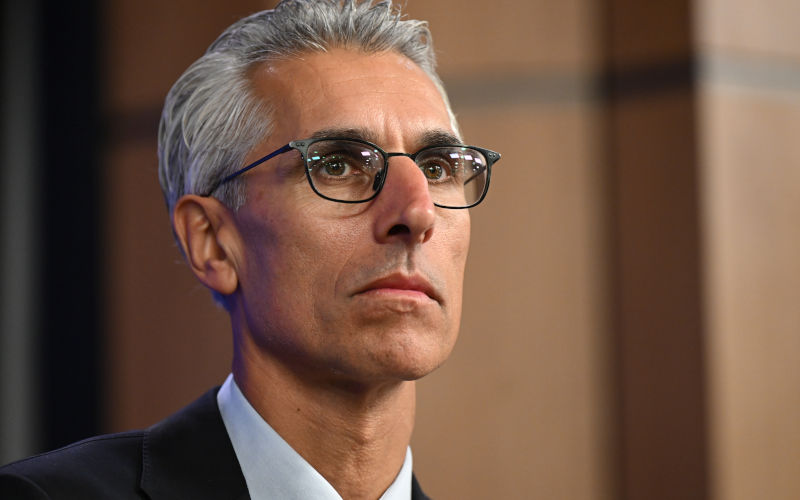
The president of the Australian Human Rights Commission this week renewed the call for national human rights legislation. The parliamentary committee report has been gathering dust since 2024. The Senate numbers exist. The only thing missing is political will.
This week at the National Press Club, Dr Hugh de Kretser, president of the Australian Human Rights Commission, renewed his plea for a national Human Rights Act. He should not have needed to.
In October 2005, alongside Malcolm Fraser, Susan Ryan, Spencer Zifcak, Greg Combe and others, we launched a national human rights campaign at Sydney Town Hall. We consulted widely across Australia and drafted a Human Rights Bill in 2009. The Rudd government appointed Frank Brennan to report on the question. Regrettably, it was persuaded by opponents that Australians’ rights were better protected by politicians than judges. Almost 21 years later, we still have no national legislation.
Since 2024 the Albanese government has been refusing to act on a parliamentary joint committee report advocating a national Human Rights Act. There has been no response. That silence is characteristic of a prime minister committed to a small-target strategy.
Since the defeat of the Voice referendum, Albanese has argued that serious reform requires bipartisan support. But a Human Rights Act does not require a referendum. Parliament could pass it tomorrow if the government had the courage. The numbers exist in the House of Representatives, and in the Senate the government could almost certainly rely on the Greens and crossbench independents. The numbers are there. The question is whether the Prime Minister is interested – or whether this will join the long list of reforms Australia talks about but never enacts.
A deteriorating record
Australia’s human rights record is being seriously eroded across a wide front. Our failures have been documented by the UN, Amnesty International, Human Rights Watch, and the Australian Human Rights Commission itself. The concerns are systemic and serious.
The human rights situation of Indigenous Australians – particularly mass incarceration, child removal at ten times the rate of non-Indigenous children, and the persistently failing Closing the Gap framework – remains the most severe and enduring failure. In immigration, mandatory and indefinite detention, offshore processing, and the documented cruelty of offshore facilities have attracted sustained international condemnation. We are denying the Rights of the Child and Australian Citizen mothers marooned in the squalid camps in Syria. Homelessness affects thousands of Australians on any given night. Domestic violence is widespread.. The rights of people with disability, despite a Royal Commission remain inadequately protected.
Since 2001, Australia has enacted more national security and surveillance legislation than any comparable democracy. The cumulative effect, assessed by legal scholars across the political spectrum, has been a dramatic erosion of civil liberties that were already weak by comparative standards. In both houses and across both major parties, freedoms have been traded away in the name of counterterrorism without the careful weighing of competing values that such decisions demand. The Law Council of Australia has repeatedly expressed alarm at the breadth of this erosion.
Hate speech legislation at Commonwealth and state levels has been used to penalise those who publicly oppose the genocide in Gaza, and to restrict demonstrations in support of Palestinians. Our media landscape – particularly the Murdoch press – further constrains access to truthful, and diverse public information. Our legacy media, including the National Press Club, has been complicit in the Gaza genocide.
The Murdoch press has been a virulent opponent of a Human Rights Act. Recently the Saturday Paper recalled a 2009 meeting between Simon Rice, now Professor Emeritus at the University of Sydney Law School, and then Attorney General Robert McClelland. As the paper recorded the meet, “With a national inquiry having recommended the introduction of a federal Human Rights Act, Price asked McClelland when the Rudd government might respond. McClelland’s answer was blunt. There won’t be a Human Rights Act for as long as News Limited is opposed to it”.
The influence of the Murdoch media has declined substantially. It mainly influences the extreme right of Australian politics. But it’s history of opposition to a Human Rights Act is instructive of past difficulties in enrolling support for a Human Rights Act.
The structural gap
Underlying all of this is a structural problem that distinguishes Australia from virtually every comparable democracy: the absence of a federal human rights act or constitutional bill of rights. Human rights protections in Australia depend on statute, common law, and international treaty obligations – all of which can be overridden by ordinary legislation. Most states and territories have enacted human rights legislation. There is no federal equivalent.
When the Commonwealth acts in ways that violate human rights – as it did with Robodebt, offshore processing, and indefinite detention – affected individuals have limited domestic legal remedies. They must rely on political accountability and UN treaty body review, both of which are slow and often ineffective. The United Nations Human Rights Council has called on Australia to introduce comprehensive human rights legislation in accordance with its obligations under no fewer than seven international treaties. Australia has consistently refused.
Those who opposed our 2009 Human Rights campaign included a senior official of the ACTU who warned that a Human Rights Act might advance the right to abortion. Cardinal George Pell argued to Susan Ryan and me, at meetings we held with him, that members of parliament were more trustworthy than judges. He clearly believed it was easier to pressure politicians than the judiciary.
The public does not share that view. When asked, Australians consistently rate judges as more trustworthy than parliamentarians.
After the Bondi attack, there has been much discussion of social cohesion. But social cohesion is better served by legislation that establishes the rights of all Australians than by a public debate narrowed – as it has been – to a single form of prejudice. Islamophobia has been widespread and largely ignored. A Human Rights Act that applies universally would serve all communities more effectively than the selective attention that has characterised recent debate.
Time to act
Our campaign supporters from 2005 included Julian Burnside QC, Professor Hilary Charlesworth – now a judge of the International Court of Justice – and Professor George Williams. The work was serious, the consultation genuine, and the legislation ready.
A Human Rights Act for Australia should protect all treaty-based rights and freedoms, including key economic and social rights such as the right to housing. Securing freedom of religion is a legitimate objective, but it does nothing to address our most serious human rights violations. The priority must be comprehensive legislation, not narrow carve-outs for specials interests.
Australia’s national parliament should legislate for a Human Rights Act. The case is unanswerable. The numbers are there. The only remaining question is whether this government has the will to act.
Watch Dr de Krester’s National Press Club address:

John Menadue is the Founder of Pearls and Irritations and a board member. He was formerly the Editor-in-Chief. John was the Secretary of the Department of Prime Minister and Cabinet under Gough Whitlam and Malcolm Fraser, Ambassador to Japan, Secretary of the Department of Immigration and CEO of Qantas.