China’s growing power is reshaping the region. Australia should respond with diplomacy and stronger economic ties rather than military confrontation it cannot hope to win.
Greg Sheridan has always been provocative. The foreign editor of The Australian is well known for his strident view urging Australia to fully embrace American military power. One recent sermon focused on the need to support the US Navy base at HMAS Stirling. “Frankly”, he writes, “I’d much rather entrust Australia’s security to the US Navy than to the Albanese government”.
Sheridan then moves to flattery for Labor’s resident Kentucky Colonel, aka the Minister for AUKUS, Richard Marles. Marles, he says, has “done quite well on the critical question of US alliance management”. Despite his distaste for most things Labor, Sheridan concludes that Marles is a good fit for the job at hand – kowtowing to the US military and its boss, the belligerent Pete Hegseth. He claims we don’t need to pretend that Stirling is an Australian military base because “we actively and happily shelter under the US extended nuclear umbrella”. Sheridan proposes that the US and Australia should now draw up “common battle plans” to prepare for conflict with “the only candidate for adversary – China”.
There is no doubt China has developed its People’s Liberation Army (PLA) land, navy, air force, marines, rocket force and cyber warfare capabilities to now claim military ascendancy in the South China Sea and beyond. In June the Lowy Institute in Sydney released a well-researched analysis of the PLA’s military strength entitled “Understanding the Chinese military threat to Australia”.
Authored by Sam Roggeveen and David Vallance, the study is good work. It explains China’s rise and President Xi Jinping’s aim to complete China’s “great rejuvenation” by 2049, the 100th anniversary of Mao’s revolutionary victory. By then, the authors assert, China will be a prosperous, technologically advanced and global military superpower – “a world class force”. Many would say this is already achieved.
The Chinese submarine launched ballistic missile (SLBM) test conducted on 6 July in the Pacific confirmed that the Chinese Navy now has the capability to reach the Australian mainland. Despite the complaints voiced by Penny Wong about “destabilisation of the region” and the Prime Minister’s accusation of “a provocative act”, no criticism is ever made by Australia of comparable practices by US forces.
On the day of the Chinese test, The New York Times reported that “The United States routinely carries out test launches of ballistic missiles from land or sea, including one fired from California at a target in the Marshall Islands this March”. They say the US conducts five to 10 tests of its Minuteman and Trident missiles over the Pacific every year. Australia’s hypocrisy is breathtaking.
While analysis of China’s growing military capabilities – as distinct from its threat – is relevant to understanding our legitimate defence needs, it should be understood that China already has the capability to interdict Australia’s trade routes and undersea communications technology – as well as conducting cyber operations against our critical communications and energy infrastructure. None of this requires missiles to be fired in anger, but there is no reason to conclude that China intends any such interdiction or military threat to Australia.
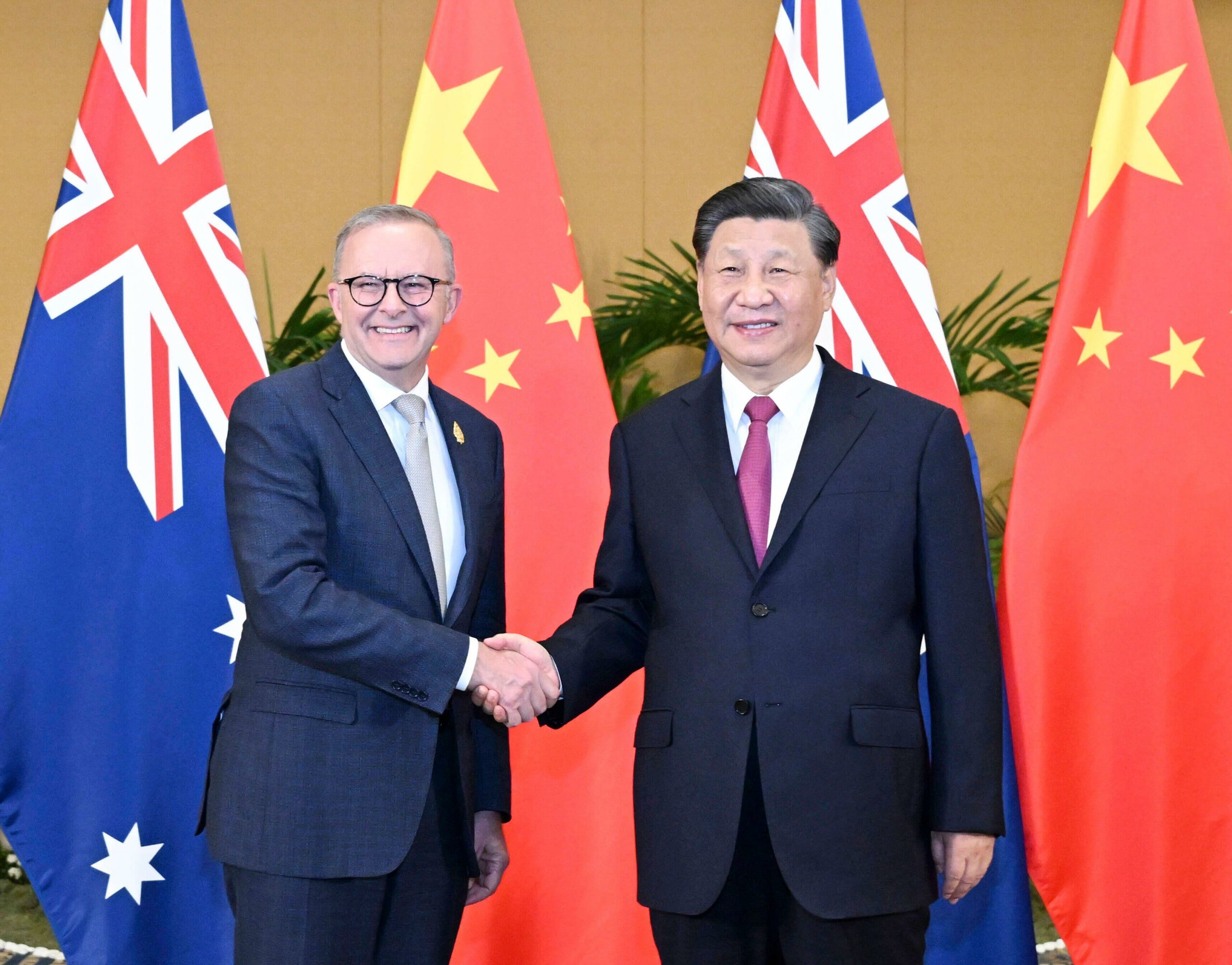
Contrast this with the fact that China is, by far, Australia’s largest trading partner, taking one third of all our exports, providing 570,000 direct jobs in Australia and driving two-way trade worth $200 billion per annum. The conclusion is surely that China already has the ability to subdue Australia economically without firing a shot. China also has the ability to continue making Australia rich.
Currently Australia is engaged in what the Canberra press gallery is calling “a diplomatic knife fight” with China over the security preferences of small Pacific nations. There are now calls for a region-wide security network that The Australian says “will further marginalise Beijing”. Former Australian Ambassador to China, Dr Geoff Raby, says the AUKUS deal sends a “very clear signal to the leadership in China that Australia now sees China as an enemy”. Dr Raby, and other experienced diplomats, have consistently warned us that Australia needs to rely more on diplomacy and statecraft rather than national security rhetoric and military posturing.
Whereas there are good reasons for Australia to invest more in Pacific nations to counter climate change and support infrastructure development, the recent move to convert those relationships into military alliances is wrong-headed and provocative. This policy may also complicate collaborative work with our neighbours in Southeast Asia. Engaging in cooperative regional diplomacy with ASEAN nations and engaging respectfully with China is far preferable to stoking hostility and inciting a conflict that Australia cannot win.
China is asserting its right to exercise power and influence in our region. Some of its actions are open to strong criticism and challenge. But the question we should consider is this: are we more likely to influence China’s behaviour as a great power through military containment and confrontation – or by engaging proactively through middle-power statecraft?
A reasonable conclusion is that the rise of China to superpower status is a reality that Australian foreign policy must embrace. The US, despite its war mongering in other theatres, is pulling back from its position as overlord in the Asia-Pacific. Beijing reads this as tacit US recognition of China’s emergence as a strategic and military equal. While Washington prods Japan, South Korea, the Philippines, Taiwan and Australia to spend more on weapons, and develop Sheridan’s relished “battle plans”, Uncle Sam is leaving the front line for its proxies to defend. That is a fool’s errand in any language.
Japan has its own East Asia security preoccupations, South Korea wants détente with North Korea and China, and Taiwan wants the status quo. Only the weak and brash military of the Philippines think a fight with China is advisable. Meanwhile, Australia dithers with AUKUS and a confused diplomacy of “strategic equilibrium” – all while striving to conjure a Pacific alliance of microstates to confront and contain China.
After Suez in 1956, Great Britain, the motherland, finally revealed its impotence as a world power. By then Australia had already switched horses to pay tribute to Washington. Now, after Vietnam, Iraq, Afghanistan and Iran, the ability of the US to project power across the globe is manifestly waning. Like all empires in decline, America has degenerated into a rogue state engaged in endless conflicts. For Australia the new geopolitical reality presents a historic opportunity to recalibrate our defence and foreign policy.
Perhaps we should embrace our new ally Papua New Guinea’s dictum: “a friend to all – an enemy to none”. It would surely work better than the current policy of barely concealed hostility toward China. The decline of American power in the Pacific is irreversible because China’s economic, diplomatic and military rise is inexorable. There is no chance that Australia can resist that power by trying to contain it. It would be, to borrow Paul Keating’s famous metaphor, “like throwing a handful of toothpicks at the mountain”. Our wisest course is to embrace China’s rise and influence it through good neighbour statecraft and the strengthening of existing economic ties.
The irony of our time is that China’s rise, including the military power that Sheridan and Marles so fear, may well prevent war in our region. America’s growing reluctance to confront that power may save us from a toxic alliance that serves only to stimulate endless strife.

Kym Davey
Kym Davey is a human rights advocate. He is a former Chair of the SA ALP Platform Committee and a member of Labor Against War and SA Labor Friends of Palestine. He was recently elected to the Board of the Australian Peace and Security Forum.