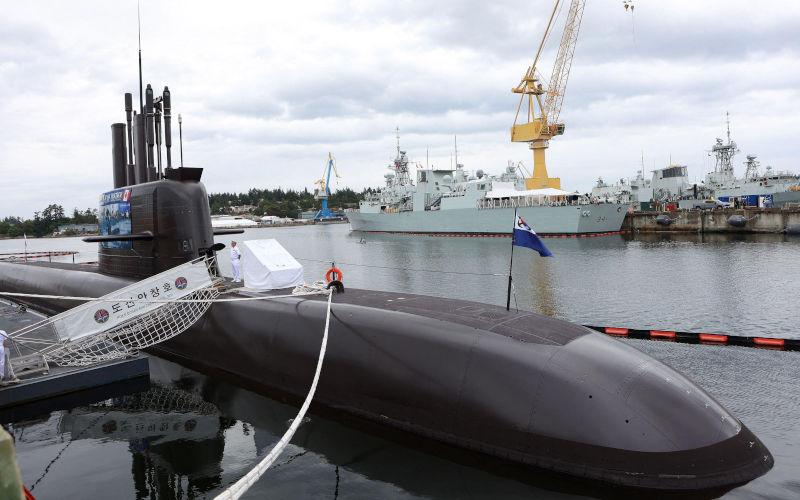
Canada’s decision to acquire conventionally powered submarines raises a question for Australia’s AUKUS program. Could South Korea’s KSS-III offer a more affordable and timely alternative to the planned nuclear-powered fleet?
In July the Canadian government announced that it has chosen the German-Norwegian bid to build 12 conventionally powered submarines to replace their obsolete Victoria class fleet. The Canadian Broadcasting Corporation reported the estimated cost of the submarines at CA$24 billion. With 35-year lifetime maintenance and sustainment costs added, the overall program cost is likely to be in the vicinity of CA$100 billion. This compares more than favourably to the A$368 billion (the dollar equivalents are similar) allocated so far to AUKUS.
The Canadians said they had a hard time choosing between two excellent options – the other being the South Korean KSS-III submarine.
Professor Hugh White has long experience with our Collins class submarine project and, more recently, with the details of AUKUS. He says that as an alternative to the AUKUS project “any off-the-shelf submarines Australia could get its hands on, we should take”.
One option is to turn back to the French Naval Group for a new order of 12 submarines. In evidence given to the AUKUS public inquiry in Canberra on 2 September, retired admiral Peter Briggs gave an informed presentation on the capabilities of nuclear-powered submarines. He favours procurement of a low-enriched uranium (LEU) nuclear-powered submarine, based on the French Suffren class, for the Royal Australian Navy (RAN). He strongly opposes purchase of the US Virginia class and the proposed British-designed SSN AUKUS boats, describing the plan as “flawed and undeliverable”.
His conclusion about the AUKUS submarines is widely supported by the evidence and a strong consensus of military and academic opinion.
During his presentation Admiral Briggs stated his view that conventional diesel-electric submarine technology was not acceptable for the next generation of RAN operations. His argument was that conventionally powered submarines have neither the stealth features nor the endurance needed for effective undersea naval operations. Nonetheless, the example he cited concerned the limitations of the existing Collins class submarine design. As is well known, Collins is an outdated platform that is nearing the end of its operational life.
Given the South Koreans only recently lost the bid for 12 submarines to replace the ageing Canadian fleet, their new submarine should be available for export without delay. The KSS-III proposal had an appealing range of handover deadlines promised for Canada. The expected first boat delivery date was scheduled to be 2032, with the initial batch of four submarines delivered by 2035 and the remaining eight boats at the rate of one per year until 2043, when the entire fleet of 12 would be in service. It has been reported that the South Korean tender may have suffered a disadvantage because Canadian infrastructure and crew capacity to absorb the fleet in that timeframe is underdeveloped. This is much less a problem in Australia.
These delivery timeframes compare to 2032 proposed for the first second-hand AUKUS Virginia; thereafter delivery in 2035 and 2038 respectively. The first British-designed AUKUS SSN boat is not expected to be delivered until the fuzzy ‘2040s’. Obviously, procurement of an entire one-class fleet of 12 KSS-III submarines by 2043 is an attractive option. It would adequately cover the capability gap of decommissioned Collins class submarines, scheduled to begin in 2040. If the argument about needing more naval capability now has any relevance, early delivery is a must.
KSS-III capability
Defence Central is the authoritative London-based bureau for published defence intelligence. They produce “deep-dive reports on procurement, weaponry and integrated command structures”.
Defence Central notes that in 2021 South Korea became the first country without nuclear weapons to successfully test a submarine-launched ballistic missile (SLBM). The launch came from the Dosan Anh Changho, the first KSS-III class submarine produced. South Korea’s KSS-III program represents the third phase of the country’s indigenous submarine development strategy. Earlier phases relied heavily on German technology. The KSS-III represents a leap forward to a fully domestic design capable of supporting strategic missions, including nuclear deterrence.
The KSS-III supersedes two earlier models in both size and capability. Measuring 83.5 metres in length with a beam of 9.7 metres, the submarine has a submerged displacement of approximately 3,800 tons. It is powered by a diesel-electric propulsion system with an air-independent propulsion (AIP) module that allows for greater submerged endurance compared to conventional diesel-electric submarines. The crew complement needed is 50 people – a massive reduction on the 135 sailors required to operate the US Virginia class boats – and the 100 crew required for the 10,000-ton SSN AUKUS boats, should they ever reach naval service.
The design configuration allows the KSS-III to remain submerged for up to 20 days without surfacing, a key feature for survivability in contested waters. The boat has a top submerged speed of 37 kph, or 20 knots, and an operational range of around 19,000 km. These specifications allow for long patrols in both coastal and open sea environments. The latest version boats are also capable of generating electricity underwater to recharge their fuel cell batteries. This enables long underwater voyages and obviates the need for frequent ‘snorts’, when the submarine has to come to the surface and potentially reveal its position to an enemy satellite.
One of the defining features of the KSS-III is its vertical launch system (VLS). It is the first South Korean submarine equipped with a VLS capable of deploying a battery of underwater-launched missiles. The Korean-designed Hyunmoo-3 cruise missiles offer a credible second-strike capability, especially relevant given the regional missile capabilities of North Korea and China. The Hyunmoo-3 is roughly equivalent to the US Navy’s Tomahawk but is supersonic, with a reported speed of Mach 1.2. In addition to SLBMs, the KSS-III can carry heavyweight torpedoes and anti-ship missiles launched from its standard torpedo tubes.
The newest design KSS-III, known as Batch 2 submarines, will have an increased displacement of approximately 4,000 tons and an expanded VLS capable of carrying up to ten missiles. They will also feature enhanced sonar systems, improved stealth characteristics and a more advanced combat management platform. Batch 2 construction is already under way, with the second unit expected to be launched this year.
The new boats also feature advanced anechoic tiles covering their HY-100 steel hulls to suppress underwater radiated noise and reduce active/passive sonar detectability. The K-111 class submarines are part of South Korea’s three-axis defence system, a strategy aimed at detecting, intercepting and retaliating against missile threats. The inclusion of SLBM capability on a conventional submarine makes the KSS-III unique.
Should the AUKUS public inquiry find that a non-nuclear-powered alternative to the Collins class is a desirable option for Australia’s defence, it is manifest that the KSS-III should be considered as a replacement. The independent publication Naval News describes the KSS-III as “the most potent conventionally powered and armed submarine in the world”. The cost is much more affordable; its performance is outstanding; it has none of the problems associated with nuclear waste disposal and security – and it can be delivered on a much faster schedule than the AUKUS boats.
Perhaps more importantly than all of this, discontinuing the purchase of AUKUS nuclear attack submarines surely removes a powerful incentive for China to attack Australia.
View the Defence Central video below:

Kym Davey
Kym Davey is a human rights advocate. He is a former Chair of the SA ALP Platform Committee and a member of Labor Against War and SA Labor Friends of Palestine. He was recently elected to the Board of the Australian Peace and Security Forum.