The rapid shift from petrol cars to electric vehicles is eroding fuel excise faster than governments expected. A replacement road user charge is inevitable, but a rushed or fragmented scheme could create new problems of fairness, privacy and administration.
Last Monday the Commonwealth restored the full 53.7 cents per litre of gasoline and diesel excise, and restored road user charges for heavy vehicles.
Well before the restoration of excise, sales of vehicles with conventional internal combustion engines (ICE) had fallen to half the new vehicle market, the other half being hybrids, plug-in hybrids, and battery electric vehicles (BEV).
The chart below, constructed from Australian Automobile Association data, shows this sharp fall in ICE vehicles, and equally sharp rise in BEV sales up to June this year. With excise now back to its full level, continuing uncertainties about oil supply, and the withdrawal of some ICE car brands from the Australian market, it’s a fair bet that this trend will continue.
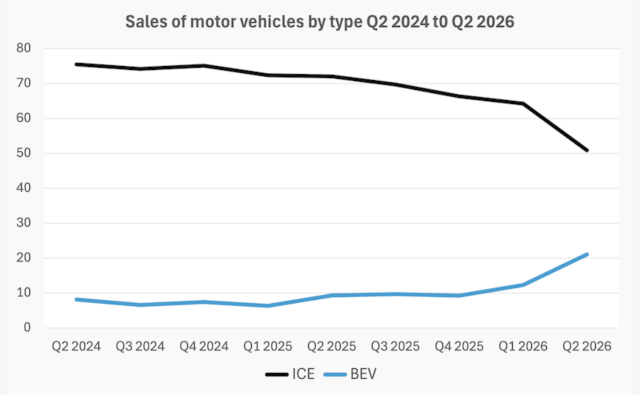
This development has probably surprised policymakers, who tend to think in terms of linear projections, rather than logistic (“S” shaped”) growth that occurs when demand for a good takes off, particularly when there are network characteristics influencing demand – the availability of chargers in the case of BEVs. Aggressive pricing by Chinese manufacturers locked out of the US market have contributed to this surge but once logistic growth is underway it becomes irreversible until some saturation is reached.
Most surprised would be the bureaucrats in treasury departments. The Commonwealth has been expecting that gasoline excise will steadily rise from $7.6 billion this year to $8.1 billion in 2029-30. (Tobacco excise all over again, but without the violence.) State treasurers, mindful of the importance of Commonwealth road grants, are also feeling the pinch, as Giles Parkinson of Renew Economy describes in his article in The Driven: A $440 million electric car tax looms for one state unless PM steps in with national scheme. That “tax” (really a user charge) to which he refers is the New South Wales decision to set a road user charge of 3.095 cents per km for EVs from next July or even earlier if EV sales reach 30 per cent of the market. The Western Australian government has a similar proposal.
As Parkinson explains, the New South Wales government would prefer the Commonwealth to set and collect the charge. This is understandable politically: states are always happy when the Commonwealth collects taxation and passes it back to the states, as is the case with GST. But it’s also understandable administratively. Think how a New South Wales road user charge would be applied to owners of cars in the Tweed Heads region, particularly if (when) the Queensland government decides to apply a road user charge to EVs, or how it would work in relation to the settlements along the Murray. And as for the ACT – will the Minns government establish Checkpoint Charlie-type border crossings on the Monaro and Federal Highways?
Perhaps it’s all bluff, trying to force the Commonwealth’s hand. A commonwealth charge would overcome cross-border problems, but there are plenty of other problems in a hastily-established road user charge.
Should just one price be set? A figure of around 3 cents per km as proposed by New South Wales is about the same as 53.7 cents per litre on a car with a fuel consumption of 6 litres per 100 km.[1] That seems to make sense, but should not larger, heavier EVs, which cause more road wear and are more dangerous to other road users be subject to a higher charge, as is de-facto the case with fuel excise? Should road use incorporate a congestion charge, which would mean the fee would vary with location and time of day? These design problems are all technically soluble but they involve privacy issues we have not started to discuss.
How should it be collected? The Victorian scheme was based on mistrust, requiring people to photograph their odometers on June 30. With the help of AI photograph modification, and electronic hacks on car computers, it would set new but simple challenges for those skilled in the art of winding back odometers.
Then there are equity issues. Should road user charges be raised in order to lower the burden of registration fees and compulsory insurance – a burden that falls most heavily on those who least use their vehicles? Jack Buckley and Aditya Maitra of e61 have published a study – Who bears the burden of higher petrol prices – considering evidence on the elasticity of demand for gasoline and associated distributional implications. Those findings should be directly applicable to estimates of the elasticity of demand related to EV use.
They find that, in contrast to earlier studies, there is some elasticity of demand: a 10.0 per cent increase in the price of gasoline leads to a 3.8 per cent decrease in consumption. It appears that most of us, particularly those living in big cities, have more transport options than they had in the past. But that does not hold for those with higher motor vehicle reliance and those with lower incomes – groups with significant overlap. Shift workers and people living in the country are among those most affected by higher charges for motor vehicle use.
Pragmatically it may be best if the Commonwealth were to set an interim road user charge, applicable to all vehicles, but with a firm sunset provision while it works out a better scheme.
Republished from Ian McAuley’s Bear Weekly Roundup

Ian McAuley is a retired lecturer in public finance at the University of Canberra. He can be contacted at “ian” at the domain “ianmcauley.com” .