A poll on attitudes to public policy confirms that the economy remains people’s dominant concern, but there is resistance to reforms that would make for a fairer distribution of income and wealth.
A poll by Capital Brief/Demos AU captured a great deal of media attention because it revealed that if an election were held today, One Nation would win more votes than any other party, but Labor would almost certainly hold on to government. Another finding taking people by surprise is that Pauline Hanson’s approval rating is higher than Albanese’s or Taylor’s.
Those findings captured the headlines, but the poll has a great more data on people’s attitudes to policy issues, including the budget. In short, people don’t believe the budget will make housing more affordable or make Australia a fairer place: rather it will hurt the economy and will make it harder for the average Australian. People narrowly approve of ending negative gearing for investment properties, but narrowly disapprove of the CGT changes and a toughening up on trusts.
Those results can be interpreted in at least four ways. Perhaps people have a warm admiration and affection for the one per cent who enjoy Howard’s tax rorts. Perhaps they believe they will make it to the one per cent themselves. Perhaps they have been misled by the hysterical reaction to the budget. Or perhaps they just don’t understand. If you look at the figures without applying too much precision (attitudinal surveys are pretty rough) you would say a third approve of the budget measures, a third disapprove, and a third don’t have any idea.
One of the more surprising findings is that 42 per cent of respondents believe that “income from investments should be taxed at a lower rate than income from work, to provide greater opportunities for people to build wealth”. Only 38 per cent believe that “income from investments should be taxed similarly to work income to ensure a fair system”.
This echoes with the idea of the “American dream” – the idea that in the land of the free everybody can become rich. It’s an illusion that explains much of the tendency for people to vote against their own interests. It’s particularly pathetic when we hear it from people who believe they can build their wealth by buying existing houses, which is a zero-sum activity that simply shuffles wealth around.
This poll aligns with other polls in relation to voting intention by income, education and age: a university education is a pretty good inoculation against support for One Nation, and if the franchise were limited to adults under 35 we would have a Green government. It also confirms what has been observed in recent elections: One Nation is drawing most of its support from former Coalition voters. That’s a significant finding, because it lends weight to the idea that people are attracted to One Nation because they see it as a genuine version of the Coalition’s populist right-wing platform, rather than as disillusionment with the two main parties.
Perhaps the most revealing part of the survey is the collation of responses to the question “In your opinion, what is the biggest issue facing Australia today?”. Unfortunately that collation was left to artificial intelligence, which showed an extraordinary inability to categorise ideas. For example, somehow “the economy” is quite separate from “the cost of living”, or “the budget”. And the total of single responses comes to 115 per cent. AI still has some way to go. So I have done a little re-assembling and categorisation to produce the table below, showing people’s responses – still not perfect but easier to follow than the original presentation.
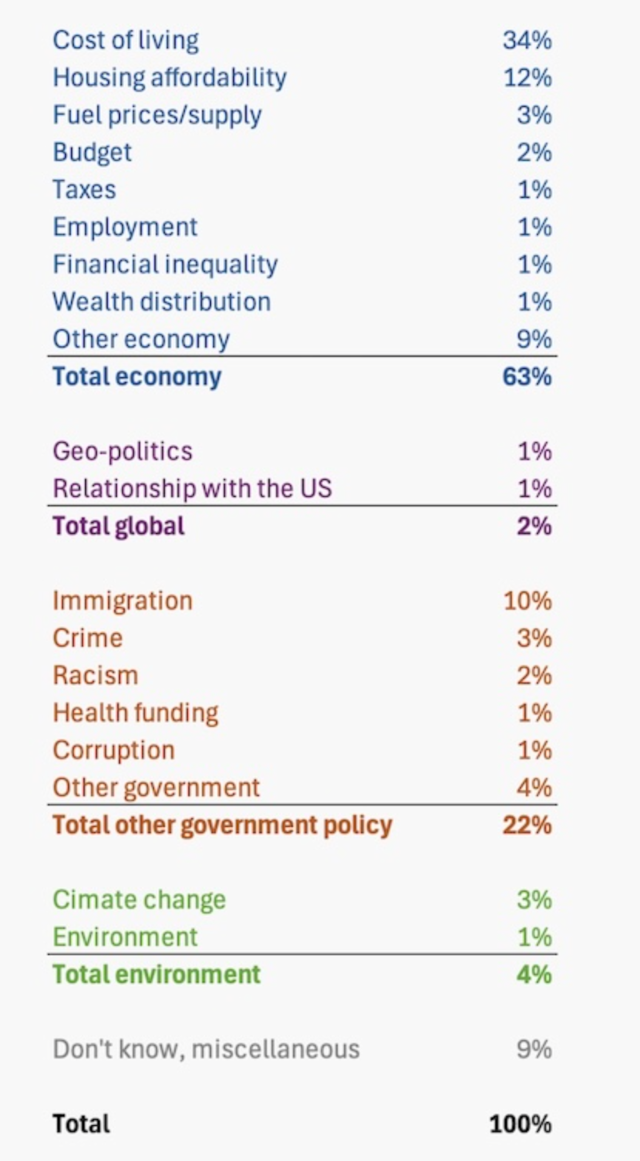
It is clear that economic issues are at the top of people’s concerns. But it would be rash to suggest that the country is suffering a general cost-of-living crisis – a notion that many journalists assume to be beyond question. The figure, 34 per cent, pretty well aligns with evidence from other sources that about 30 per cent of people are having a really tough time, 40 per cent are having the usual trouble of matching income to demands, and another 30 per cent are enjoying a high level of financial security.
It’s also notable that only 2 per cent of respondents nominate inequality, when economists, and businesspeople who understand how markets are sustained by well-paid workers, see inequality – particularly wealth inequality – as a major threat to the legitimacy and stability of a capitalist economy. One Nation has tapped into the aggrieved who believe that their hardship has been inflicted by a class of “elites”. If Labor is to win these people over it needs to engage in the language of class interest.
There are other messages in these figures. Immigration is probably not the issue Taylor and Hanson would like it to be, and warnings about climate change are still not getting through to the public. In fact as pointed out in a recent post on P&I by Ralph Evans, progress in the electricity sector may be distracting us from serious inaction on climate change in the rest of the economy.
Republished from Bear Weekly Roundup

Ian McAuley is a retired lecturer in public finance at the University of Canberra. He can be contacted at “ian” at the domain “ianmcauley.com” .