Australia’s home ownership rate is 66 per cent when counted by household, but just 51 per cent when counted by person. The difference leaves millions of Australians living in an owned home without owning one themselves – and changes how we should understand Australia’s housing crisis.
Counted by house, Australian home ownership is 66 per cent. Counted by person it is 51. The gap has held at sixteen to eighteen points at every census since 2006, and close to three million adults live inside it.
Anna is 26. Last Tuesday night she filled in the Census at her parents’ kitchen table, in the house she has never managed to leave. The form asks whether the home is owned or rented. Her parents own it, so the household lands in the owners’ column. And Anna disappears.
The Census asks you fifty-nine questions about yourself. Then it stops asking about you and asks about the building. Owned, or rented? The form is honest about the switch, and the ABS does nothing wrong. The trouble comes later, when an answer about a building is reported as though it describes the people inside it. Say “two thirds of Australians own their home” and you have changed the subject.
Most of us have that wrong. I did too, until recently. The error only ever runs one way. The people locked out of ownership are propping up the very number that says the market is fine. Housing reform has been hard to win for many reasons. This one is underrated – you cannot build political urgency on a statistic that hides the problem.
The Federal Reserve Bank of Minneapolis ran this analysis in July and found that the American home ownership rate fell from 65 per cent to 53. I was intrigued – what if the same was true here?
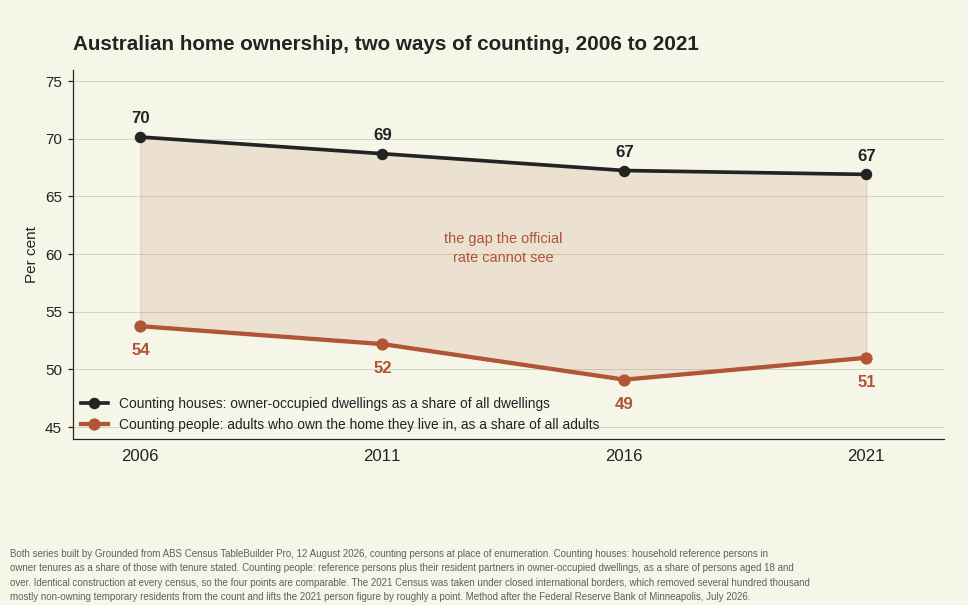
The person-counted rate fell from 54 to 49 between 2006 and 2016, with the 2021 reading inflated by the border closure.
This disparity made housing ownership look 32 per cent better than it was across the last four Censuses.
For young Australians the gap is worse, and the ABS has already published the answer without adding it up. It reports that 54.6 per cent of people aged 25 to 39 owned a home in 2021. Read the footnote and that figure covers only households run by someone in that age group or their partner. Just 69 per cent of the age group runs a household at all. The rest live with parents, in share houses, with relatives. The biggest group is the 541,000 still in a parent’s home. Multiply the two numbers the ABS printed in the same article and ownership for that generation comes out near 38 per cent.
What that means is that one of the most watched barometers in Australian politics quietly excludes about 541,000 people in the prime of their lives. We would never accept an unemployment rate that counted a jobless 26 year old as employed because her father has a job.
Miss out badly enough and you stop being counted as someone who missed out. Anna is one of that half million.
Her parents’ house is counted once, as owned, in their age bracket. Her housing failure is filed under her parents’ housing success.
She has plenty of company in the vanishing. Flatmates and boarders. Adults who separated and moved back in with a parent. Older parents living under an adult child’s roof. Live-in carers. Grandchildren staying with grandparents. Every one of them swells the owners’ column without owning a thing.
At the first Commonwealth Census in 1911, 49 per cent of Australian households owned or were buying their home. In 1947 it was just 53. War service home loans became a priority, as did public housing. Cheap land on the edge of every city became a building boom. By 1961 the ownership rate had reached 70 per cent. Meaningful policy led to seventeen points in fourteen years.
Those old censuses counted dwellings, as ours still does. Measured the old way we sit at 66 per cent and look fine. Run the people count over 1947 and the 53 per cent of that year becomes about 33, because households held 3.75 people and most of them owned nothing. The gap between the two measures is not new. What has changed is where the queue stands. In 1947 it was on the verandah, in the wagon, in the second family sharing one house, and the Census had a table for every one of them. Today it is in a spare bedroom in a comfortable house, and there is no table for that at all.
That hiding does real work. Canberra is not idle, and the recent federal effort is real. But policy is sized to the country the statistic describes, one where two thirds are safely inside the market
A marginal-seat MP can read 66 per cent as proof that most of the electorate wins when prices rise, and vote accordingly. The locked-out themselves keep the number alive – each cohort that gives up and moves back home makes the owners’ column look a little healthier. Nearly half of Australian adults have no stake in rising prices, and no number on the public record represents them. They have lost trust in the system.
Hope has to be built into the fix, or the locked-out will keep tuning out. It is why Grounded works on community land trusts: buy the home, lease the land beneath it from a trust that holds it for the community in perpetuity. With the land removed from the price, a deposit near $50,000 opens the door.
Anna has spent her whole adult life inside the home ownership statistic without owning anything. Last week the Census statistic was refreshed for another five years. What would it do to the politics of housing if the headline number said plainly that nearly half of us own no home?
Karl Fitzgerald is the Managing Director of Grounded Community Land Trust Advocacy, where he is working towards the establishment of perpetually affordable housing. He has a long history of tax reform, protecting Victorian communities from speculative behaviour (vacancy taxes, rezoning windfalls, land taxes).