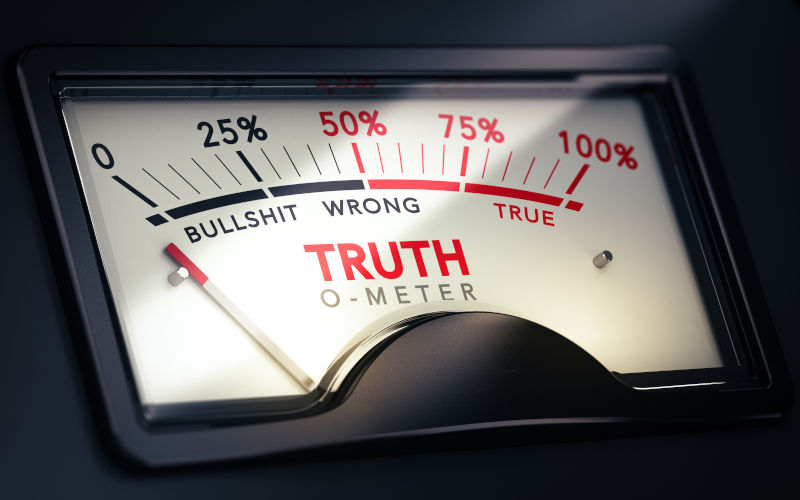
Bullshit may be easy to dismiss, but from politics and gambling to advertising and public relations, it can obscure truth, shape debate and carry serious consequences.
Bullshit is not just harmless fun – it has serious consequences for our lives.
Whenever I hear a prerecorded message say “Your call is important to us” I don’t know whether to laugh or scream, because ‘Your Call is Important to Us’ is the title of a book by Laura Penny which is subtitled ‘The Truth about Bullshit’. It is described as a “guide through the phoniness of advertising and public relations, the claptrap of big pharma, the gobbledygook of the media, and the poppycock of the service industry”.
If your call really was important to them, they would have hired enough receptionists to be able to attend to your call in a timely manner. Except, of course, when they are “currently experiencing a higher-than-normal volume of calls”. But if the recorded message says this every time you phone, this means that the current high volume of calls is the normal one. So they’re bullshitting.
The first serious treatment of bullshit in human communication was by Princeton philosopher Harry G. Frankfurt. In the 1980s he wrote a short essay entitled ‘On Bullshit‘ for an obscure academic philosophy journal. Then in 2005 an enterprising publisher published it as a monograph and it struck a chord with the populace and became a bestseller, spending 27 weeks on the New York Times Bestseller List.
Frankfurt’s main contribution to our understanding of bullshit was to distinguish it from lying. Frankfurt claimed that while lying involves deliberately making a false claim, the hallmark of bullshit is that the person saying it doesn’t care whether what they’re saying is true or false. Thus, while lying is a deliberate falsehood, bullshit can often be deceptive without being explicitly untrue. It is a way of obscuring or manipulating information to suit one’s purposes.
The 21st century bullshitter par excellence is Donald Trump, but his bullshitting has become so habitual and unremitting that almost everything he says is bullshit. What is dangerous about Trump is not the bullshit itself, but the fact that behind it he wields immense power, capable of causing great destruction and disruption.
From an Australian point of view, more dangerous bullshit that directly affects our community is being propagated by our own common-and-garden politicians.
The most salient example is the ongoing debate about the regulation of gambling. The government is trying to sell its inadequate legislation with the pernicious claim that it “strikes the right balance”, which sounds responsible and judicious, until you think about what this “balance” is actually between: on the one hand protecting the huge profits being made by (mainly overseas) gambling companies, while on the other preventing the financial debt and bankruptcy, mental health struggles, damaged family relationships and increased risks of suicide caused by gambling. The claim you can meaningfully find a “balance” between these two outcomes is bullshit. The only morally acceptable “balance” is harm prevention 1 / corporate profit 0.
One government minister tried to make it sound better by claiming the balance was actually between preventing harm and protecting the right of ordinary Australians to have a bet. This is also bullshit, because you don’t need a TAB or Ladbrokes to have a bet. You can have a bet any time with anyone anywhere on anything and regulating advertising or even eliminating gambling companies altogether can’t stop you, so your right to bet is not threatened.
The gambling industry has its own armoury of bullshit. One of the most pernicious is their claim to support “responsible gambling”. A responsible gambler is one who stops betting when he or she starts to lose too much or the stakes get too high. If everyone was a responsible gambler and stopped betting when they started to lose, then the gambling companies would not make much money. They actually depend on a significant number of problem gamblers for their business model to work.
One of the most famous pieces of political bullshit this century was Scott Morrison’s much touted claim that “I stopped the boats”. As P&I founder, John Menadue, has pointed out numerous times, an examination of the facts reveals that it would be not entirely true but certainly more accurate to say that Morrison started them. Here is John’s graph of illegal boat arrivals in Australia from 2011 to 2014.
It is clear that the huge spike in boat arrivals only started after the offshore processing legislation was blocked by opposition leader Tony Abbott and his shadow minister for immigration, Scott Morrison. It is also clear that they dropped back quickly and significantly when Kevin Rudd announced that “boat people” would never be allowed to settle in Australia. So, contrary to the vain boasts of the latter, it was Kevin Rudd who “stopped (most of) the boats”, not Scott Morrison. Morrison just cleaned up the tail.
Bullshit is perhaps most prevalent in the public relations and advertising sectors. Indeed, if we banned bullshit the whole advertising and PR industry would probably grind to a halt.
How many media releases begin: “We take this issue (or your complaint) very seriously”? If you Google “We take your complaint very seriously”, you will find multiple websites instructing businesses on how to effectively bullshit their way to keeping dissatisfied customers happy. Starting off with “We take your complaint very seriously …” of course.
Some people would see academia as another area that attracts more than its fair share of bullshit. One cultural and academic movement that has been frequently labelled bullshit is post-modernism. In 1996 American academic Alan Sokal wrote an extended piece of deliberate bullshit entitled ‘Transgressing the Boundaries’ and submitted it to a prominent postmodernist journal, which unquestioningly accepted it for publication. Sokal later revealed the entire paper was unmitigated nonsense.
How do we avoid being taken in by bullshit? Researchers have found that people who were worst at detecting bullshit grossly overestimated their bullshit detection abilities and believed they were better at detecting it than the average person. So the first step is to be aware of our own biases and limitations.
My favourite bit of bullshit was in a story I read in The Reader’s Digest when I was just a kid. This chap is driving from Pennsylvania to Ohio and just before he reaches the border he comes across a gas station with a big sign saying “Last Chance for $4 Gasoline”, so he pulls in and fills up. As he’s paying for it, he casually asks the attendant “How much is gasoline in Ohio anyway?” and the attendant responds “$3.50”.

Ian Robinson
Ian Robinson is a proud fourth generation Australian. He is a former tutor in Logic and in Political Philosophy at the University of Melbourne and President Emeritus of the Rationalist Society of Australia.