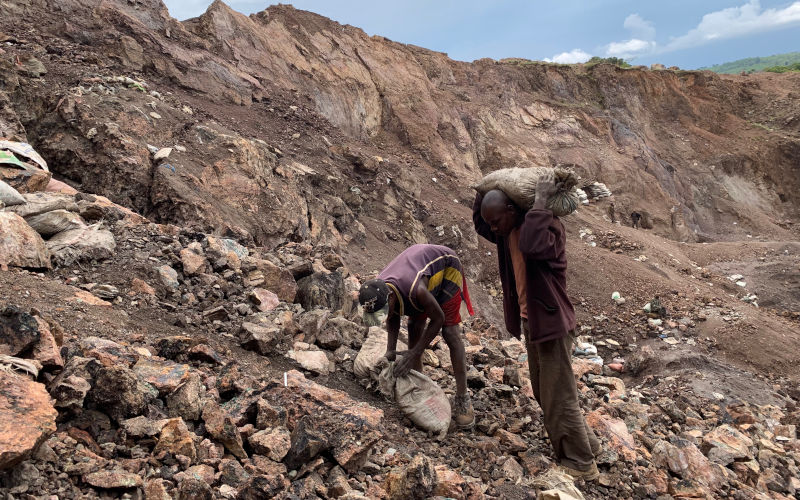
Cobalt mining in the Congo exposes both the hidden human cost of technologies we rely on and the limits of a news culture that directs our attention towards some crises while leaving others almost invisible.
I have some sympathy for those who say they don’t engage with the news. Why spend your life engaging with negative stories handpicked to create outrage?
Our global media world is a manufactured nightmare. If we think of our ancestors, they were largely unaware of what was happening beyond their own village, beyond their own region. Bad things certainly happened. Witches were burnt, towns were razed, people starved when it didn’t rain. But when spring was in full bloom and the birds were singing, you had no idea of what catastrophes were happening in other parts of the world.
This is not possible any more.
Last night I stumbled on an interview that landed in my feed. I did not choose it. But I chose to not ignore it. It was some guy being interviewed on Joe Rogan. I had no idea who he was. Within ten minutes I was involved. The man was a great storyteller.
“Our daily lives are powered by a human and environmental catastrophe in the Congo”, he said. “Cobalt mining is the slave farm perfected. The cost of labour has been nullified through the degradation of Africans at the bottom of an economic chain.”
What really made me sit up were the salient details. He claimed that every day at least 300,000 Congolese, including women and children, dug for cobalt, often with their bare hands. They worked underground or in huge pits exposed to searing daily temperatures. But the natural environment was not the main hazard. He related that the cobalt-bearing dust itself is incredibly toxic, particularly to breathe, with prolonged exposure carrying an increased risk of cancer. The threat of contamination was also present in the surrounding air and waterways, so even if you are lucky enough not to be working in the mine, you could still develop serious health issues just from being alive.
And what do the Congolese earn for this dangerous labour? A few American dollars a day, if they are lucky. Often considerably less.
Why is this happening? Because the Congo produces around three-quarters of the world’s cobalt, much of it used in batteries for mobile phones, computers and electric cars. In short, this exploitation is helping to run our clean energy revolution.
I reached for my phone to check what I was hearing (yes, I am aware of the irony). I was a little wary of Joe Rogan. Although a seasoned interviewer, he has been known to be loose with the facts and prone to conspiracy theories. I wanted to know: who was this man he was interviewing and why hadn’t I heard of him?
I found out that his name was Siddharth Kara. He was someone who had spent years investigating cobalt mining in the Democratic Republic of the Congo. Kara’s book, Cobalt Red (2023), had become a New York Times bestseller and was a finalist for the Pulitzer Prize. Yet long after its publication, I was encountering it as if for the first time.
I thought I was better than this.
There is a prevailing smugness among people who feel that because they follow the news, they have a reasonably comprehensive understanding of world events. I admit there are times when I put myself in this position.
Yet phenomenology teaches us that for every moment we focus on something, we do so to the detriment of everything else. Like a bird focusing on a worm emerging from the ground, we narrow our attention every waking hour.
I am embarrassed to admit that my knowledge of the Congo has been largely shaped by Joseph Conrad’s Heart of Darkness. Having taught the novel for many years, I am familiar with Achebe’s criticism that Conrad’s fascination with the ‘dark continent’ contains racial overtones, presenting Africa as a primitive place far removed from Europe and the Enlightenment. To be fair, Conrad criticises European colonists as having no greater ambition than “to tear treasure out of the bowels of the land”, with no more moral purpose than burglars breaking into a safe. Such attitudes underpinned the horrific history of King Leopold II of Belgium, who turned the Congo into his private colony where millions perished under forced labour, terror and resource extraction. Yet whereas these visions of the Congo were tucked away in the 19th century, Kara opened my eyes to the fact that something disturbingly familiar was happening today.
I woke up the next morning and ordered Kara’s book. Driving to university, I listened to the interview again. When I got home, I read about his other books and watched many more interviews with him.
But as so often happens, life got in the way. This semester I will mark over 300 essays, mostly densely theoretical criminology research projects. During the week I teach at Melbourne University and spend my early mornings writing articles. In our household there are also two hungry dogs who need feeding and whose poo often needs to be cleaned off the carpet.
Despite all this, I kept returning to Kara’s claim that we all have blood on our hands. That even without being directly involved, we are supporting slave wage labour that kills people.
This is not to say that Kara’s work is uncontested. I became aware this week that academics who know the Congo well have criticised him for sensationalising conditions and underplaying the economic importance of mining to communities with few alternatives. None of this makes the abuses he describes imaginary, but it does mean his account should not be treated as the last word.
So how should we live with Kara’s uncomfortable claims? Right now I am using a computer to write this article and I still have a smartphone. Kara seems well aware of the difficulty of conveying his message to Western audiences. One practical response he advocates is simple: stop upgrading your smartphone every other year. The same goes for other technology we use. Stop being so influenced by capitalist culture. Stop doing unnecessary things that are harmful to the environment and to other human beings.
At the same time, there is the question of attention. Israel, America and Ukraine dominate our news feeds, whereas what is happening in Sudan and the Congo rarely rates a mention. What to do with disturbing realities that do not attract our attention?
Human psychology is a multifaceted thing. While focusing on news headlines and the pressing events of the day, we can also meditate on something bubbling away in the background. Such background attention is not worthless. It remains there ready to move forward when more immediate things fall away.
We may choose not to engage with the news as a way of keeping our sanity, but the world has a way of seeping into everything we do. Petrol prices are going up for a reason. The climate is getting hotter for a reason. Our consciences are being pricked for a reason.
In his bestselling book and interviews, Kara may not convey all the complexities of cobalt mining in the Congo. As an academic, I know that this can be problematic. But as a human being with limited attention, I can say this: he has cut through.
Adrian Rosenfeldt
Dr Adrian Rosenfeldt teaches at Melbourne University. He is a journalist, public speaker and the author of The God Debaters: New Atheist Identity-Making and the Religious Self in the New Millennium (2022). www.adrianrosenfeldt.com