
Is the government right to encourage the development of AI in Australia? If so, how should they do it, and do it equitably. Michael Keating examines the issues in a two-part series.
The cost-of-living crisis continues to be the number one political issue in Australia. As I have argued on numerous occasions (Pearls & Irritations, 8 October 2025, 2 April 2026, 21 April 2026), this is the obvious reason for the surge in populism and support for One Nation.
In response, Prime Minister Anthony Albanese points to the recent tax cuts that favoured those on lower incomes, the government’s $43 billion housing agenda, and the boosts in Medicare. But the size of the budget deficit, and the government’s refusal to increase taxation, means that it is fiscally limited in providing much more targeted assistance along these lines.
Instead, the only way to significantly reduce the pressures on living standards for most households is to achieve an increase in real wages, which in 2025 were slightly lower than they were at their peak four years ago (see Table 1). But real wages will only increase on a sustainable basis if productivity also increases at the same rate. Indeed, Australian productivity was also lower in 2025 than it was at its peak four years previously (see Table 1), and so the fall in real wages is not surprising.
Table 1 International comparison of real wage and productivity growth since 2019
Index values with 2019=100.0

The government has received many proposals about how to increase productivity growth, but while they may help a bit, it is doubtful that these proposals will make much difference. As can be seen from the comparison in Table 1, in only five out of 15 OECD countries with economies similar to Australia’s were real wages higher than in 2025. In only four of these countries was the increase in their real wages between 2019 and 2025 greater than in Australia.
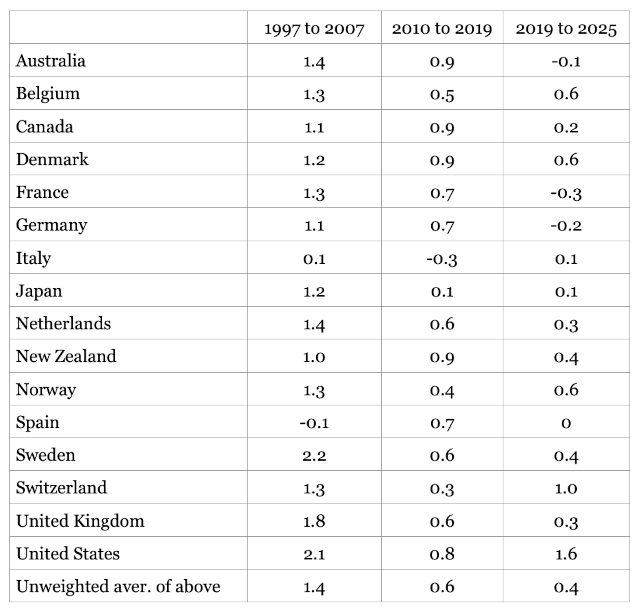
The problem is that, just like Australia, productivity growth has been generally stagnant throughout the OECD. Furthermore, the obvious reason for this productivity stagnation is that there has been no major new technological innovation since the mid-2000s when computerisation was pretty well complete. Consequently, productivity growth has slowed since then and has been negligible in all developed economies since Covid (see Table 2).
Table 2 Labour productivity growth
Average annual percentage change
But the introduction of AI may be about to change that, and lead to renewed productivity growth and the possibility that living standards will start to improve again. For example, although there is considerable uncertainty about the estimates, recent modelling by the Productivity Commission suggests that AI could deliver a $116 billion boost to Australia’s GDP over the next decade, worth about $4,400 per person.
As always, however, a critical issue is how widely the benefits from AI will be shared. Furthermore, we cannot take for granted that the benefits of any new technology, including AI, will be equally shared.
As two Nobel laureates, Daron Acemoglu and Simon Johnson, have documented in their book, Power and Progress.
Acemoglu and Johnson say: “the idea that new machines and production methods that increase productivity will also produce higher wages is false.
“… the last thousand years of history are filled with examples that brought nothing like shared prosperity.
“How productivity benefits are shared depends on how exactly technology changes and the rules, norms and expectations that govern how management treats workers.
“Shared prosperity gains emerge because, and only when the direction of technological advances and society’s approach to dividing the gains are pushed away from arrangements that primarily serve a narrow elite,” they say.
In particular, there is a very real risk that AI could displace many workers, particularly white-collar workers who are early in their career, and whose work supports more senior analysts and service providers.
At one extreme, Kristalina Georgieva, the head of the IMF, has warned that AI is “hitting the labour market like a tsunami”. Meanwhile, Anthropic CEO Dario Amodei has predicted that the technology his company is developing could wipe out “half of all entry-level, white-collar jobs, increasing unemployment up to 10 to 20 per cent in the next one to five years”.
Already a number of studies, not just in the US, have found that recent graduates in fields exposed to AI have suffered markedly worse employment outcomes.
It is still early days, however, with a recent US Census Bureau survey finding that only 37 per cent of large firms with at least 250 employees currently use AI, while only 20 per cent of firms with fewer than 30 employees currently use AI.
Indeed, AI adoption and its impact are being impeded by difficulties in adapting existing business models to take full advantage of new data generated by AI. Also, the delays in adopting AI are likely to be longer if, as is desirable, AI is used to augment human skills rather than replacing them. Augmentation is much harder than automating existing tasks as it requires a willingness to reimagine what can be achieved, and, possibly, major organisational change.
This may be why data from the Census Bureau also show that the rate of take-up of AI in the US has slowed in the last year or so, with Deloitte finding that the current generation of models are having less impact on productivity and profits than expected.
Nevertheless, US productivity growth has picked up economy-wide over the last year or so, and the Federal Reserve Bank has accordingly revised its medium-term growth forecast upwards.
In Australia, the Australian Government authority, Jobs and Skills Australia, says that the people in more exposed occupations are more likely to be women and have university qualifications. Meanwhile, a recent analysis by the Department of Employment and Workplace Relations found some evidence of a modest slowing in employment growth in some highly exposed occupations, such as accounting clerks, keyboard operators, positions in human resources and telemarketers.
Consistent with this finding, research by Zac Gross at Monash University found that firms that were adopting AI were enjoying stronger earnings growth than businesses not using it. Within those firms, the salaries of those whose jobs were at risk of being replaced by AI were not growing as fast as those safe from the new technology.
Although there is no proof yet of large AI-driven job loss in Australia, it is still very early days. Furthermore, Australia is positioning itself to be a major user of AI internationally. In the 12 months ending in March, businesses spent a record $21.8 billion on AI and IT, which accounted for almost all the business investment over that period.
Looking further ahead, what matters most, as Acemoglu and Johnson said recently, is whether machines “destroy or create jobs all depends upon how we deploy them, and on who makes those choices.”
In short, if the government is to be successful in relieving cost-of-living pressures, it faces a dual challenge. Facilitating the adoption of AI offers the best hope of restoring productivity growth, but how to do this while ensuring a fair distribution of the benefits and avoiding mass unemployment.
Tomorrow – Part 2: Reviewing the government’s strategy.

Michael Keating is a former Secretary of the Departments of Prime Minister and Cabinet, Finance and Employment, and Industrial Relations. He is presently a visiting fellow at the Australian National University.