
The rise of populism reflects unmet expectations about living standards, but the answer lies in restoring productivity growth rather than blaming inequality.
Cost of living is by far the number one political issue today in Australia. This is the obvious reason for the dramatic rise in support for One Nation, which tries to appeal to those people whose living standards are falling short of their expectations and who feel that they have missed out.
Understandably, these people do not consider this to be their fault. It is much easier to blame others, most obviously migrants, whom they see as taking their jobs and competing for houses.
This rise in populism is not unique to Australia. A recent US study of democratic governance warned that “it is under threat globally, marking a sharp contrast with the post-Cold War era of democratisation and liberalisation”.
According to one of the authors, Zehra F Kabasakal Arat, “[a] deepening sense of insecurity and economic grievance creates opportunities for illiberal and anti-democratic politicians to exploit voter’s distrust, foment division and depict some segments of the population as an existential threat”.
If we are to stem the rise in populism and reduce the threat to our liberal democratic values, then we first need to understand its cause. Critics here in Australia, noting the increase in populist support is concentrated among manual workers, attribute this to an increase in inequality. Furthermore, many of these, including authors here in Pearls & Irritations, allege that this supposed increased inequality was caused by the spread of neo-liberal economic doctrines in the 1980s. No evidence is ever provided to support these ideological accusations.
While it is true that market-income inequality did rise here in Australia from around the early 1980s to the mid-2000s, this is almost entirely explained by the impact of technology, which led to a hollowing out of relatively routine middle-level jobs. Automation and computerisation, especially, hit these sorts of jobs in manufacturing, agriculture, government and business.
This redistribution of jobs in turn meant, statistically, each income quintile was automatically redefined; that showed up as an increase in inequality. However, in Australia, unlike the US, for example, relative wage rates did not change, so all those Australians who kept their jobs experienced no change in their relative income.
Furthermore, as Chart 1 shows, there has been almost no change in the wage share [total paid to workers in wages and salaries] of national income over the last 65 years. Indeed, the most recent data show the share of wages in total factor income was 53.7 per cent in 2024–25, which is higher than the wage share of 50.4 per cent in 1959–60. And, while the wage share did peak back in 1974–75 at 62.0 per cent, this was associated with stagflation, with both unemployment and inflation above 10 per cent – an economic contradiction. Clearly, markets were not working properly, and reforms were needed to make markets more flexible and efficient. But all through the years of these so-called neo-liberal reforms, the wage share hardly changed.
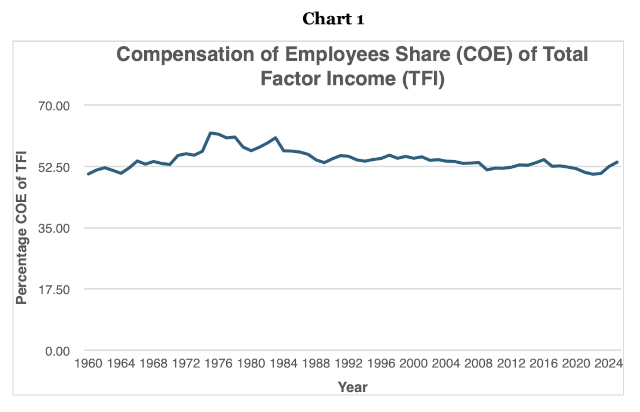
This relative stability of the wage share in Australia, notwithstanding the major shifts in the distribution of jobs, was basically due to the efforts by Australian governments to retrain and find new, equally good, jobs for those who lost their jobs to automation.
In addition, the Hawke-Keating Labor Governments changed the tax-transfer system to improve the relative position of those at the bottom of the income distribution, so that disposable income-inequality actually improved relative to market-income inequality. Indeed, the Hawke and Keating Governments redistributed more income to the poorest 20 per cent of the Australian population than any other OECD country except Denmark.
These Australian policies were very different from America and some other European countries, and that is why inequality in many other developed economies has increased much more there than in Australia. It also shows that any increase in Australian income inequality back then had nothing to do with the spread of neo-liberal doctrines, as the critics allege. Rather the reverse, as the Hawke and Keating governments were actively pursuing greater equality.
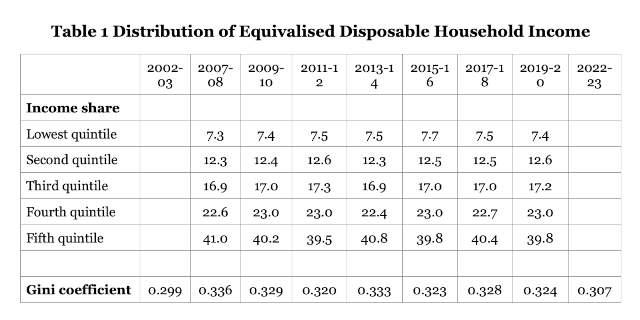
But moving on from the Hawke-Keating era, the available data from the ABS (see Table 1) show no change in inequality since the beginning of this century. The disposable income shares of each quintile of households have so far hardly changed over this century. Similarly, while an increase in the Gini coefficient would indicate an increase in inequality, it also has hardly changed.
So again, the assertions about increasing inequality being the reason for the surge in One Nation’s popularity are just not supported by the facts.
Instead, the problem Australia is facing today is that productivity growth has slowed since the mid-2000s and has been negligible for the last seven years. Since Labor took office in May 2022, productivity has actually fallen (see Table 2).
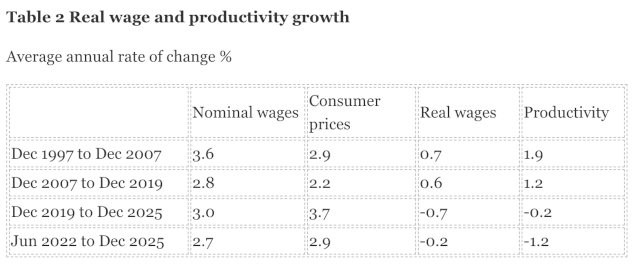
Real wage growth is largely driven by productivity growth, so it is not surprising that real wages are also lower now than they were before COVID. It is this wage stagnation that is the obvious reason for the recent surge in One Nation support. It cannot be reversed without a pickup in productivity growth.
However, even though Australian workers have experienced a small fall in their living standards since COVID, they have not suffered to anything like the same extent as workers in the US and quite a few other OECD countries.
Because of their poor response to technological change in the US, the living standards of less-skilled American workers went backwards not just recently, but since the 1980s. As Nobel Prize winner Joseph Stiglitz found in 2015 “the typical American man makes less than he did 45 years ago (after adjusting for inflation)” – a complete denial of the American Dream.
No wonder Trump won the Presidency back in 2016. But living standards in Australia were not stagnating then. Productivity and real wages were continuing to increase in Australia until just a few years ago, and this is most probably the reason why support for populists was much slower to emerge here in Australia.
Finally, where Australians are today most experiencing difficulties in making ends meet is the cost of housing. The cost of housing has risen much faster than incomes, with average dwelling prices increasing from around two to three times average disposable incomes in the 1980s and early-1990s to approximately 8.2 times the median income today. While in Sydney – one of the most unaffordable housing markets globally – the median house price-to-income ratio is 13.8.
While this increased cost of housing is tough, it mostly affects young people seeking to buy their first home or who have only recently bought their first home. Older people actually like higher house prices, which they see as an increase in their wealth, and the opinion polls tell us it is older people who are the main support for One Nation, not young people.

Michael Keating is a former Secretary of the Departments of Prime Minister and Cabinet, Finance and Employment, and Industrial Relations. He is presently a visiting fellow at the Australian National University.