Australia and China can rebuild trust through practical confidence-building measures and cooperative projects, especially in the Pacific, where shared interests are urgent.
Working together towards a common goal is the best way to deepen understanding and build trust. This is a truism in international as well as personal relationships. In the case of Australia-China relations, I call on my own experience as evidence that this approach works.
Before the minerals export boom, the bedrock of Australia-China economic relations was wheat, wool, sugar and other agricultural commodities. Thirty-five years ago, Australia was the world’s largest producer of fine wool and China was emerging as the largest textile manufacturer. The then Australian Wool Corporation and its offshore arm, the International Wool Secretariat, engaged me to establish cooperative links between the two industries so that technically advanced and fashionable Chinese products could take Australian wool products into Europe and the Americas. Working with designers and textile mills across the breadth of China – including Hong Kong and Taiwan – experts on both sides shared information and worked to solve problems. Australia benefited and so did China.
That was several decades ago, but such cooperation could be revived and even expanded in this decade. For Australia, stabilising and securing long-term relations with China is more vital now than it was in the 1990s. Recent events have shown how fragile bilateral trust is and how much we need to rebuild confidence.
How to begin? Following informed commentary, including from John McCarthy’s article in P&I, I suggest we could do no better than by starting in our own Pacific neighbourhood. Or is this too much to ask?
China’s recent missile test in the Pacific did not win friendship. Penny Wong called the test and the recent clash between China and the Philippines navy “destabilising and risky”. I would like to suggest that both sides need CBMs (confidence-building measures) not ICBMs (intercontinental ballistic missiles).
Confidence-building measures (CBMs) are designed to signal goodwill, enhance transparency, and reduce the risk of accidental escalation. Starting from a basis of zero or minimal trust, they can be stepping-stones in conflict resolution. They help build predictable, working relationships as each side gets to understand the other’s perspectives and ambitions and make adjustments in their own thinking.
Simon Mason and Matthias Siegfried of Swisspeace and the Swiss Centre for Security Studies, experts in mediation and conflict resolution, have identified four steps in confidence building:
- Communication: Creating secure, trusted channels – such as direct hotlines or designated points of contact – to prevent misinterpretation during crises.
- Transparency: Voluntarily sharing information regarding military movements, capabilities, or political intentions to eliminate surprise and reduce suspicion.
- Verification: Using international observers, joint monitoring, or reciprocal inspections to ensure commitments are upheld.
- Constraint: Implementing mutual agreements to limit power demonstrations, such as pausing military exercises in contested zones or restricting certain armaments.
There seems no reason why all these steps cannot be immediately implemented between Australia and China.
History provides many examples of CBMs’ ability to decrease tension and prevent hostility. In the Cold War period, the 1975 Helsinki Final Act paved the way for landmark arms control. More recently, India and Pakistan established military hotlines and provided mutual notifications of exercises to prevent conventional clashes from spiralling out of control. Egyptian President Anwar Sadat’s 1977 visit to Jerusalem was a psychological confidence-building measure that ultimately led to the Camp David Accords.
Extending beyond projects at the industrial and professional level, national jointly designed and administered cooperative projects can lead to a “peace spiral” steadily building trust.
China and Australia already collaborate in science research and innovation. A recent study by the Australia China Relations Institute at UTS Sydney demonstrated that the risk of collaboration with China is smaller than the cost of curbing it. The Walter and Eliza Hall Institute partner with Chinese counterparts to develop biomedical solutions for global health challenges. The Australia-China Science and Research Fund supports several joint research centres in areas such as medical technology and advanced manufacturing. The National Foundation for Australia-China Relations in its most recent programs has funded bilateral cooperation in renewable energy including photovoltaic technology.
The two countries have in the past worked together internationally. The Department of Foreign Affairs and Trade signed a Memorandum of Understanding on Development Cooperation with China in 2013 and has renewed it since then. The Australia-China-Papua New Guinea Trilateral Collaboration on Malaria Control extended over several years, concluding in 2024, and is acknowledged to have achieved significant health outcomes. Other collaborative work has taken place under UN auspices. Australia and China in the past have collaborated in peacekeeping in several African conflict zones.
In our own region, there is surely much to be gained from working together, for the benefit of Pacific neighbours as well as for ourselves. Jon Barnett, Mark Wang and Tearinaki Tanielu of the University of Melbourne have urged both countries to cooperate in the Pacific on many pressing issues, including measures to combat climate change, where many Island nations are on the front line.
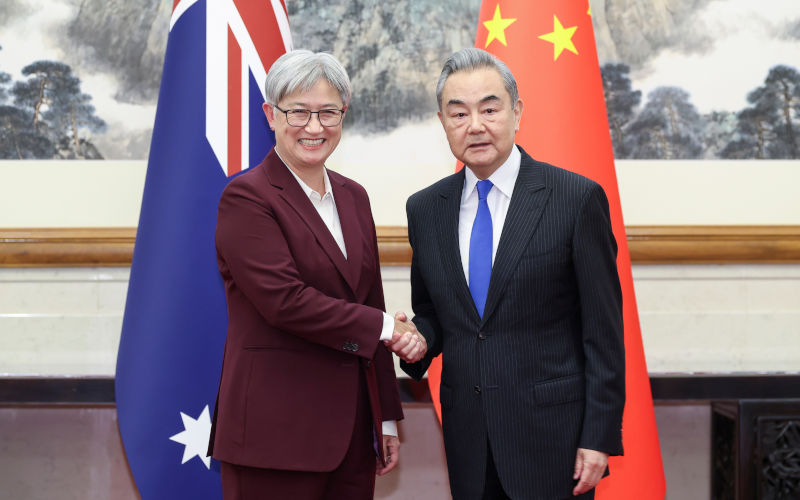
Following a meeting between Penny Wong and Chinese Foreign Minister Wang Yi in Manila on 21 July, Wang expressed the hope that Australia will work with China to safeguard the improving trajectory of their relations. She noted that China is ready to enhance exchanges with Australia, build up mutual trust, expand cooperation, and work for continued new progress in bilateral ties.
Let us hope the new measures extend to our whole region.

Jocelyn Chey is Visiting Professor at the University of Sydney and Adjunct Professor at Western Sydney University and UTS. She formerly held diplomatic posts in China and Hong Kong. She is a member of the Order of Australia (AM) and a Fellow of the Australian Institute of International Affairs.