China’s careful approach to ensuring its energy security is paying off, even as the closure of the Strait of Hormuz damages the global economy.
The entire world is being hurt by the US/Israel war on Iran, particularly by the closure of the Hormuz Strait, doubly closed, first by Iran, and then by the US. Everywhere the cost is being counted in increased fuel, fertiliser and food prices, higher inflation and interest rates, and a weaker global economy.
China, however, has prudently prepared itself for such event in numerous ways. As an increasingly voracious energy consumer, it has long known the danger from its external energy sources being cut. At the end of 2003, then-Chinese premier Hu Jintao made a closed-door speech to the Communist Party leadership in a Central Economic Work Conference that became known as the ‘Malacca Dilemma’ speech.
He warned that China’s energy security was vulnerable to ‘certain powers’ (clearly a reference to the US) controlling the Strait of Malacca, the 2.8-kilometre-wide strip of water between Malaysia and Singapore, through which China’s oil has to pass. In 2004, that threat was expanded to include the Strait of Hormuz, identified as the ‘Malacca Hormuz Axis’.
China is countering such a threat in two ways. First, it has chosen increasingly to move away from traditional energy sources. Second, when still needed, China has developed the necessary infrastructure, as part of the Belt and Road Initiative and BRICS+, to secure access to them, even when others are scheming to thwart that.
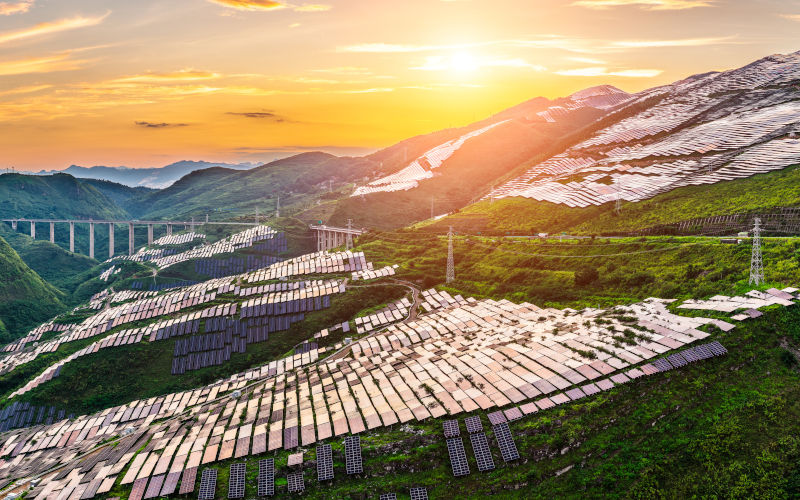
To the first of these, the Chinese Government has invested massively in renewable energy, high-speed rail and electric vehicles in order to electrify its economy and make sure the country would no longer be hostage to the closure of either of those two straits.
In terms of infrastructure, 54,000 kilometres of high-speed rail have been built in just 20 years, making the Chinese rail network twice as large as the rest of the world combined. This saves massively on air travel with its appetite for aviation gas. Meanwhile, the rapidly expanding road and highway network in China is increasingly populated by EVs. During 2025, over 50 per cent of new vehicles in China were EVs. Even long-haul trucks are increasingly electric, with 54 per cent of heavy-duty trucks registered in China in December 2025 being EVs.
China is well on its way to being the world’s first electro-state, something as momentous as the industrial revolution when the world began to use carbon-based energy. That electro-state will be charged by renewable energy, an area in which China leads the world, both in research and roll out, with it adding some two-thirds of the world’s additional renewable energy in 2025.
Not only has it prepared itself internally, China is also benefitting from the current crisis, which is acting as great stimulus for China’s clean energy sales of solar panels, wind turbines, batteries and electric vehicles, all technologies in which it dominates.
By electrifying its economy China will no longer be hostage to any closure of either of the Hormuz or Malacca Straits. As long as the sun shines and the wind blows China’s growing appetite for energy will be satisfied.
However, in its transition to an electro-state, China still needs oil, and here again it has moved prudently to shore up its supply. Presently it holds oil storage capacity sufficient for 120 days, well above the the International Energy Agency benchmark of 90 days (Australia holds around 35 to 40 days).
As for countering any future threats in accessing oil, China first constructed oil and gas pipelines, running from the coast of Myanmar in Kyaukphyu in the Bay of Bengal to Kunming in China’s Yunnan Province, were completed in January 2015. While vastly underused, supplying just four to six per cent of China’s oil imports, these pipelines still offer a partial alternative to the Malacca Strait.
China has also moved to bring key nations controlling the Hormuz and Malacca Straits into the BRICS+ grouping: Indonesia and Iran as full members, Malaysia as a partner member. As extra insurance against the Strait of Malacca being blocked, a major project in the Belt and Road Initiative, the China-Pakistan Economic Corridor, provides China direct access to the Indian Ocean from the port at Gwadar in Pakistan.
Further, through the Belt and Road Initiative, rail links have been established across Eurasia, including to Iran. With Iranian oil currently under a US maritime blockade, rail provides another, less efficient in terms of logistics and volume, method to move it. Currently China buys 1.38 million barrels of Iranian oil daily, 13 to 15 per cent of its imports.
This rail link between the dry water port of Aprin, near Tehran, to Xian has cut travel time from 30 to 40 days by sea, to just 12 to 15 days. Container trade, including oil, surged 260 per cent on the line during the first half of 2025. The US recently bombed the line, but crews now have it back in operation. Given current US reticence to resume bombing of Iran, it is likely this route will remain operational.
Clearly part of the US reasoning for going to war with Iran was to damage the Chinese economy by foiling its energy imports. Again, however, in the crucial domain of energy supply and security, by careful planning China has emerged not only unscathed, but stronger.

John Queripel is a Newcastle-based historian, theologian, social commentator and published author of four books. His latest book, ‘In Wisdom and in Passion: Comparing and Contrasting Buddha and Christ’. His examination of the Easter events, ‘On the Third Day: Re-looking at the Resurrection’ has just been re-printed. His blog may be found at www.johnqueripelblog.com.Substack / https://johnqueripel.substack.com’