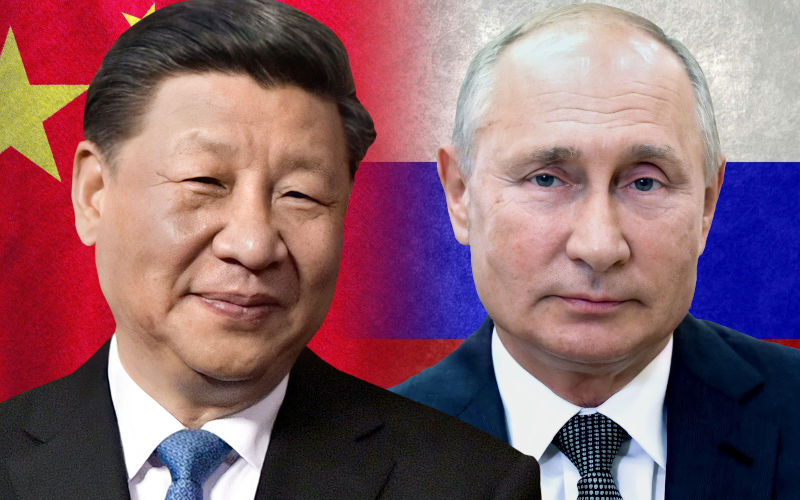
Observers in China detect the possibility of ‘trilateral coordination’ between China, Russia and the United States, with the US the biggest variable.
As energy cooperation tops the summit agenda, back-to-back state visits of Donald Trump and Vladimir Putin could pave the way for emerging ‘trilateral coordination’ between China, Russia and the United States. That is according to Cui Hongjian, a former diplomat and the head of European studies at Beijing Foreign Studies University. But Cui said the US would remain the biggest uncertainty.
During talks with visiting Russian leader Putin on Wednesday, Chinese President Xi Jinping said both countries should step up strategic coordination to counter ‘jungle law’ in the global order.
Putin’s trip came days after American leader Trump’s visit to the Chinese capital, when Beijing and Washington agreed to pursue a ‘constructive relationship of strategic stability’.
It has also drawn attention for what it may signal about the trajectory of relations among China, the US and Russia – seen as one of the most decisive dynamics shaping the fast-moving world order.
Cui said the APEC leaders’ summit in November, which will be hosted by China in Shenzhen, might be a chance for the three nations to test the possibilities of trilateral coordination:
Previously, it appeared to be a series of paired confrontations: a certain level of confrontation between China and the US, as well as between the US and Russia, while China and Russia maintained a collaborative relationship. China and Russia were drawing closer, just as Europe and the US were.
The risk of bloc confrontation – despite its persistence – is declining as the US is now adjusting relations with Europe and playing down such rhetoric. A new possibility has emerged: could the three bilateral relationships among China, the US and Russia evolve into a single trilateral relationship?
Cui said Putin also needed to know what was discussed about Russia during the Xi-Trump summit. “The stability in US–China relations is becoming evident, sending a strong signal of easing tensions. Consequently, the pressure is now on Russia,” he said.
But he said the US was “the biggest variable” in forging any trilateral coordination. How the US can avoid a quagmire from the Iran war, the US mid-term elections and whether the US can form a bipartisan consensus are all big uncertainties.
Zhao Long, a senior research fellow at the Shanghai Institutes for International Studies, argued that Beijing was not seeking to revive the Cold-war era triangular dynamic, in which one power was leveraged against the other two.
He noted that the three superpowers now shared common agendas and overlapping interests in areas including energy supply and demand stability, military application of artificial intelligence and cooperation in Arctic development.
More trilateral interactions among the heads of state are expected later this year, notably at the Group of 20 summit in Florida.
“However, this does not imply that Beijing seeks to establish a China–US–Russia strategic triangle to carve out spheres of influence or engage in great-power transactional diplomacy,” Zhao said.
During the talks on Wednesday morning, Putin played up energy deals between the two neighbours, portraying Russia as a “reliable” supplier of resources and China as a “responsible” consumer.
“Russia is counting on China to resolve its energy export challenges,” Cui said, noting that completion of the Power of Siberia 2 pipeline – which delivers gas from Russia’s west to northern China via Mongolia – could nearly double energy cooperation and partially replace lost European markets.
The worsening situation of Russia’s domestic economy and the battlefield in its war with Ukraine have increased Moscow’s need for support from China. “Leaning on a massive market like China means Beijing can provide crucial financial and economic support” if the confrontation with Ukraine and Europe continues, Cui said.
But Cui noted that Beijing may want more than just buyer–seller relations with Moscow on energy cooperation. China’s strategic priority was likely to be more about having a comprehensive partnership across the entire energy supply chain – both upstream and downstream sectors, including infrastructure.
The two sides signed dozens of documents on Wednesday afternoon, covering deals in trade and technology cooperation, energy, innovation, and cooperation in media and news as well as intellectual rights protection.
At a press conference after the signings, Xi said China and Russia should oppose all forms of unilateral bullying and attempts to reverse history, while pledging to deepen mutual trust and expand bilateral trade.
Republished from South China Morning Post

Fan Chen
Fan Chen joined the Post in 2024. She has reported in Cambodia, Nepal, and the Czech Republic. Her work appears in Reuters, Newsweek, and Southern People Weekly. She holds two journalism degrees from Columbia Journalism School and New York University.

Shi Jiangtao
A former diplomat, Shi Jiangtao has worked as a China reporter at the Post for more than a decade. He’s interested in political, social and environmental development in China.