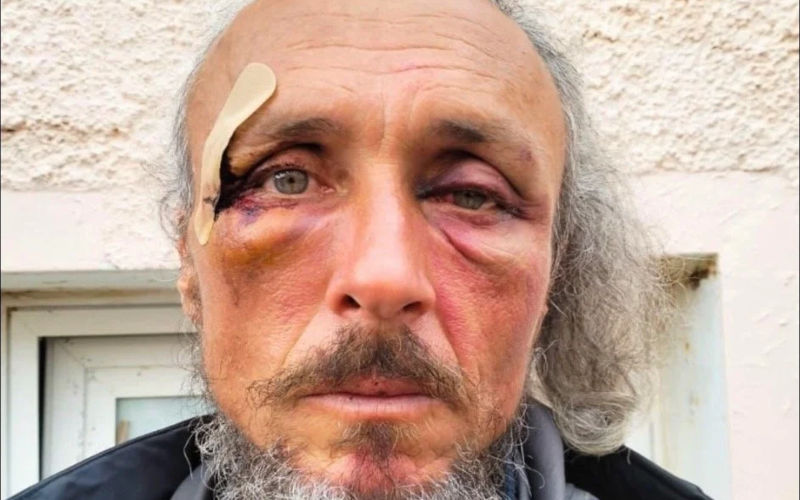
The Israeli assault on the Gaza-bound Global Sumud flotilla has sparked accusations that New Zealand’s government abandoned its own citizens and failed its most basic obligations under international law.
Whoever uses a citizen ill, indirectly offends the state, which is bound to protect this citizen; and the sovereign should avenge his wrongs, punish the aggressor, and, if possible, oblige him to make full reparation; since otherwise the citizen would not obtain the great end of the civil association, which is, safety.
Swiss jurist Emmerich Vattel expounded this principle in his landmark The Law of Nations, 1758. It is universally accepted today that every state has an obligation to protect its nationals when they are overseas. A leader who betrays this principle of citizenship is unworthy of high office. Such a man is New Zealand Prime Minister Christopher Luxon.
Late in the night of 29 April a large Israeli force made up of several warships, a prison ship, aircraft and drones attacked the Global Sumud, a fleet of over 60 humanitarian vessels drawn from dozens of nations across the globe. The Sumud flotilla, in international waters near the Greek island of Crete, was Gaza-bound, planning to open a humanitarian aid corridor to the enclave.
More than 20 vessels were boarded, many dozens of activists beaten, some later requiring hospitalisation. Once the crews were transferred to the prison ship, the vessels were sabotaged and abandoned in international waters. For the next three days the Israelis beat dozens of the Sumud crew, tortured some, terrorised others with threats of murder, guns in their faces, and performed other unlawful and sadistic acts, including denying essential medication, forcing hostages into stress positions and others to hug the Israeli flag, flooding decks to make sleep impossible. Several Kiwis were savagely kicked and punched in the head, back and ribs.
Like many Western governments, New Zealand leaders did absolutely nothing to condemn the attack, nor initiate action against Israel. They did not even offer material support to their citizen-victims once they had been dumped onto Crete without money, adequate clothing or phones.
Let’s be clear: according to international law, sovereignty does not end at the borders of a country. New Zealand suffered the most serious state terrorist attack on its own citizens since the French Government bombed and sank Greenpeace’s Rainbow Warrior in Auckland Harbour on 10 July 1985. This time the state was Israel. Both events bear uncanny resemblances – and disturbing differences – that are immensely consequential.
In 1985, when news that terrorists had infiltrated New Zealand and attached limpet mines to the hull of the Rainbow Warrior, blasting a hole below the waterline and killing photographer Fernando Pereira, the government, the media and the population of New Zealand went into a frenzy. Within days the culprits had been identified: they were agents of the French Direction Générale de la Sécurité Extérieure (DGSE), the French equivalent of the CIA. Two of the large squad of French agents, Dominique Prieur and Alain Mafart, were caught. It eventually emerged that this terror plot – which the French impudently code-named Opération Satanique – reached all the way to President François Mitterrand. The story riveted and animated New Zealand for months. The government relentlessly pursued the villains, eventually forcing the resignation of high officials, including defence minister Charles Hernu and the head of the DGSE, Pierre Lacoste. As part of the settlement, the French had to pay for a replacement vessel for Greenpeace and the two spies were sentenced to 10 years in prison, some of which were spent in New Zealand jails before they were transferred to internment on Hao Atoll.
New Zealanders were shocked when they learned Australia had helped some of the attackers to escape, and that their other closest allies, the UK and USA, uttered not a single word of condemnation to the French. This betrayal and the terror attack itself fundamentally altered New Zealand’s relationship with its Western allies and set it on a path towards an independent foreign policy, the high points of which were the Nuclear Free Zone Act 1987 and New Zealand’s expulsion from the ANZUS security pact with the US and Australia, both within two years of the attack. It was a time when many felt proud to be New Zealanders.
Fast forward 41 years and we have the most serious state terror attack on New Zealand since the Rainbow Warrior bombing. The media, to the shame of reporters I have spoken to off the record, treated it as a minor story and quickly moved on. The government told the victims of this terrorist attack they had to fend for themselves and offered not a breath of condemnation. No mainstream reporter grilled the government over this inaction.
Prime Minister Luxon’s conduct is reprehensible on so many fronts. Prioritising ‘strategic alignment’ with Israel and the US over the physical safety of New Zealanders is a betrayal of his most fundamental duty. Luxon’s failure to defend his citizens – however contemptible it may be – probably does not reach the threshold of treason under the Crimes Act 1961 definition (lawyers may disagree) but it does confirm that the man has no place as the leader of a sovereign and democratic nation.
The Prime Minister constantly refers to himself as a Chief Executive or CEO, so I appreciate politics isn’t his strong card. Political philosophy is clearly a weakness too. Permit me, Christopher, a few observations on sovereignty and democracy.
Among my first lessons as a tender-faced youth attending Political Science at Victoria University was Thomes Hobbes’s principle that the only reason individuals surrender their liberty to a sovereign is for protection. The litmus test for a sovereign democracy is not how the state treats docile citizens and its buddies but how it protects even vociferous dissenters when they are in the hands of a foreign power.
The Sumud flotilla crew are anti-racist, anti-fascist, anti-genocide; in other words, the opposite side to the Prime Minister and the New Zealand government. They still deserve protection and medals not boots in the head and abandonment. The Kiwis are free now and mindful that their ordeal was short and less than the medieval mistreatment of thousands of Palestinians in Israeli concentration camps today.
As a minimum the New Zealand government should confront the Israelis and demand two things: non-repetition and reparations. Non-repetition is a commitment that such wrongful acts won’t happen again. The government should issue a Note Verbale – a formal warning to Israel of real consequences if citizens are in any way abused.
Secondly, the government should demand full reparations (payment for medical bills, evacuation costs, trauma, damage to property, including the millions of dollars in damage to all the vessels sabotaged, and return of stolen property (including Sean Janssen’s pounamu pendant, a Māori taonga (treasure) that was ripped from his neck by an Israeli stormtrooper).
I was proud to be a New Zealander when our government stood with Greenpeace following the French state terrorist attack in 1985. I am proud today of the men and women of the Global Sumud Aotearoa Delegation, including Hahona Ormsby, Julien Blondel, Jay O’Connor, Samuel Leason, Mousa Taher, Sean Janssen and Rana Hamida. They keep alive the flame of hope that one day New Zealand will again stand for humanity, international law, peace and an independent foreign policy.
Eugene Doyle is a writer based in Wellington. He has written extensively on the Middle East, as well as peace and security issues in the Asia Pacific region. He hosts the public policy platform solidarity.co.nz.