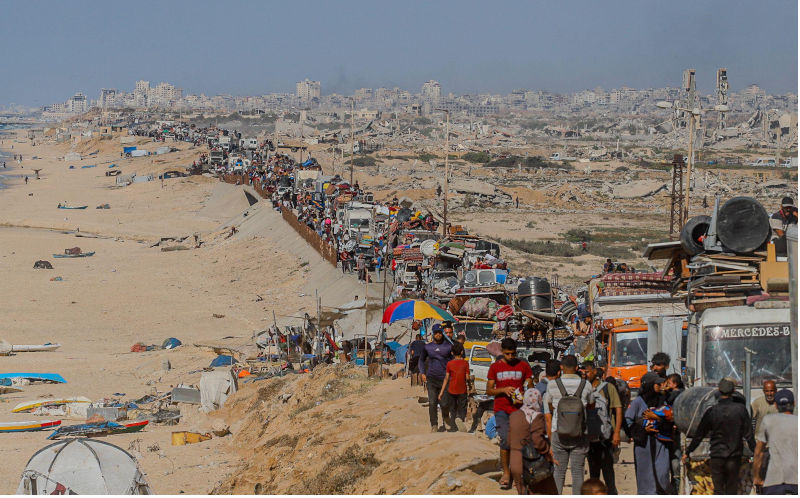
In a personal submission to the Antisemitism Royal Commission, P&I founder John Menadue argues that it is impossible to separate increasing rates of antisemitism from the way Israel has conducted its genocide in Gaza.
“Antisemitism – it’s a trick, we always use it.” So said the late Israeli parliamentarian, Shulamit Aloni. UNSW Honorary Associate Professor Peter Slezak, when drawing attention to it, added the observation of distinguished Israeli diplomat Abba Eban 50 years ago: “one of the chief tasks of any dialogue with the non-Jewish world is to prove that anti-Zionism is merely the new antisemitism.”
The trick is still being used. It has led to this Royal Commission.
George Orwell in 1984 speaks of language to control consciousness and using language as an anaesthesia to numb moral perceptions. We see that in the use of the term ‘antisemitism’ to describe criticism of genocide in Gaza. It takes a term with a precise morally serious meaning and misuses it. When language is debased, Orwell wrote, truth is obscured, not incidentally, not as a side effect, but for a purpose.
As with terms like ‘terrorism’ or ‘genocide’. the abuse of the term ‘antisemitism’ does not merely distort the language. It distorts the reality the language is supposed to describe.
For centuries the Christian church led anti-Jewish prejudice. That prejudice is still latent. Because of that, misuse of the term ‘antisemitic’ stores up danger for the future. It disarms the concept at precisely the moment when precision is most needed.
Emeritus Professor Robert Manne, writing under the headline Don’t mention the war, put it plainly:
the sharp rise in antisemitic acts since October 7 – insults, tweets, graffiti, doxing, arson – did not occur for no reason. They are self-evidently connected; in ways we must try to understand…to the character of Israel’s war in Gaza…
Professor Henry Reynolds, writing in Pearls and Irritations in January 2026, noted that surveys found 76 per cent of Australian Jews considered themselves Zionists and 86 per cent felt responsibility for Israel’s continued existence. He said:
This helps us understand why there is so much determination to relate the growth of criticism of Israel to antisemitism rather than to the utter barbarity of the IDF in Gaza and the continuing pillage of the settlers in the West Bank…
It would greatly facilitate social cohesion if the leaders of the mainstream Zionist organisations could trace the true source of discomforting, community criticism back to Israel rather than to the broader Australian community.
The upsurge in antisemitism, and the conduct of Israel’s military campaign in Gaza, have occurred simultaneously and are plainly connected. The refusal of pro-Israel lobby organisations in Australia to acknowledge it is dishonest. (See my earlier article, The weaponising of antisemitism is to hide the genocide in Pearls and Irritations.)
The very important context includes not only Gaza, but also US violence and Israeli occupation of Palestinian lands. Five million people in Muslim-majority countries in the Middle East have been killed in US-led wars since 2001, with a further 38 million displaced. Israel and Australia have supported all these wars.
In 1948, Palestinians owned 94 per cent of all land in Palestine. Then came the Nakba and the beginning of ethnic cleansing. Then regular Israeli ‘mowing the lawn’. Then Gaza and the West Bank. Now Palestinians own only 18 per cent. Why wouldn’t Palestinians in Australia be angry!
The Security Council, UN agencies and the ICJ have determined that Israel is breaching numerous international laws. Human rights experts have highlighted Israel’s crimes against humanity – murder, torture, sexual violence – and war crimes with starvation as a weapon targeting civilians. Despite all this the Zionist lobby in Australia has said little or nothing about this genocide.
No one should be deterred in calling out Israel’s behaviour for fear of being called antisemitic.
The pro-Israel lobby in Australia is “formidable, well-funded, and effective”. These are the words of John Lyons, a senior ABC journalist writing in Pearls and Irritations in 2021. Another senior journalist Peter Greste said that “the pressure the Israeli lobby places on Australian journalists is frankly outrageous”.
Former NSW Premier and Foreign Minister Bob Carr described his experience in Pearls and Irritations in October 2021:
My experience as Premier and Foreign Minister confirms that the lobbying exceeded that marshalled by any other diaspora community. As Foreign Minister, on my first visit to the UN, I released a very routine statement noting the latest burst of Israeli settlement activity was not helpful to the peace process. From Australia arrived a request that I make myself available for a telephone conference with community leaders who would patiently explain to me that Australia was not entitled to criticise settlements – even though they represent a clear breach of international law.
Professor Ilan Pappe, a world-renowned Israeli-Jewish historian, writing in the Palestine Chronicle in April 2025, described the failure of Western political and media institutions to engage honestly with the context of Gaza as:
intentional and not out of ignorance. Both Israel’s actions and the discourse that accompanies them are too visible to be ignored unless politicians, academics and journalists choose to do so. This kind of ignorance is first and foremost the result of successful Israeli lobbying that thrived on the fertile ground of European guilt, racism and Islamophobia.
The lobby organised support for this Royal Commission following the Bondi tragedy. The government was initially opposed but gave way to the pressure of the Zionist lobby. When the government appointed former High Court Justice Virginia Bell to lead the commission, lobby members declared the appointment ‘unthinkable’ because it did not enjoy the community’s backing. Former treasurer Josh Frydenberg said so explicitly.
The lobby invited Israeli President Isaac Herzog to visit Australia before the Australian government had considered the matter – and the government duly issued a formal invitation. The tail wagging the dog!
The question is not whether Zionist organisations have the right to advocate – they do, as does every community in a democracy. The question is whether the cumulative effect of that advocacy, combined with the structural weaponisation of accusations of antisemitism, has produced a profound asymmetry in public debate: one in which Palestinian voices are structurally underrepresented, legitimate criticism is systematically mischaracterised, and the regulatory response to pro-Palestinian demonstrations is disproportionate to anything applied to comparable causes.
We need a public inquiry into the lobby’s activities more than we need one on antisemitism.
Zionist interests have campaigned relentlessly for a definition of antisemitism that suits their view and shuts down criticism of their settler/colonial project in Palestine. Sara Dowse, in Pearls and Irritations, commented as follows on the definition:
The 2016 International Holocaust Remembrance Alliance’s Working Definition of Antisemitism is a non-binding document including eleven examples of antisemitism, seven relating to Israel. Two of those are contentious, for stifling criticism of Israel and limiting free speech. Yet despite its principal drafter’s objections, Israel and its supporters have campaigned for the definition to be adopted. The Morrison government did so, followed by some universities and other entities here, while Holocaust scholars, highlighting its flaws, have proposed either of two alternatives. The Jerusalem Declaration and the Nexus Doctrine are both more specific than IHRA’s definition and allow critiques of Israel. Yet the campaign persists.
The purpose of the International Holocaust Remembrance Alliance working definition of antisemitism is to stifle legitimate criticism of Israel.
When it suits, the lobby embraces Israel, celebrating Israeli Independence Day in Jewish schools, linking Holocaust memory to Israeli statehood. This close identification with Israel is actively cultivated. Israeli flags were prominently displayed at the Bondi memorial service. Many Jewish people feel support for Israel is part of their Jewish identity. That presents a problem.
When it does not suit – when Israel’s genocide invites world-wide condemnation – those who criticise Israel are accused of hating Jews and being antisemitic. This inconsistency is not accidental. It is, as Shulamit Aloni said, a trick.
The UN has made it very clear that the brutality of genocide is being inflicted on the Palestinian people. On 16 September 2025, the UN reported:
Israel has committed genocide against Palestinians in the Gaza Strip, the UN Independent International Commission of Inquiry on the Occupied Palestinian Territory, including East Jerusalem, and Israel said in a new report today. The Commission urges Israel and all States to fulfil their legal obligations under international law to end the genocide and punish those responsible for it.
For more than two years, hundreds of peaceful protests have taken place across Australia against Israel’s genocide in Gaza. I have attended several protests in Canberra. I did not hear any antisemitism. Speakers consistently went out of their way to distinguish criticism of the Israeli government from any animus towards Jewish people. Jewish Australians have also been very prominent among those attending the protests. A senior leader of the Israel lobby called these Jews “vicious antisemites”.
If I criticise Israel over its genocide in Gaza, that does not make me antisemitic. If I criticise India, that does not make me anti-Hindu. If I criticise Indonesia, that does not make me anti-Muslim. The principle is not complicated. Discrimination is covered by existing legislation, the Racial Discrimination Act 1975.
We are told to heed the hurt feelings of Zionists, some on university campuses, who support genocide or have wilfully chosen to ignore it. They should be protected. But they should also feel shame. When will perpetual victimhood end? When the Gaza genocide has run its tragic course, how will Zionists explain to themselves as well as their children the moral position they took on Israel’s murderous behaviour?
‘Social cohesion’ has been diluted of clear meaning through self-serving application by numerous commentators including the Prime Minister. It should not be used to stigmatise persons or communities that have a legitimate grievance.
After the Bondi massacre, the Prime Minister urged Australians to “lower the temperature” in the interests of social cohesion. That urging was directed at those Australians who had expressed serious concerns about the Gaza genocide. It was not directed at the Israeli lobby whose campaign was to suppress pro-Palestinian voices. It was not directed at media organisations that had systematically and wilfully misrepresented the scale of Palestinian casualties. Or at persons like Josh Freudenberg who described the pro-Palestinian demonstrations as “incubators of hate”. That was more inflammatory and destructive of social cohesion than anything said during the protests in support of Palestine.
The PM’s appeal was selective. He asked Palestinian Australians and their supporters to be quiet. It asked nothing of those whose conduct was generating the conditions that made many Australians feel unheard.
Australian multiculturalism and social cohesion attempt to manage the consequences of diversity. It acknowledges the right of all Australians to cultural identity; the right within limits to express their cultural heritage in such areas as religion and language; the right to social justice, and equality of treatment and opportunity, regardless of race, language, religion and gender; and the need to maintain and develop the diverse skills and talents of all Australians.
Australian multiculturalism also importantly insists that, with the rights of newcomers, go certain obligations. There must be an overriding and unifying commitment to Australia and its future. There must be acceptance of the basic principles and structures of Australian society – the Constitution, rule of law, parliamentary democracy, freedom of speech and religion, English as the national language and tolerance and equality. A superstructure of diversity can only be securely built on a common and secure substructure. Diversity for its own sake is not sufficient. The test is what it contributes to the common good.
The Australian multicultural framework articulated in the Galbally Report of 1978 proposed a commitment to cultural maintenance alongside social participation. It acknowledged that migrants brought cultural identity, which had value that should not merely be dissolved into a homogeneous Australian identity. It also recognised that social cohesion in a diverse society requires not just tolerance of difference but engagement with the structural barriers that prevent full participation by minority communities.
I don’t think the government understands that.
Scanlon Foundation Research on social cohesion in 2025 found negative attitudes among Australians as follows: 4 per cent toward Buddhists, 14 per cent toward Hindus, 15 per cent toward Jews, 18 per cent toward Christians, and 35 per cent toward Muslims. Sixty-seven per cent of all Australians said racism was a problem. Those figures suggest that Islamophobia is a significantly larger problem in Australia than antisemitism — yet receives a fraction of the political and media attention.
Australia’s multicultural project to promote social cohesion has delivered great social and economic benefits, but it is always a work-in-progress and needs regular attention. (See my earlier article, Australia’s multicultural success cannot be taken for granted.)
Australian governments from Howard to Albanese have marginalised multiculturalism and social cohesion. The failures are in plain sight. Consider the problems!
Attacks on Muslim and Arab lands: We have brought foreign conflicts to Australia by abetting US-led or US-supported wars in Muslim countries from Iraq to Palestine and Iran. The death toll has been horrific. By failing to call out genocide in Gaza, large sections of our population are also frustrated and angry. And rightly so.
Administrative arrangement : The multiculturalism and social cohesion function within the large Home Affairs Department, should be moved to a seperate department . We have a Cabinet Minister for Multicultural Affairs, Dr Anne Aly. She is in the Cabinet but junior to the Home Affairs Minister, Tony Burke, who seems to care more about border protection than social cohesion. Historically, immigration/multiculturalism/citizenship/ethnic affairs have been in a separate department. That allowed a much more considered focus on social cohesion. I was Secretary of Immigration and Ethnic Affairs from 1980 to 1983.
Australia’s response to the Gaza genocide is in stark contrast to our earlier humanitarian responses in Kosovo, Afghanistan and Ukraine.Why wouldn’t Australians with family in Gaza be upset that we couldn’t show the same empathy as before?
The hostility to Palestinians in Gaza was led by Peter Dutton, who said that Australia should deny all Palestinians entry into Australia. The Albanese government continued that hard line. Earlier, with the immigration function in a separate department, the government was able to implement humanitarian programs despite the difficulties of access and processing. The earlier department had a can-do approach.
Multicultural report ignored: Almost two years ago, the government received an Independent Review of the multicultural/social cohesion framework. That review proposed a nation-building cabinet-level department of Multicultural Affairs, Immigration and Citizenship. The report also recommended improved ways to protect peoples’ languages; a citizenship process that is less about learning cricket scores; diversifying our media sector so it more effectively reflects and involves our minority communities; and ensuring that the arts and sports sectors are spaces for intercultural collaboration and cooperation. But two years later, very little has been done.
No Human Rights Act: Social cohesion is best served by legislation that establishes the rights of all Australians rather than by a public debate narrowed, as it has been, to a single form of discrimination – antisemitism. A national Human Rights Act that applies universally would serve all communities more effectively. Two years ago, a Parliamentary Select Committee recommended that Australia legislate for a national Human Rights Act. Once again, the Albanese government has been sitting on that report ever since.
Partial treatment of Jewish and Muslim communities: The Segal report on antisemitism, which was released in July 2025, was adopted on the day of its release. The Malik report on Islamophobia is being “carefully considered” by the government, but we haven’t heard anything since. Once again, the well-organised Zionist lobby gets immediate attention but not the Muslim community.
Legacy media: The Australian Human Rights Commissioner President, Hugh de Kretser, points out that on social cohesion “our media drives polarisation and feeds a harsher political cycle. Social media algorithms monetise division and outrage.”
About 300 Palestinian journalists have been assassinated in Gaza by the IDF, but our legacy media and our government show no concern. The National Press Club withdrew an invitation to world-renowned journalist Chris Hedges to speak about Western media coverage of the conflict and the assassination of journalists in Gaza. Yet the Israeli Ambassador is a regular speaker at the NPC.
Our legacy media also compounds the problem when the unacceptable behaviour by a few Muslims is used to tarnish the reputation of all Muslims. The portrayal of Palestinians in the media as sympathisers with Hamas is misleading, discriminatory and inflammatory.
A weak citizenship framework: Citizenship is the glue that binds us together. The citizenship framework needs strengthening in many ways. We should significantly increase ESL support, particularly for older migrants and humanitarian entrants; a citizenship pledge that has commitments both for migrants and older Australians-a two-way commitment.
Too often multiculturalism and social cohesion assumes that new migrants and new communities must adopt the values and attitudes of the host community. In a successful multicultural society, we learn and benefit from new communities. They have their own contributions to make. The process is dynamic. The Australia of today is not like the Australia of yesterday.
There are problems of dual citizens and dual loyalties. The Assistant Minister for Citizenship, Customs and Multicultural Affairs recently suggested that children attending faith-based schools should mix with children outside their faith. A third of our students attend faith-based schools. This is a problem, for example, with some Jewish schools that highlight loyalty to Israel as much as or even more important than loyalty to Australia. Over 600 Australians are fighting with the IDF.
No Voice: The most severe cohesion deficit is the relationship between Indigenous and non-Indigenous Australians, produced by centuries up dispossession, violence and exclusion. We need improved civic education including Indigenous history and the Statement from the Heart. With the defeat of the Voice, the government has retreated on this most critical social cohesion issue.
De Kretser pointed out that the antisemitic terror attack at Bondi, the Australia Day attack on Aboriginal protests and the alleged foiled terror plot to attack mosques, police and the parliament in Western Australia highlight acute risks. He added that at the last election we saw hostile comments from the Coalition about Indian and Chinese Australians. Social cohesion requires honest engagement with Indigenous dispossession, with Islamophobia, with antisemitism and with the imbalance of influence of different communities.
Loss of trust in our key intuitions, inadequate housing, social inequality, low wages and part-time casual employment associated with major economic and social change have heightened concern about change in general. This concern has focused on foreigners. In times of uncertainty and change, the focus on outsiders or newcomers is an unfortunate feature of the human condition.
Multiculturalism and social cohesion are always a work-in-progress. The Government gives us a lot of rhetoric about social cohesion but shows little understanding of the issue.
(This is an edited version of the submission to the Commission.)

John Menadue is the Founder of Pearls and Irritations and a board member. He was formerly the Editor-in-Chief. John was the Secretary of the Department of Prime Minister and Cabinet under Gough Whitlam and Malcolm Fraser, Ambassador to Japan, Secretary of the Department of Immigration and CEO of Qantas.