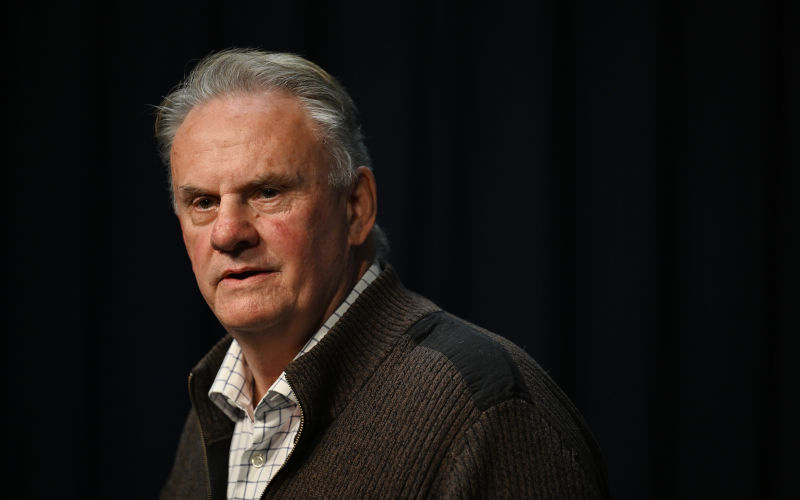
Mark Latham’s bid for an independent inquiry into NSW Director of Public Prosecutions Sally Dowling was defeated 19–14. But the allegations aired in Parliament – and Labor MLC Stephen Lawrence’s criticism of her conduct – have not gone away.
Independent NSW MLC Mark Latham has upped the ante in the furore over the state’s director of public prosecutions, Sally Dowling, SC, narrowly missing a majority for his explosive motion this week that slammed not only Dowling, but also Attorney-General Michael Daley and Senior Crown Prosecutor Brett Hatfield, SC.
Latham’s motion called on the Minns government to establish an independent statutory inquiry into the various allegations and “other improprieties” of Dowling, as found recently, 4–3, by a Legislative Council committee.
No doubt, the Latham attack will be discounted by many who have branded the former federal Labor leader and former NSW One Nation leader a firebrand who makes controversy for its own sake.
But his notice of motion, which took him 12 minutes to get through in the Legislative Council on 22 September (with two brief attempted interruptions from Government Leader Penny Sharpe), was not just high on invective; it ran deep on detail.
Latham said the inquiry was needed to explore Dowling’s “sustained pattern of lying under oath to the Legislative Council and the damage she is causing to the integrity, honesty and reputation of the DPP and the NSW criminal-justice system”.
He then listed a handful of “lies under oath”, including having “falsely denied” to the committee the authorising of the pitching of a story to the media aimed at discrediting a judge.
He quoted the committee, which had found false her claim that “she only discovered in December 2025 the story had been pitched by [her] office … despite having sat in the meeting where pitching the story to 2GB was decided upon”.
Latham told Parliament: “Ms Dowling told [the committee] on 31 August 2026 that she believed no leak had taken place: that the deliberate passing of information to damage her bitter enemy [District Court Judge Penelope Wass] to a media outlet [2GB] previously unaware of this information did not constitute ‘a leak’,” Latham said. “Obviously this position, presented under oath, is a combination of delusion and dishonesty.”
He accused the DPP of having changed her position several times at the committee inquiry and was perhaps most devastating about the suggestion that Dowling had not been paying attention at the relevant meeting, and that there had been several other agenda items.
He said that the Government Information (Public Access) Act documents obtained by Labor MLC Stephen Lawrence put the lie to that notion. Lawrence, a former barrister, split with his Labor colleagues, facilitating the 4–3 committee vote against Dowling.
However, with the threat of expulsion from the Labor Party hanging over him, Lawrence did not vote for the Latham motion. The Legislative Council vote was 19-14 against. Lawrence’s vote would have made it 18-15, meaning only two other MLCs would have been needed for Latham to succeed.
The DPP office meeting at the centre of the furore had been convened only an hour and a half after a media inquiry had been received and with the sole purpose of dealing with that inquiry.
Latham continued: “It is inconceivable for a single-purpose meeting dealing with her acrimonious struggle with Judge Wass, that Sally Dowling would have zoned out, vaguely listened to a conversation between [colleagues] about the leak against Wass and simply typed out some things on her phone.
“No normal, reasonably intelligent person would believe that story. And no-one in this Parliament should.”
Latham claimed also that Dowling had a “sustained pattern of withholding important evidence from the Legislative Council”, had sought to frustrate the committee, including by “not directing all staff to cooperate fully with the parliamentary inquiry, leading directly to a situation where her staff had to choose whether to incriminate their boss or go on sick leave and not meet their obligations to the Parliament”.
While Latham was deploying the machine-gun, Lawrence was looking to pick off Dowling in this one particular area: her duty to maintain a psychologically safe workplace.
Lawrence spoke on the adjournment debate on the night of 23 September.
“Three people were in a meeting with DPP Sally Dowling on 24 October 2024 and by early 2026 two of them were on mental-health leave …” he said. “The media officer who planted the story after the meeting [Sally Killoran] gave evidence she believed Sally Dowling authorised it.
“This created a strange situation: staff believe boss authorised leak, boss claims the possibility they did it never occurred to her.
“For 15 months we are asked to believe these conflicting beliefs are simultaneously held by people working together.
“While a public controversy raged over who had planted the story.
“An absurdity.”
Lawrence noted that Killoran was a junior public servant, and the only one well enough and brave enough to come forward and give evidence to his committee about the meeting.
“She is due to give evidence on 17 December 2025, preparing to attend knowing this fact of authorisation has never been admitted, nor has the meeting on 24 October 2024, not even when Sally Dowling attended the committee and gave evidence,” Lawrence told Parliament. “She attends knowing she has to decide if she exposes her boss and tells her truth, that there was a meeting, that we planned it and she authorised it.
“What an unbearable load to place on a junior public servant. What a disgusting and irresponsible thing to do to a person you owe a duty to ….
“Dowling was hoping the committee wouldn’t get Killoran and the truth of the meeting would never be exposed.
“I thank Sally Killoran for fronting the committee. I commend her.
“She has shown more bravery and integrity than many people who posture as leaders who are complicit in this matter.”
In his broadside, Latham took aim at some of those other leaders, saying Hatfield had “unethically circulated an email giving Crown Prosecutors 40 minutes to opt out of a sycophantic public letter of support of Sally Dowling on the day of the release of the [committee] report and then falsely communicated to the media that the statement had the support of all the Crown Prosecutors”.
He criticised also “the actions of interstate Directors of Public Prosecutions who wrote a letter of support for Ms Dowling to Michael Daley just prior to the … report being released, which Daley provided to the media without their consent”.
Daley received special attention, the Latham motion calling for the upper house to condemn “the actions of the Attorney-General … in covering up for Sally Dowling …
“Daley worked overtime to get the [committee] numbers and protect Sally Dowling. The Honourable Greg Donnelly was subbed off … for the Honourable Bob Nanva, who voted down the line and signed a dissenting report defending Ms Dowling, even though the Honourable Member hadn’t heard any of the evidence.”
You can see how supporting such direct criticism of his party’s first law officer was a step too far for Lawrence.
No doubt, many will seize on the growing general view of Latham as a multi-party deserter and general parliamentary ratbag and lash out at any reporting of his motion as being a dreadful beat-up, full of attacks on fine public figures, all made under parliamentary privilege. That’s become par for the course with Latham, and, in various other instances, it might well be thoroughly deserved.
But have a read of the motion itself and see if you really think the DPP, the attorney and the silks are all absolutely squeaky clean on this one, which is what we should be able to expect of our “ministers of justice”.

Andrew Fraser began his journalistic career in 1979 and has been practising criminal law since 2008.