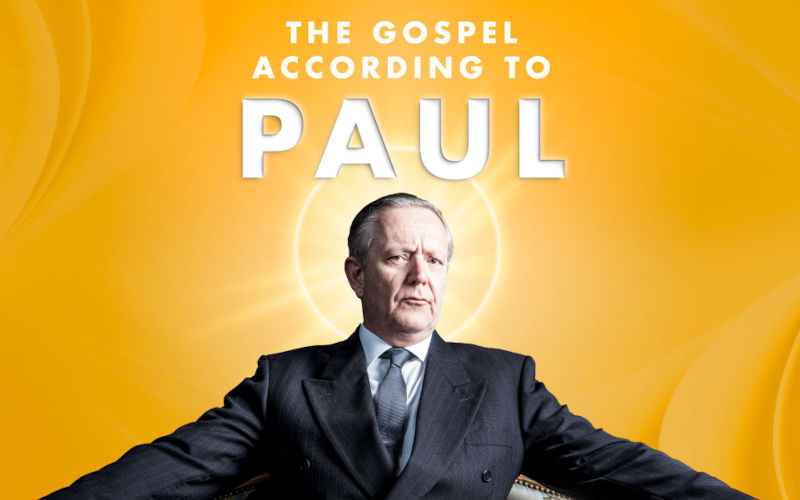
Jonathan Biggins brings Paul Keating’s famous wit to the stage in The Gospel According To Paul, but beneath the laughs lies a moving portrait of family, sacrifice and loss – and the personal cost of a life in politics.
In the first half of 1986, I worked for a right-wing federal Labor MP in Sydney. In that office, I was quickly apprised of the uncompromising work done by Paul Keating, the boy who left school at 14, to learn where all “the levers” were at Treasury.
He had virtually run himself into the ground throughout 1983, and the policy transformation he led over the next decade and a bit is history.
In the second half of 1986, I worked in the office of a junior minister, where Question Time was always a treat. First, we got all our own minister’s files in order and dropped off any ‘Potential Parliamentary Question’ to the eager backbencher chosen to serve our boss this week’s free kick at the despatch box.
Then we’d settle back in the office and “monitor” Question Time, in which Keating, now in the second term of the Hawke government, was supreme, toying with the constantly sparring Andrew Peacock and John Howard.
Keating was magnificent again this week (15–20 September) – at least as brought to us by Jonathan Biggins at the Canberra Theatre in The Gospel According To Paul, that is.
The great lines flew thick and fast, and the punters lapped it up, but it was the serious stuff that was most moving, in my view.
Unexpected by many perhaps, but Biggins wove a visceral narrative of sacrifice and loss through an otherwise wickedly funny routine.
It was a faithful personal ‘PJK’ history lesson sure enough: you could just about have followed the text of Kerry O’Brien’s Keating: The Interviews as Biggins took us through the life and times.
There was Jack Lang (“Mr Keating, you don’t have a second to lose”), Rex Connor (whose minerals and energy plan could have made us “as rich as Norway”) and Gough Whitlam, on Lang and Connor (“Paul has always preferred older men”).
There was the new backbencher seeking out Sir John Bunting at Prime Minister and Cabinet to learn where the power lay, and then, within one parliamentary term and still in his 20s, missing the first Whitlam ministry by just a single vote.
All was told lovingly and with enough gags to keep us all in stitches.
There was the mandatory piss-take of Bob Hawke, but also some fair dinkum acknowledgement of the success of the Hawke-Keating partnership, which stayed intact longer than many had been led to believe.
There was pride in the hard yards, the ones slogged out without a vote to be earned, on native title, claimed as Keating’s proudest achievement, and on APEC. How could they deride his Asia focus when there was “no-one more European than me”, proclaimed Biggins, waving an arm across his set of the Keating office with its Mahler records, vintage clocks and a portrait of Napoleon?
It was the loss and sacrifice that was the real heart of this show.
Silence fell when “Keating” spoke of Kokoda (he kissed the ground not for the cameras but for his Uncle Bill), or of the sudden death of his father at 60, and especially what he lost in family through carrying the heaviest load of any politician for the longest time.
Keating had a growing family while treasurer but endured the utter grind of the Expenditure Review Committee, keeping him at Parliament House for unreasonable 10-week hauls every year, as well as all the rest of parliamentary and ministerial life.
I felt this part acutely, having thoughtlessly added to those pressures back in 1989 with a misconceived and poorly executed front-page ‘splash’ when I returned to journalism. It was only in recent years that I finally wrote to Keating, apologising for having invaded his family’s privacy and, indeed, having potentially put them at risk.
Keating’s newspaper clippings, in which I would surely have featured dishonourably, were legendary, and got a solid workout from Biggins, all with a flourish that left us pinching ourselves to remember that this was a theatre show and not an actual audience with the former prime minister.
There was music, as you’d expect from a performer long a mainstay of The Wharf Revue, Biggins belting out a number of songs.
But it was a secondary resort to music that was far more powerful for my money, with the simple playing of various records.
There was, of course, Mahler, with “Keating” painfully deep in thought about loss.
There was Tom Jones, with the bouncing “Placido Domingo” of Australian politics explaining to us how this was a great operatic tenor, praising the range and the phrasing of the great vocalist.
And there were The Ramrods, the 1960s band which Keating managed, signed to the Beatles label and was ready to take to the States. But then his players wavered on him in a real sliding-door moment.
Rock-and-roll management’s loss was Australia’s gain, not only with superannuation for all, a proper social wage with fewer industrial disputes, and an unshackled dollar and banking system, but with a more open outlook, a chance to truly widen our horizons.
The Biggins journey through the Keating life was, as you’d expect, full of famous quips, with some extras that we might brand as ‘in the style of’ the master.
As the crowd left the theatre, everyone, it seemed, was trying to remember their favourites, including some specials for those who had turned up in Parliament after PJK departed.
Like Malcolm Turnbull, “the only bloke who could make a real leather jacket look like vinyl”.
Kevin Rudd: “Tintin meets The Rainman.”
And Peter Dutton, who couldn’t get anyone to follow him even if he had been given Ian Thorpe’s body and was in a mankini out the front of Mardi Gras.
But the killer for me was the epithet for the late Bill Ludwig, that dinosaur of the Queensland and Australian union movement and general thorn in Keating’s side.
No, I can’t.
Not in a family publication like this.
You’ll just have to go to the show.

Andrew Fraser began his journalistic career in 1979 and has been practising criminal law since 2008.