Claims that forests stop growing after 25 years are contradicted by field evidence showing old forests continue storing carbon, while dead trees and burned forests retain vital ecological value.
There has been a lot of discussion about forests in the past few months. Much of the attention has focused on a forest carbon method and associated carbon crediting system aimed at protecting forests and forest biodiversity. Like many debates, there have been some good arguments. But there has also been some extraordinary disinformation. Some of this has come from the native forest logging industry, but perhaps surprisingly, some has come from environment groups that most people might think would want forests protected.
One of the greatest furphies of all has been that forests stop growing by the time they reach 25 years old, and the trees die and the carbon is returned to the atmosphere. I can understand these absurd claims being made by lobby groups for the native forest logging industry. This is because it is sobering to understand the very large amounts of carbon that are actually stored in a forest when it is not logged and allowed to become old growth. The reasons why some environment groups would make a similar claim about forests ceasing to grow at 25 years are somewhat mystifying. But perhaps it is best to examine some of the evidence.
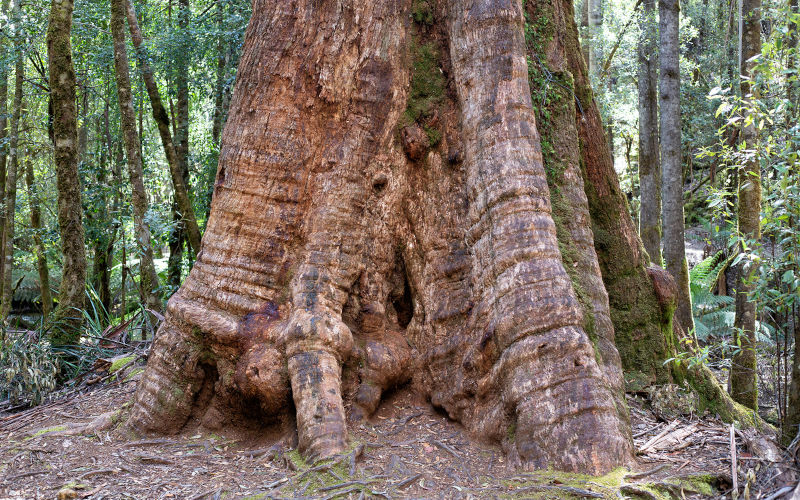
First, all field measurements to date show quite clearly that forests do not stop growing after 25 years. Rather, the most carbon-dense forests are intact old-growth forests. For example, old-growth mountain ash forests can store up to 1,850 tonnes of above-ground biomass, or more than twice the amount typically measured in younger stands like those with a logging history.
Importantly, even very old trees continue growing well after they are a few hundred years old, and at the same time continue to store more and more carbon as they age. As an example, my research team and I have been measuring giant living mountain ash trees, 35 years since they were first mapped and measured. Some trees have grown, on average, at least two centimetres every year since 1991.
Second, it is true that many younger trees die as a stand of trees matures. This is natural – it is called self-thinning and it occurs in all forests globally. It occurs because it is impossible for every single seedling to survive in a forest as it ages – there simply isn’t enough space or nutrients to support all of them.
Older forests are typically comprised of fewer, larger old trees than regrowth forest, which is characterised by a larger number of smaller trees – the successful competitors are the ones that survive. Large old trees are also the ones that store by far the most carbon in a forest – a highly disproportionate share.
But the dead trees continue to have an important role in the ecology of a forest. As they break up, they return nutrients to the soil – a crucial part of forest nutrient cycling. This is why the soils in many kinds of old-growth forest have much higher levels of carbon than, for example, soils in forests that have had a history of logging.
Beyond their roles in nutrient cycling, dead trees have many other fundamentally important roles in forest ecology. For instance, they are habitat for innumerable species. They provide hollows and runways for many animals. They are also colonised by many mosses, lichens and fungi that live nowhere else except on dead trees. There is even a special name for these kinds of organisms – saproxylic species – and their important role in nutrient cycling is increasingly being recognised.
Third, perhaps some people arrive at the 25-year timeframe because of wildfire frequency – on the assumption that frequent wildfires mean no tree lives more than 25 years past the last one. But this, too, is wrong and does not fit what the science shows. In many types of forest, overstorey eucalypts are not killed. Rather, they resprout and continue growing. Even in those forests like those dominated by mountain ash and alpine ash trees, where most of the overstorey trees are killed, most of the carbon is not lost. We know this because we have measured carbon stocks on a large number of sites before and after wildfires, such as those in 2009 in Victoria. That work shows that, on average, six per cent of carbon is lost in a moderate-severity wildfire, and 14 per cent in a high-severity wildfire. That is, at least 86 per cent of the carbon remains in a forest after a wildfire, even if that forest is burnt at very high severity.
The patently absurd claim that forests stop growing at 25 years old is not a scientific dispute – it’s blatant disinformation. The science clearly shows that intact forests that are unlogged support the greatest amounts of carbon. Dead trees in those forests contribute to soil fertility and nutrient cycling, as well as providing habitat. And even if forests are subject to a high-severity wildfire, most of the carbon remains.
Lobbyists for the native forest logging industry and, bizarrely, the lobbyists for some environment groups have added to the epidemic of disinformation on forests. They need to stop this and recognise what is most important – that is, properly protecting native forests. This is crucial to boost carbon stocks and to conserve forest biodiversity.
David Lindenmayer
Professor David Lindenmayer is a distinguished Australian scientist and academic, specialising in landscape ecology, conservation, and biodiversity. His research focuses on integrating nature conservation with agricultural production, improving biodiversity conservation in forestry and plantations, and enhancing fire management practices. With over 1000 peer-reviewed papers and 50 books, David is one of the most published ecologists globally. He leads large-scale, long-term research programs in south-eastern Australia. A Fellow of the Australian Academy of Science, he has received numerous prestigious awards, including the ESA Whittaker Award, multiple Eureka Prizes, and the Australian Natural History Medal.