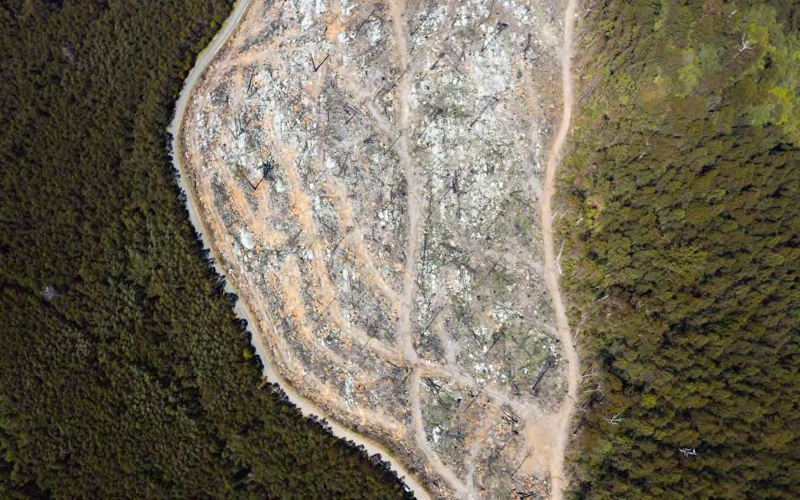
The forest industry claims 80,000 jobs are threatened by a proposed new forest carbon method. But employment data from three states tell a very different story, according to David Lindenmayer
There has been a lot of discussion about forestry in Australia over the past few months. Much of it is related to a proposed new forest carbon method which is an approach to reduce the substantial emissions that come from logging our native forests. Lobbyists from the forest industry are worried about the significant step down in the amount of native forest logging that would come from the forest carbon method. They have claimed that the implementation of the method will result in the loss of 80,000 jobs. The number 80,000 has recently been re-ventilated by members of parliament in Canberra. But is this true? Will there be tens of thousands of people thrown out of work by a new forest carbon method?
I have worked in the native forest logging sector for more than 43 years, and the issue of employment numbers has been discussed routinely for more than two decades. The actual number of direct jobs is a long way short of the claimed 80,000. Let’s examine some of the evidence.
In the southern region of New South Wales – from Sydney to Eden – a detailed economic analysis by Frontier Economics published in 2021 shows that native forest logging had 110–120 cutting and log haulage jobs and 180–200 processing jobs. Frontier Economics has since confirmed a statewide public native forest logging employment estimate of approximately 1,070 direct jobs across NSW as a whole. Either way, employment levels are a small fraction of the number of people employed in the plantation sector in the same region and also across all of New South Wales.
Victoria no longer officially has a native forest logging industry, although it still cuts large amounts of native forest as part of *de facto* logging operations such as carving out thousands of kilometres of so-called firebreaks in national parks and state forests. It even has a financial framework for selling that timber – although it is supposedly no longer supporting a native forest logging industry. But before the purported closure of the native forest logging industry in Victoria, the total number of people directly employed in the industry in 2012 was 1,100. Move forward another five years to 2017, and a report by the now defunct state government logging business VicForests to the certification body, the Forest Stewardship Council, had the employment number at around 500 (including roughly 100 VicForests government employees).
The numbers employed in Tasmania tell a similar story – and the trajectory is more revealing than any single figure. A 2018 report commissioned by a forestry industry body estimated 1,112 jobs in native forestry activities in Tasmania, including growing, harvest, haulage and primary processing. That figure was itself down from 4,120 in 2006 – a collapse of more than 70 per cent in 12 years. By the 2021 census, just 885 people were employed across all forestry in Tasmania – both native forest logging and plantations combined. The number directly employed in native forest logging is less than half of this – about 290 people. This is less than 1 per cent of the Tasmanian workforce, and in a sector the state’s resources minister inexplicably recently described as a “sunrise industry”.
In all states, employment levels in the native forest logging sector have declined steeply in the past few decades. This is understandable because the high-economic-value part of the overall forest industry is in timber milling, and Australian Government statistics show quite clearly that approximately 90 per cent of all sawn timber (for making roof trusses, floorboards and furniture) comes from plantations. The cost of a single direct job in the plantation sector is also much lower than it is in the native forest sector. In 2016 it was $1.5 million per full-time-equivalent job in the native forest logging sector versus $574,000 per full-time-equivalent job in the plantation sector.
It is clear that the actual employment numbers fall far short of the 80,000 claimed by the industry and its advocates. The Australian Forest Products Association’s own submission to the federal government as recently as April 2026 describes 80,000 jobs across “the forest, wood and paper products industry” – sawmilling, manufacturing, marketing, and paper products from tree to retail shelf. That is not native forest logging employment. It is the entire supply chain. Even combining both native forest and plantation sectors, Australian Government data suggests the figure is still well short of 80,000 – about 52,000, with native forest logging representing a small fraction of the plantation sector.
The figure of 80,000 has now been repeated in the Senate in the context of the current disallowance motion. It should not go unchallenged. I can only surmise that the massively inflated job numbers recently reported by some senators and by forest lobby groups are disinformation aimed at trying to maintain a native forest logging industry that is economically and environmentally unsustainable.
In 2024 I wrote a book on the native forest logging industry in Australia. The book included a summary chapter on employment levels. I know the industry did not like the book and they wrote to my publisher complaining about it. You can bet that if there were errors in the book, they would have been the first in line demanding that the book be pulped and reprinted and the numbers corrected. But most importantly, they never challenged the job numbers that I published.
I understand that jobs are important and there will be some job losses when the native forest logging sector is no longer heavily subsidised by state governments and has to close. There should be an appropriate safety net for those people to help them transition to other jobs. Importantly, the skills these people have from working in the native forest logging industry are almost identical to those needed in plantation forestry – which needs workers. This paves the way for a plantation-only industry in Australia – the same transition made in New Zealand almost 25 years ahead of this country.

David Lindenmayer
Professor David Lindenmayer is a distinguished Australian scientist and academic, specialising in landscape ecology, conservation, and biodiversity. His research focuses on integrating nature conservation with agricultural production, improving biodiversity conservation in forestry and plantations, and enhancing fire management practices. With over 1000 peer-reviewed papers and 50 books, David is one of the most published ecologists globally. He leads large-scale, long-term research programs in south-eastern Australia. A Fellow of the Australian Academy of Science, he has received numerous prestigious awards, including the ESA Whittaker Award, multiple Eureka Prizes, and the Australian Natural History Medal.