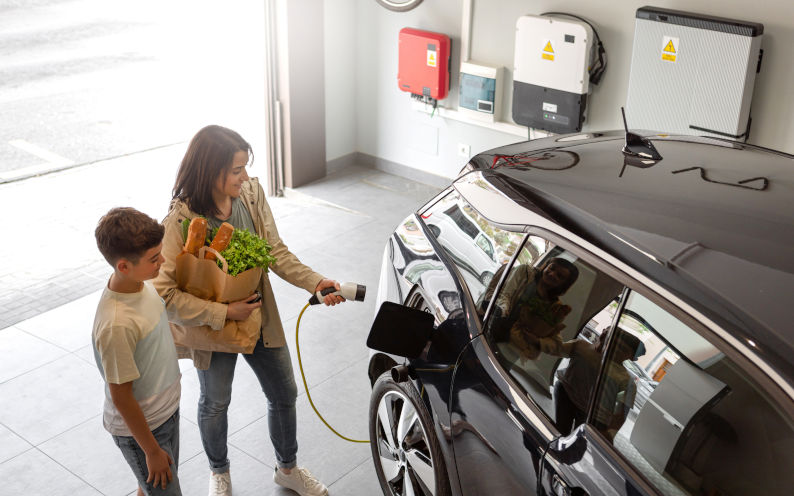
For self-funded retirees, home electrification can cut energy bills, reduce exposure to petrol and gas prices, and add value to the home.
Self-funded retirees routinely compare term deposits, shares and managed funds when deciding how to invest their savings. Few would think to compare them with electrifying their home. They should.
Our experience suggests why.
In 2023, inspired by Saul Griffith’s The Big Switch, we electrified our Californian bungalow in Melbourne’s inner north. It has cut our energy bills by more than 80 per cent.
We stopped using gas and petrol altogether. By mid-2026, our annual household energy costs have fallen from more than $6,600 to less than $1,200.
What began as an environmental decision became something else: one of the best financial investments we have ever made.
What we changed in 2023
Over the course of 2023, we invested $55,296 in electrifying our home.
This expenditure included:
- additional rooftop solar
- a household battery
- a heat pump hot water system
- reverse-cycle electric heating and cooling
- an EV charger
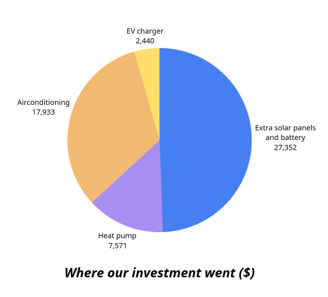
We also replaced our internal combustion car with an EV.
We later used Victorian Energy Compare to shift to a retailer offering better rates and moved from a flat rate to a Time of Use tariff.
The result so far
Our annual nett energy costs changed dramatically:
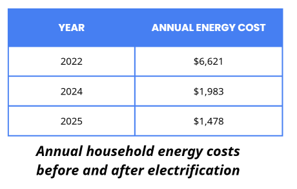
In the financial year 2025/2026 the nett energy cost dropped further to $1,131.
These figures include electricity, gas and petrol before electrification, and electricity and EV charging after electrification. Feed-in tariff credits are included.
As we expected, our average daily energy cost for the summer months (between October and March) is now negligible.

A common criticism of electrification is that households become more dependent on electricity in winter. To our surprise, our winter costs also fell dramatically despite cold weather and shorter daylight hours. Electric reverse-cycle heating is far more efficient than gas heating. Our rooftop solar and battery system still reduced our reliance on grid electricity, and we have made good use of off-peak rates when importing from the grid.
Between April and September 2022, before electrification, our average daily energy cost was $22.62.
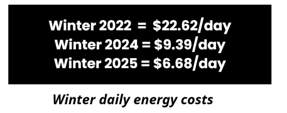
By 2025, it had fallen to $6.68.
Further savings in prospect
The Victorian Government Midday Power Saver will be available from 1 October 2026. It will give consumers 3 hours of electricity free of charge in the middle of the day. Because we have solar energy, a battery and charge our EV at home, we now have the prospect of keeping our EV charged for free even during the winter months.
This was not a cost. It was an investment
The conventional way to think about electrification of the family home is as a large upfront expense that takes years to repay. Our experience suggests a different way of thinking about it.
The reduced expenditure on energy functions like a safe long-term investment product with a high return. Like a true investment, the ‘dividend’ in saved cost of energy adds to disposable income; unlike it, the benefit doesn’t contribute to assessable income.
It has important advantages over a safe investment like a bank term deposit. Not only is the return higher, but it is not limited to a fixed term. Moreover, the value of the capital is not eroded by inflation; it adds value to the house.
Compared with investment in equities, it has given us an excellent return without the day-to-day market volatility associated with listed investments.
Our EV already costs far less in fuel and maintenance than our previous car. We hope with the Midday Power Saver to fuel it for free year-round. We are unaffected by international volatility in the cost of petrol and threats to the supply chain as seen in the Middle East crisis this year.
By eliminating gas and petrol and thereby satisfying all our energy needs with electricity, we have been able to maximise our total savings. We already save by shifting most of our energy consumption off-peak; the free Midday Power Saver will enable us to save much more. By adopting the best retail energy plan available to us, we receive its benefits across all our energy usage.
In sum, home electrification is a valuable investment product well worth considering by self-funded retirees and their financial advisers. It also helps the planet.
Implications for self-funded retirees
Financial advisers may recognise the likely benefits of home electrification for self-funded retirees like us, but they don’t have the technical knowledge or the time to help us in implementing it.
Self-funded retirees now have much more readily available information about home electrification than we did in 2023. Increasingly this is extending to tailored technical advice.
If home electrification can deliver returns that rival or exceed conventional low-risk investments while simultaneously reducing household expenditure and strengthening energy resilience, perhaps it deserves to be discussed alongside superannuation, term deposits and managed funds as part of retirement planning.
Resources
In Victoria, the Easy Electric SEC is a good place to start. Victorian Energy Compare helps with finding the best retail energy offer. See here for the Victorian Midday Power Saver.
Saul Griffith’s Rewiring Australia provides an excellent guide to the home electrification process. As he points out, it doesn’t need to be done all at once. Each step works on its own but they’re even more powerful together.
Disclaimer – This article is for informational and educational purposes only. It does not constitute financial, investment, or legal advice.
