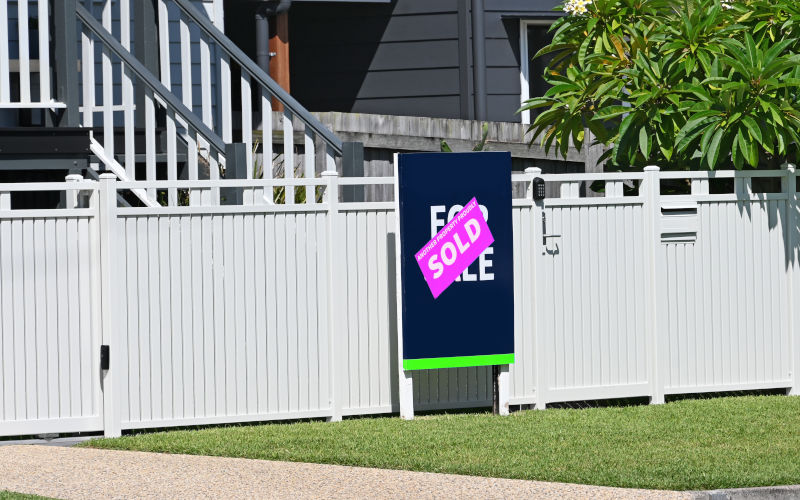
Australia’s housing market has long been powered by fear of missing out. But stretched incomes and record prices could produce the opposite response – a growing fear of overpaying.
It is a psychological contagion driven by one relentless message: buy now, or lose out forever. For years, mainstream media, the real estate industry and property commentators have framed Australia’s housing crisis through one dominant lens: supply and demand.
Too many people. Too few houses. Prices must rise. But what happens when we reverse the script and look first at demand and then supply?
Demand is not simply the number of people who need somewhere to live. It is influenced by fear, expectations, borrowing capacity and the belief that property prices can only go in one direction. And that is where something very interesting may now be happening.
FOMO — the fear of missing out — is becoming FOOP: the fear of overpaying.
The contagion
Remember the toilet-paper panic of 2020? Australia never actually ran out of toilet paper. We suffered a shortage of perspective. Fear created the perception of scarcity. People saw others buying more than normal, interpreted that as evidence of an impending shortage, and bought even more themselves.
Fear created demand. Demand created apparent scarcity. Apparent scarcity created more fear.
Housing is obviously different. Toilet paper is consumed; housing is an asset. But markets are driven not only by what something is worth, but by what people believe it will be worth tomorrow. For years Australians have been told: If you don’t buy now, you’ll never get in; property always goes up.
When government joins the bidding
The Federal Government’s expanded 5 per cent Deposit Scheme was presented as a lifeline for first-home buyers.
But if you reduce the deposit without reducing the price of the house, you have not made the house cheaper. You have simply made it possible for the buyer to borrow more.
REIA’s latest data shows that servicing an average home loan now consumes 50.8 per cent of median family income. That should force an uncomfortable question: did we make housing more affordable — or simply increase the purchasing power of buyers competing for the same properties?
If it is the latter, the policy may help an individual buyer get through the door while simultaneously helping push the price of the door higher. That is not the same thing as affordability.
The numbers don’t lie
Cotality reports that Australia’s national dwelling-value-to-income ratio has reached 8.2, while a median household is taking around 11 years to save a 20 per cent deposit.
We are now above 50 per cent of family income simply to service an average new home loan.
At some point we have to stop calling this merely an affordability problem.
It is a structural distortion.
The affordability ceiling
For years, falling interest rates helped sustain rising prices. Lower rates increased borrowing capacity; greater borrowing capacity enabled buyers to bid more, supporting higher prices and larger mortgages.
But debt has a limit.
When a household is already borrowing at the maximum level it can reasonably service, another $50,000 or $100,000 added to the price cannot simply be absorbed by borrowing more. Eventually the buyer says: No.
From FOMO to FOOP
For years the property market has operated on FOMO: If I don’t buy this house today, someone else will — and next year it will cost me even more.
Now imagine the psychology reversing: If I buy this house today, it might be worth less next year. Why would I pay today’s price?
That is FOOP — the Fear of Overpaying. FOMO makes buyers compete against each other. FOOP makes buyers compete against the seller. The buyer starts asking ‘what is this house actually worth?’ That is a fundamental change in market psychology.
The cure nobody wants
Markets do not necessarily crash simply because something is overvalued. They crash when the mechanism supporting the overvaluation fails. If buyers stop believing prices will inevitably rise, the premium they are prepared to pay begins to disappear.
If first-home buyers stop believing they must buy immediately, demand falls. If sellers discover fewer buyers willing to meet their price, asking prices eventually have to adjust.
A correction can be economic healing: the process by which an asset whose price has become detached from the capacity of ordinary Australians to pay begins to reconnect with reality.
Yes, it will hurt
A significant decline in property prices would cause pain. Recent buyers could see their equity disappear, highly leveraged borrowers could experience negative equity, and construction, developers and banks could all suffer.
But what happens if we don’t allow prices to correct?
Do we really believe the answer is to keep making housing more expensive while continually devising new ways to help Australians borrow enough to buy it?
Six times income? Eight times? Ten times? At what point do we acknowledge the obvious?
The problem isn’t that Australians cannot borrow enough money. The problem is that Australian housing costs too much.
The awakening
Perhaps the most important change occurring in Australia’s housing market is not happening in auction rooms. It is happening inside people’s heads. For years the property market has depended upon an almost religious belief: Buy now. Prices will be higher later.
But beliefs can change. FOMO can become FOOP, and the psychology that inflated the market can begin to deflate it.
Perhaps Australia needs an awakening.
Because if the only way we can keep housing prices rising is to continually convince Australians that they must borrow more, pay more and buy sooner, then we are not solving the housing crisis.
We are perpetuating it.
The cure may be the one thing the property industry does not want to hear: Australians simply stop buying overpriced houses. Not forever, and not irrationally.
But until price once again bears some reasonable relationship to income, value and the capacity of ordinary Australians to pay.
That is not a property catastrophe.
It is the beginning of a return to sanity.

Keith Amor
Keith Amor has spent more than 50 years working in Australia’s building and property industries. A qualified carpenter and builder, his experience spans construction, project management, business development and property development. He has worked across the industry from hands-on construction to managing complex building and development projects, giving him a practical understanding of the forces that shape housing costs and property values. Now semi-retired, Keith continues to write and comment on issues affecting Australia’s housing market, with a particular interest in housing affordability, construction costs, land values, government policy and the economic forces influencing property prices.