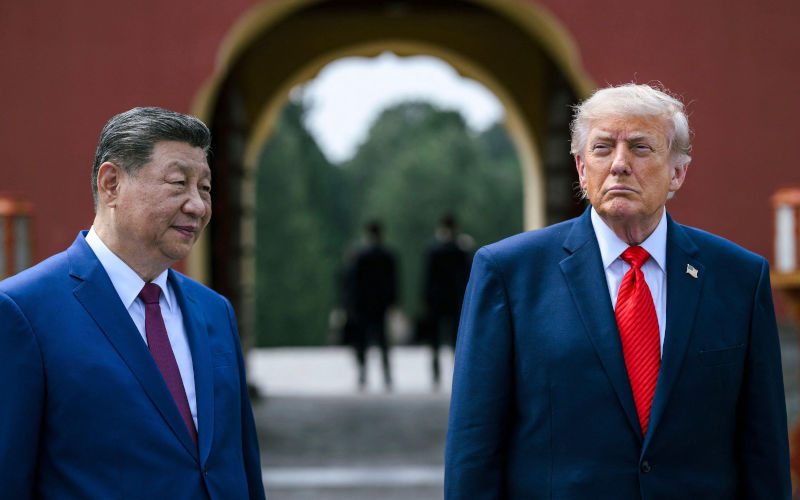
Across much of the world, attitudes towards China are improving as views of the United States deteriorate, with trust in American leadership, reliability and respect for freedoms all taking a hit.
Donald Trump has achieved something remarkable. According to a July Pew Research report, most of the 36 countries surveyed found that more people have a favourable view of China than the US.
The survey results were based on 42,151 respondents and the favourable views were especially large in several Asia-Pacific and Middle Eastern countries.
When the survey was taken, 28 per cent of respondents in Korea had a favourable view of China while 45 per cent of the US sample had an unfavourable view of the US.
Given Donald Trump’s latest embrace of North Korea’s Kim Jong-un, these numbers would be reversed dramatically. Once again Trump has been found to favour dictators above democrats.
Across 20 countries, views of China have turned more positive and views of the US more negative.
Perhaps the most astonishing finding was that of those surveyed, 56 per cent of respondents believed the US does not respect the personal freedoms of its people, compared with 58 per cent for China.
There have been dramatic drops in respondents saying the US respects personal freedoms in Singapore, Spain, the Netherlands, Greece, Sweden, Canada, the UK, France, Italy, Germany, South Korea and Australia.
Pew also found that 17 per cent of middle-income countries tend to say the US interferes more in other countries and that China is a more reliable partner.
When asked which countries interfered in the affairs of other countries and which is a more reliable partner, 75 per cent said the US interfered compared with 45 per cent for China.
Forty-five per cent said the US was not at all, or not too, reliable a partner, compared with 49 per cent saying China was a reliable partner and 69 per cent saying a very reliable partner.
Fifty-two per cent think the US contributes not much or not at all to peace and stability around the world, compared with China’s 40 per cent a great deal and 58 per cent a fair amount.
When asked whether, in taking international policy decisions, the countries took into account the interests of countries like their own, 51 per cent said the US did so not too much and not at all 42 per cent, while 57 per cent said a fair amount.
When asked about favourable opinions of China and the US, majority favourable views were held in Pakistan, Malaysia, West Bank/East Jerusalem, Indonesia, Singapore, Thailand, Sri Lanka, Bangladesh, Turkey, Spain, Italy, Mexico, Greece, South Africa, Nigeria, Kenya, Chile, Canada, Peru, France, the Netherlands, Sweden, Australia (not by much), Argentina, Germany, the UK and Colombia, Brazil and Poland (narrowly).
Countries more positive of the US included Hungary, Poland (very narrowly), the Philippines, South Korea, India, Japan and Israel – the last massively more favourably viewed than any other nation – at 81 per cent more favourable compared to China 19 per cent.
Confidence in both Xi and Trump is generally low, but many of the 36 countries surveyed view Xi more favourably.
The countries where the US-China favourability gap has reversed in recent years include Canada, Spain, Indonesia, the UK, Australia, Sweden, Italy, Greece, the Netherlands, Germany, France and Argentina.
Meanwhile, the latest opinion polling is coming in on the forthcoming Israeli elections. A poll by The Economist (18 August 2026) found that the current Netanyahu coalition government would probably win about 53 seats while the opposition would win 65 seats.
Sixty-one seats are required for a majority. But Israeli elections and post-election manoeuvring are – to say the least – complex.
An ongoing rule of Israeli politics is never underestimate Bibi. But it increasingly looks as if his time is really up this time.

Noel Turnbull has had a 50-year-plus career in public relations, politics, journalism and academia. He blogs at http://noelturnbull.com/blog/