Housing tax reform shows how strongly tax settings shape behaviour. Australia should now shift more of the tax burden from work and employment towards consumption.
Australia is now seeing perhaps the starkest example in recent history of how tax changes affect human behaviour and the economy as a whole.
Since May’s budget announcement of changes to capital-gains tax and negative-gearing concessions, housing prices have fallen 5 per cent. Various industry predictions say they will fall up to 15 per cent.
It is a massive butterfly effect caused by tax changes which have not even come into effect yet.
Humans flock from higher-tax environments to lower-tax environments. It is just fear and greed.
We knew that the tax system was causing people to ‘invest’ vast amounts of money in housing, driving up prices and shutting young people out. And simple logic says that to make houses more ‘affordable’, the price of them had to come down.
At last, the government did the obvious after everything else and every other explanation for the housing crisis fell short. It was good policy even if the government did not sell it well.
But as I wrote at the time of the budget, “The political question is whether people buying are more appreciative than sellers are angry. My guess is yes because there is another element to the equation. Many people have expressed disquiet for a long time about the way many home-buyers have been shut out by investors subsidised by the taxpayer.
“These people recognise that that problem had to be dealt with and will probably accept falling house prices.
“And fall they will. After a quarter century of this warped capital-gains policy there is bound to be some blood on the floor in correcting it. But it had to be corrected. So, yes, there will be some individual losers, but overall Australia will benefit.”
Australia’s tax system is riddled with idiocies that discourage good behaviour and encourage bad behaviour. And Australia’s political system seems incapable of doing very much about it, but this government’s axing of the Morrison government’s Stage Three tax cuts and the Howard government’s housing-warp tax measures are cases that show all is not lost.
One of the glaring examples of poor tax policy is the way Australia relies too much on taxes on salaries and wages – more than half of total revenue. And far too little on consumption – just 13 per cent.
It means we are discouraging work and encouraging consumption. And we wonder why our economy is not performing as well as it should.
Last week, former treasurer Josh Frydenberg in his memoir A Grateful Son called for a “considered but ambitious national debate about lifting the GST and removing some exemptions, with a significant portion of that additional revenue to fund a major reduction in income taxes”.
Just to prove how difficult it is to have a considered or ambitious debate about anything in Australia, Liberal leader Angus Taylor responded almost immediately, “We will not be raising the GST in the middle of a cost-of-living crisis. That we won’t do.” Very predictable.
Worse, with polls splintering support three ways with Labor, One Nation and the Coalition all below 30, no one seems to have enough political authority to guide any major reform.
Of course, Frydenberg was treasurer for three and a half years and did nothing about the GST. The exemptions – mostly misguided – were the price paid for getting Australian Democrat support in the Senate to get the GST through, but they could have been tackled later.
The exemptions seemed like motherhood at the time: on health, education and fresh food. But they were utterly inequitable as the well-off spend much more on these things (private school fees and salads to go with the pinot gris) than the less well-off.
These exemptions should go, and with well-directed compensation, the rate should go up. The GST is much more difficult to evade than other taxes and a higher GST would help the well-off pay more tax as they should.
Frydenberg’s call for a reduction in income taxes would be worthwhile if directed at wage and salary earners, especially at the lower end.
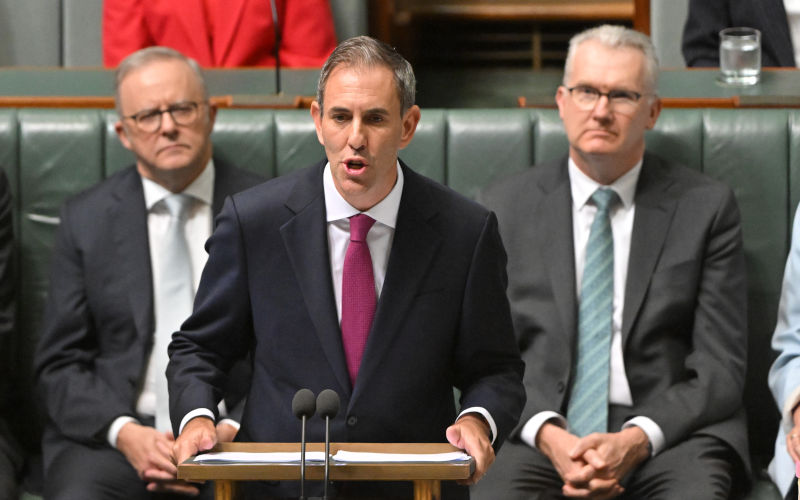
And here the present treasurer, Jim Chalmers, enters the fray. Last budget Chalmers introduced a measure that over time could seed a major shift away from taxing labour income – the Working Australians Tax Offset. It only amounted to $250 last budget, but it has great potential.
If you put the ex-treasurer’s and treasurer’s ideas together, you could double the GST (to a level that many OECD nations have) and remove the exemptions. That would raise enough money to wipe out all taxes on wages and salaries under about $100,000, and perhaps give relief to incorporated small businesses.
Better still, some of the extra GST money could go to the states to remove payroll taxes – perhaps the most insidious tax in Australia.
The basic point is that removing taxes on work and employment will encourage employment and work. It will also contribute to intergenerational fairness as younger people tend to earn more of their income from labour.
*******
In last week’s column, I should have acknowledged Malcolm Gladwell’s excellent book The American Way of Killing, which was the genesis and basis for my looking at Australian policing and gun laws and some of the conclusions in the column generally.
Also, a reader has pointed out that between 1976 and 1991 an enormous amount of work was done by the ACT Public Service and by ACT recreational firearms organisations to develop the 1991 ACT legislation, the Weapons Act 1991, which required firearms licensing, club membership, and club storage of weapons. The 1996 federal legislation drew heavily on that legislative regime, which accommodated recreational shooters while heavily regulating firearm ownership.
This article was first published in The Canberra Times and other Australian media on 20 October 2026.
Republished from Crispin Hull.com
Crispin Hull
Crispin Hull has written for The Canberra Times for 30 years on a huge range of topics, but mainly legal and constitutional. He was Editor for seven years. He taught journalism at the University of Canberra, and is the author of ‘The High Court of Australia 1903-2003’ and ‘Canberra – Australia’s National Capital’. He is also a marine rescue skipper on the Great Barrier Reef with Marine Rescue Queensland.