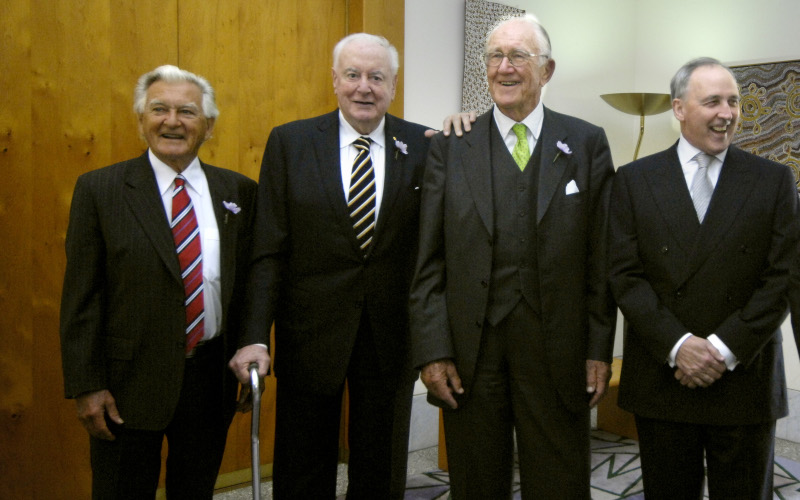
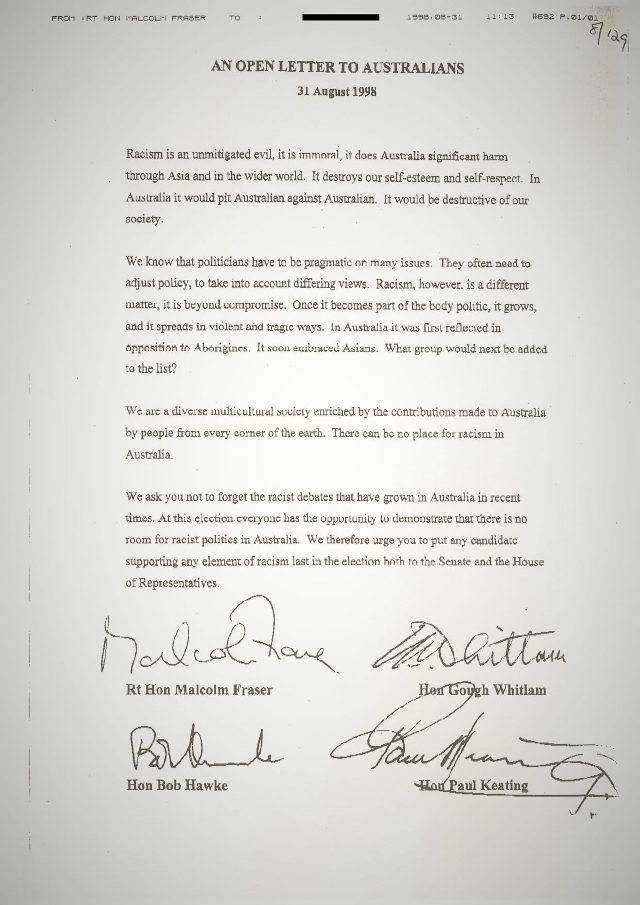
In an open letter in August 1998, four former prime ministers expressed their concern about the upsurge in racism at the time of the Howard Government and the coming election.
The four said “racism is an unmitigated evil, it is immoral, it does Australia significant harm through Asia and the wider world, it destroys our self-esteem and self-respect. In Australia it would pit Australian against Australian. It would be destructive of our society.”
They urged voters “to put any candidate supporting any element of racism last in the election both to the Senate and the House of Representatives”. Fortunately, that is what voters did.
Will the leaders of the three major parties do the same at future elections?
The four signature prime ministers were Gough Whitlam, Malcolm Fraser, Bob Hawke and Paul Keating.
These four prime ministers had each played key roles in ending White Australia.
Gough Whitlam, and Don Dunstan, the South Australian Premier, were responsible for deleting White Australia from the ALP platform at a Party conference in Sydney in 1965.
In government, Gough Whitlam, in the Racial Discrimination Act, outlawed racial discrimination in any form.
In government, Malcolm Fraser together with Ian Macphee, successfully put the non-discriminatory migration policy to the test by supporting 250,000 Indochinese coming to Australia. They were chiefly refugees. Malcolm Fraser didn’t wait for a focus group to tell him what to do. He provided leadership and Australians supported him.
In government, Bob Hawke and Paul Keating pushed back against John Howard and Pauline Hanson. In 1988, the Hawke/Keating government introduced a motion in parliament in support of a non-discriminatory immigration system. Three Liberal members of parliament, Ian Macphee, Steele Hall and Philip Ruddock, supported this motion in defiance of Liberal Party whip.
There was an alarming lead up to the 1998 federal election, which triggered this open letter. Pauline Hanson entered parliament in 1996. In her maiden speech, she attacked multiculturalism, Asian immigration and Indigenous welfare reforms. Regrettably John Howard refused to condemn Hanson’s comments. In wanting to appeal to her voter base, he claimed that her rise was a symptom of people feeling that political correctness had gone too far. He dog whistled that he wasn’t opposed to the changes in immigration but said many people had spoken to him about their concerns.
At the same, in the late 1990s, there were divisive debates over Aboriginal land rights following the High Court’s Wik decision. The Howard Government, mining interests and others conducted a campaign against native title and warned that even suburban land might be at risk of land claims.
At the 1998 election, One Nation captured over 8 per cent of the national primary vote in the House of Representatives. Fortunately, One Nation failed to win a single seat because the strategy of putting One Nation last was effective. Liberal, National and Labor preferences flowed away from One Nation. Hanson contested the newly created Queensland seat of Blair. She lost because of the flow of preferences against her.
All surveys show that Australians overwhelmingly support multiculturalism. But we remain hesitant about the latest wave of migrants, whether they were Irish, Jews, Germans, Balts, Vietnamese or even Afghans!
What gives confidence is that there is a pragmatic acceptance of newcomers. We are favourably impressed with the personal experience we have of our neighbour or shopkeeper who is Italian, Chinese, Vietnamese or Lebanese. Is there something in the casualness and our easy-going acceptance that overcomes ideological and philosophical opposition? We eschew the extremes and don’t get too excited by ideologies at either end of the spectrum. There hasn’t been “much blood on the wattle”. Except of course in the Frontier Wars. Bondi was the exception. We bump into each other, but we don’t cause a great deal of hurt.
In addition to time healing differences, we have also had leaders who have inspired the best in each of us. They touched the better angels of our nature. Do we have the leadership today on race that we saw in 1998 in Whitlam, Fraser, Hawke and Keating?

John Menadue is the Founder of Pearls and Irritations and a board member. He was formerly the Editor-in-Chief. John was the Secretary of the Department of Prime Minister and Cabinet under Gough Whitlam and Malcolm Fraser, Ambassador to Japan, Secretary of the Department of Immigration and CEO of Qantas.