Indonesia’s response to the Bondi shootings and the royal commission hearings exposed a deeper unease – one where fear, politics and prejudice still shape how Judaism and Israel are discussed in public life.
The Royal Commission on Anti-Semitism and Social Cohesion has been meeting this month in Sydney to hear some of the 7,400 submissions on the Bondi shootings on 14 December. How has the Indonesian media reported the targeted killings and the royal commission hearings?
With trepidation and a determination not to mention the victims’ and alleged shooters’ religions and arouse wrath among readers, listeners and viewers who might demand the J word never assault their senses.
Unsurprisingly, there are few details about Jews and Judaism in Indonesia because there are no diplomatic ties, and it’s not a state-registered religion. There are six: Islam, Protestantism, Catholicism, Hinduism, Buddhism, and Confucianism. The individual’s selection is recorded on their compulsory national ID card.
Metro TV, a usually serious news platform, reported the Bondi killings by “strongly condemning the shooting incident.”
The Foreign Ministry expressed its “deepest condolences and prayers … and solidarity with the government and people of Australia during this difficult time.”
No mention of the victims’ faiths or names, nothing about the “suspected attackers”.
It’s a shabby piece of journalism that would have left viewers and readers asking why the report was so incomplete. That they didn’t tells a story of hatred so embedded in Indonesia’s psyche that it’s become an unshiftable article of faith.
The Jakarta Globe, an English-language news site, obliquely recognised Jewish culture without using the J word. Indonesian citizens in Australia were warned to be alert.
It reported the shooting “coinciding with the first day of Hanukkah, when an event titled ‘Chanukah by the Sea’ had been scheduled.” No other details.
To its credit, The Jakarta Post, also in English, did let the terms “antisemitic”, “Jewish” and “Islamist militancy” get published, so no reading between the lines necessary for the complete picture.
That was the exception.
The Indonesian community often faces a difficult environment, with significant antisemitic sentiment among a large portion of the Muslim-majority population, largely driven by the conflation of Jewish identity with the Israeli-Palestinian conflict.
There are some anti-Israel posters in public places and occasionally shrill graffiti on Indonesian city walls. Muslims in Gaza are Sunni, like those in Indonesia, so commentary often uses the abstract noun ‘brotherhood.’
Those in Iran belong to the Shia sect. Followers in Indonesia are few and often persecuted.
There are supposed to be only a few hundred Jews in Indonesia, mainly in the Christian province of North Sulawesi, which is believed to have the nation’s only synagogue, Sha’ar Hashamayim. (Gate of Heaven.)
On a visit before Covid, it was shut, and the surroundings looked unkempt. Locals couldn’t (or wouldn’t) explain the situation.
A small community of Iraqi Jews once lived in Surabaya (the Republic’s second biggest city in East Java) early in the last century. They may have originally immigrated from the Netherlands as traders.
They worshipped in a private home converted into a synagogue. This was demolished in 2013, allegedly after pressure from militant Muslims.
Surabaya’s big Christian cemetery, Makam Kuning, has a walled section alongside the crematorium for Jewish graves. Official records show 107 burials. Two list birthplaces outside Indonesia – ‘Bagdad’ and Cairo.
That was early this century, when headstones were mainly intact, but on a later visit, they’d been completely smashed; referrals to origins and extended families were no longer legible.
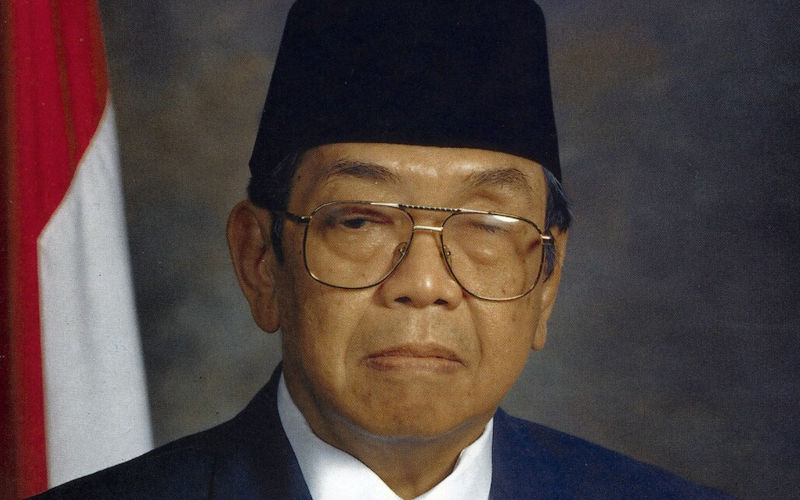
The only Indonesian leader with the courage to accept Jews was the late fourth President Abdurrahman Wahid (1999 – 2001), aka Gus Dur.
He went to Israel in 1994 for the signing of Israel’s treaty with Jordan, but also to promote peace in the Middle East. For 15 years he’d led Nahdlatul Ulama (Revival of the scholars), reportedly the world’s largest Islamic NGO with maybe more than 100 million members.
He visited again in 1997. An NU official said: “Gus Dur’s approach to Israel had a clear mission, roadmap, and strategy, with parameters of the common good, national interests, and humanity. Principles such as peace, justice, and human equality were Gus Dur’s main foundations.”
Gus Dur’s biographer Australian academic Dr Greg Barton wrote that although his trips were condemned by hard right Islamists:
“He demonstrated his commitment to religious pluralism by giving speeches in non-Muslim places of worship … he carved out a role as an advocate of change in national affairs that was without precedent in NU history.”
Gus Dur died in 2006 and even if present his values would probably not get a hearing in Indonesia today where sympathies are with Palestine, as street posters and graffiti declare.
The western label ‘Islamic terrorists’ isn’t heard in Indonesia, though the term ‘extremist’ gets a peep into commentary now and again.
After Gus Dur’s trips and before Trump and Netanyahu started fighting Iran, Kornelius Purba, a senior editorial writer (and a Catholic) with The Jakarta Post, opined: “It would be political suicide to say anything good about Israel.
“It is almost unimaginable that the current (Indonesian) government would consider opening a formal relationship with Israel. So far, trade and defence ties between the two countries go through a third party.”
Indonesia’s present President Prabowo Subianto told the UN last year that his country would recognise Israel only if it accepted Palestinian statehood.
A final comment from Dr Barton: “(Gus Dur’s) point was that Islam was at its best when it was open-minded and pluralistic.”

Duncan Graham has been a journalist for more than 40 years in print, radio and TV. He is the author of People Next Door (UWA Press). He is now writing for the English language media in Indonesia from within Indonesia.
Duncan Graham has an MPhil degree, a Walkley Award, two Human Rights Commission awards and other prizes for his radio, TV and print journalism in Australia. He lives in East Java.