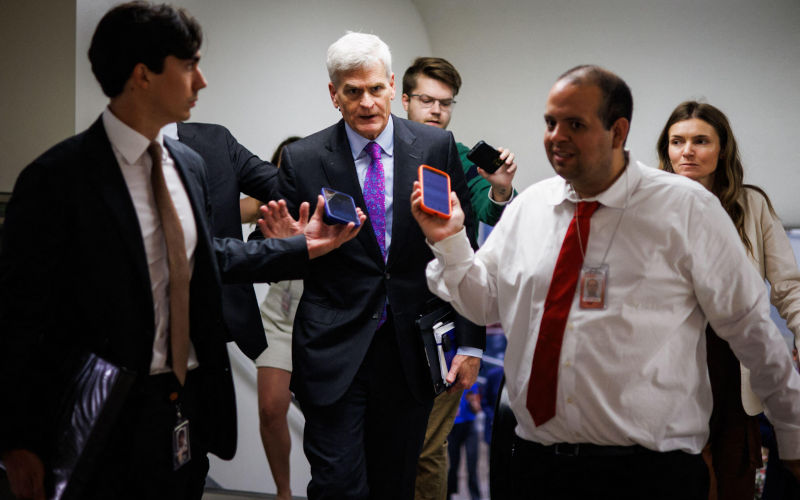
A bipartisan Senate vote to advance a War Powers Resolution against Operation Epic Fury marks a significant challenge to the Trump administration’s attempt to wage war against Iran without sustained congressional authorisation.
For 80 days, the most powerful military on earth ran without a leash. No congressional mandate. No allied consultation. No defined strategy. Just a president, a fleet, and a social media account.
Launched on 28 February, 2026, Operation Epic Fury decimated Iran’s conventional navy and drone infrastructure in a blistering opening assault. When a fragile ceasefire was brokered in April, the Trump-Vance administration declared a famous victory for “Peace Through Strength.” The world exhaled. Too soon.The war didn’t stop. It mutated. The White House exploited the pause to engineer an audacious legal fiction, claiming the ceasefire had reset the 60-day War Powers Resolution clock to zero, handing the executive unlimited time to wage war, enforce a naval blockade near the Strait of Hormuz, and threaten Tehran with little more than a social media post as notice.
On Tuesday, the Senate said: enough. No more blank cheques. No more blind faith.
The crack in the wall
Seven times, Senate Democrats had tried to halt the unauthorised conflict. Seven times, the Republican wall held. On Tuesday, it finally broke.
In a significant 50–47 procedural vote, the Senate advanced a War Powers Resolution led by Senator Tim Kaine of Virginia, directing the immediate removal of US forces from hostilities unless Congress formally authorises war. The collapse of Trump’s unified partisan front came down to four Republicans who placed constitutional principle above party loyalty: Susan Collins of Maine, Lisa Murkowski of Alaska, Rand Paul of Kentucky, and Bill Cassidy of Louisiana.<
Cassidy proved decisive. Fresh from a bruising Louisiana primary in which Trump had actively campaigned against him, he was no longer constrained by the threat of presidential retaliation. His statement was direct:
“While I support the administration’s efforts to dismantle Iran’s nuclear program, the White House and Pentagon have left Congress in the dark on Operation Epic Fury. No congressional authorisation can be justified until that changes.”
Four senators. One Constitution. A line, finally drawn.
The world was always in this war
To read Tuesday’s vote purely as a domestic constitutional dispute is to miss its broader significance. This was never confined to the halls of Congress. Its consequences were global from the outset.
The Strait of Hormuz carries roughly 20 per cent of the world’s traded oil every single day. When a unilateral American naval blockade closed that chokepoint, the effects were swift and far-reaching. Brent crude surged past $115 a barrel. Gulf shipping insurance premiums tripled. Japan convened an emergency cabinet session to assess its energy exposure. In Pakistan and Bangladesh, fuel subsidies already stretched to breaking point were wiped out almost immediately. For tens of millions of people who had never heard of Operation Epic Fury, the war arrived not with fanfare but quietly, in rising electricity bills, climbing food prices, and the cost of a weekly shop.
When one country controls the world’s most critical energy chokepoint without institutional restraint, the costs are distributed globally regardless of who made the decision.
America’s allies found themselves in a similarly difficult position. The United Kingdom’s Foreign Secretary reportedly learned of the escalating Tehran strike threat not through the Five Eyes intelligence channel but from a journalist requesting comment on a Truth Social post. Berlin, Tokyo, and Seoul each issued measured statements expressing concern about “unilateral actions,” the careful diplomatic language of partners who feel sidelined but cannot afford open confrontation. An international order cannot hold when its anchor power treats its closest partners as spectators rather than stakeholders.
Governing by social media
The White House declined to brief the Senate Armed Services Committee. It withheld the legal opinions underpinning the campaign. It conducted the foreign policy of the world’s leading power through a social media feed and offered no formal accounting to Congress or to allies.
Twenty-four hours before the Senate vote, Trump announced on Truth Social that he had ordered a “full, large-scale assault” on Tehran, halted only after Gulf leaders made direct personal appeals. The military, he added, was ready to act on “a moment’s notice.” Markets fell sharply. Governments scrambled to assess the situation in real time from a social media post rather than through established diplomatic channels. The Saudi foreign ministry issued a rare public statement urging “all parties to exercise maximum restraint,” a pointed signal directed squarely at Washington.
An international order built over 80 years on the expectation of institutional communication and predictable great power behaviour cannot absorb indefinitely an approach to statecraft conducted through notifications. Tuesday’s vote was the Senate’s clear response: foreign policy requires democratic deliberation, not unilateral declaration.
The fight is far from over
The resolution still faces a full Senate debate, a House vote, and a presidential veto that few expect the administration to withhold. Assembling the two-thirds supermajority required to override it remains a considerable challenge in a deeply divided Congress.
But the importance of Tuesday’s vote extends beyond its immediate legislative prospects. It signals to allies, to financial markets, and to governments that have spent months navigating decisions made without consultation, that the institutional mechanisms of American democratic governance have not been permanently sidelined. That accountability, however slowly it arrived and however narrow the margin, is still capable of asserting itself.
For 80 days the conflict ran without constraint and the world bore the consequences alongside it.
On Tuesday, a bipartisan coalition drew a line. It came later than it should have. Whether it holds remains to be seen. But it was drawn.
And in the current environment, that matters.

Muhammad Amir
Muhammad Amir is a PhD researcher in International Relations at Deakin University, focusing on conflict resolution and regional politics.