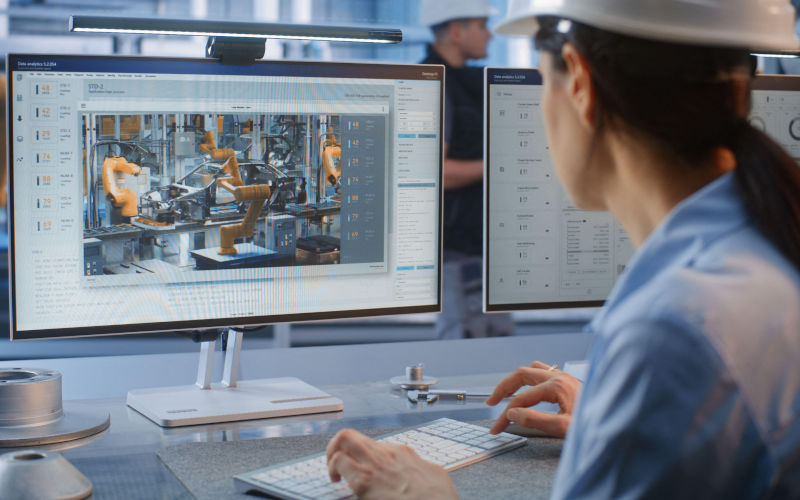
Australia’s biggest AI opportunity may lie not in building ever-larger language models, but in transforming manufacturing and industrial systems. Realising that potential will require investment in skills, research and access to computing power.
Another day, another existential threat to humanity.
The warning by frontier AI labs of an artificial super-intelligence may be a real one. Or it may be a cynical ploy to justify “regulatory capture” by these same AI labs, for whom the real threat is an increasingly precarious business model.
Whatever the case, it should not distract us here in Australia from the opportunities that might otherwise be missed. These opportunities are unlikely to be found in competition with US and Chinese large language models (LLMs), given the scale of investment required, though more specialised small language models are perfectly feasible here.
The transformative opportunities for “middle power” economies may instead lie in the application of AI to physical products and systems as a basis for new forms of competitive, high-value manufacturing. This is being termed “industrial AI”, and it provides a mechanism for addressing Australia’s productivity slowdown.
As we know from even the most optimistic Treasury forecasts, including the latest Intergenerational Report, productivity growth shows no signs of a significant uplift on current policy settings. This is because the problem is deeper than the Treasury or the Productivity Commission are willing to concede.
The fundamental problem is that Australia’s woeful productivity performance in recent decades can no longer be seen as a matter of regulatory fine-tuning, but rather the need to diversify our resources-heavy trade and industrial structure. This path dependency has also made the economy increasingly vulnerable to commodity price volatility, supply chain disruptions and geopolitical shifts.
Historically, productivity growth has been driven by technological change and innovation, with large manufacturers generating most of the global investment in R&D. But Australia’s narrow pursuit of comparative advantage in unprocessed raw materials has crowded out the prospect of competitive advantage in knowledge-intensive manufacturing.
Indeed, the decline of manufacturing in Australia to the lowest share of GDP among OECD countries has in turn precipitated a collapse of business R&D. In this context, even a boost to publicly funded R&D would do little to shift the dial on productivity in the absence of far-reaching structural change.
Consequently, the question we ask in our new report, Turning AI into Productivity, is whether the deployment and diffusion of industrial AI might enable the Australian economy to break out of this cycle, and how it could do so with a focus on value creation in advanced manufacturing, as well as energy, minerals processing and food security.
The report begins from the premise that AI is a general-purpose technology, like electricity, which becomes productive only when combined with complementary investments in infrastructure, skills, institutions and management capability. Clearly this is not something that can happen instantaneously.
Electricity took more than 40 years to achieve an economic impact, and then only through a wholesale reconstruction of industrial systems. In the 1980s, the economist Bob Solow famously remarked that “you can see the computer age everywhere but in the productivity statistics”. The impact became evident in the following decade.
However, the impact was more evident in some places than others, and we found that this was becoming the case for industrial AI as well. In examining 110 innovation ecosystems in 35 countries, including several at close quarters, it was clear that the productive impact of AI was concentrated in places with an institutional focus on collaborative research translation and enterprise capability-building.
This is particularly important for middle-power economies, squeezed between the behemoths of China and the US. Such economies may not be able to keep up in the frontier model race but can use AI to both optimise industrial processes and create specialised areas of competitive advantage in global markets and value chains.
The opportunity for Australia is to leverage the current wave of data centre investment with negotiated conditions not only around energy and water usage, but also the promotion of sovereign manufacturing capability. We will only get this chance once, so it must be seized as an immediate priority.
Implementation will require a mandated computer reservation scheme along the lines of Expectation 5 in the government’s National AI Plan. This states that “providers of large-scale compute, including hyperscalers and neoclouds, are expected to contribute to research and innovation, including by enabling access to compute for Australian start-ups, innovative small businesses, researchers and not-for-profits on favourable terms”.
Such a scheme would be a world-first, like the social media interventions, and might involve reserved compute capacity, demand-side vouchers and access to specialised AI tools. The scheme could also be accompanied by human-centred co-investment in homegrown small language models, which would suit a range of industrial tasks.
Communities everywhere are engaging in an urgent conversation about guardrails for the evolution of AI models. While this conversation is necessary and overdue, policymakers should also take advantage of the huge potential for AI to contribute as part of a national industrial strategy to a future made in Australia.

Emeritus Professor Roy Green AM is Special Innovation Advisor at the University of Technology Sydney, where he was Dean of the UTS Business School. He has pursued a career in universities, government and industry, and has published widely on innovation and industrial policy, including with the OECD. He has chaired the CSIRO Manufacturing Sector Advisory Council, the Enterprise Connect Innovative Regions Centre, the Queensland Competition Authority and the NSW Manufacturing Council. Currently, Roy chairs the Advanced Robotics for Manufacturing (ARM) Hub and the Port of Newcastle, and he is a board director at CSIRO and SmartSat CRC. Roy Green is Special Innovation Adviser at the University of Technology Sydney and Chair of the Advanced Robotics for Manufacturing (ARM) Hub

John H Howard
John H Howard is a researcher, policy analyst, management adviser, and author with three decades of experience advising governments, universities, and industry on science, research, and innovation policy and strategy. He is Executive Director of the Acton Institute for Policy Research and Innovation and an Honorary Visiting Professor at the University of Technology Sydney. He can be contacted at john@actoninstiyute.au