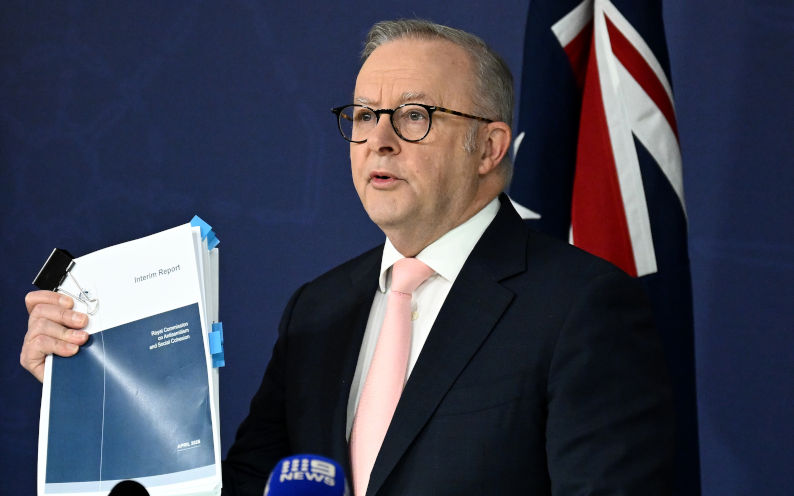
The recommendations from the interim report of the Royal Commission on Antisemitism and Social Cohesion are tentative, lightweight and backed by scarcely any supporting analysis. Further recommendations must take into account the Netanyahu government’s responsibilty for the stimulation of antisemitism here and around the world.
Greg Barns is right to welcome the observation in the interim report of the Royal Commission on Antisemitism and Social Cohesion that “there is no suggestion that any legislative reform is required” to help prevent Bondi-style attacks.
That’s not to say that Bell’s report is without its disappointments, some of which may have been inevitable given the ragged history of the Royal Commission’s creation and the circumstances in which it must now operate.
While the Prime Minister appeared flat-footed in the immediate aftermath of the Bondi atrocity, a week after it he announced a review of the role of federal law enforcement and intelligence agencies to be conducted by the former departmental secretary, Dennis Richardson. Richardson would have done a good job but it was seen as insufficient. Voices arose for a having a royal commission, although many of those calling for it may not have been full bottle on the terms of the Commonwealth Royal Commissions Act 1902 or realise what they were asking for.
On 8 January 2026, Albanese relented and a Royal Commission, to be conducted by former justice of the High Court, Virginia Bell, was established. It was asked to provide an interim report by the end of April. Richardson’s review was folded into the Royal Commission to which he was made a ‘special adviser’. That was unsatisfactory. It may have been better if he’d been made a Royal Commissioner along with Bell but he wasn’t and he subsequently pulled out, saying he was being greatly overpaid for what he was doing, an unusual sentiment for a person working for the Commonwealth.
The end of April deadline for an interim report owed more to politics than any realistic expectation that a Royal Commission would have much to say before its formal hearings had even begun. As Bell’s interim report notes, the procedures of a Royal Commission “occasioned delay that might not have attended…an administrative inquiry”; it was impossible for the Commission Counsel to “adduce evidence” in the time allowed. Further, what Commissioner Bell can say publicly is constrained by the need not to prejudice criminal proceedings against one of the alleged Bondi gunmen.
Bell’s interim report contains useful outlines of the history of counter-terrorism laws and institutions, how they work and relate to one another, their resourcing and relation to other government organisations and community groups. There is also helpful material on the recent threat environment, the security arrangements for the Hanukkah ceremony at Bondi and the emergency responses to the attacks at it. Its recommendations, however, are tentative, lightweight and backed by scarcely any supporting analysis. Five of them are not disclosed. Some are unconvincing and one bleedin’ obvious.
Tentative: all the recommendations made public suggest ‘should’ be done or ‘consideration be given to’: a review should be commissioned and so on. Framing recommendations in these terms gives the impression of half-heartedness that doesn’t put enough acid on governments to act on them.
Lightweight: recommendations that the Commonwealth Counter Terrorism Coordinator should be a full-time job or that the Counter Terrorism Handbook should be updated or that there should be a review of Counter Terrorism Teams are not of great consequence.
Absence of supporting analysis: the only justification provided for the recommendation that governments should ‘prioritise efforts to finalise and implement an updated and nationally consistent National Firearms Agreement’ is that differences can ‘undermine arrangements’. But if all governments agreed on minimum standards, it’s not clear why, should any jurisdiction want to exceed those minima and so cause inconsistency, they could not be permitted to do so.
Unconvincing: a recommendation that ‘the Australian Government should consider whether all National Security Committee members, including the Prime Minister, should participate in a counter-terrorism exercise, along with all National Cabinet members, within nine months of each federal election’, is supported only by an assertion that this would enhance their ‘match fitness for a major terrorist attack…’. Really? If so, might it also be useful for heads of police and intelligence agencies to participate in a Cabinet meeting exercise aided, inevitably, by a facilitator? Better perhaps for all parties to stick to their knitting; Ministers should not be involved in counter-terrorism operations.
Bleedin’ obvious: does it really need a Royal Commission to tell Australian governments that they ‘should prioritise efforts to finalise and implement the proposed National Gun Buyback Scheme’? Things are in the bogs if it does.
Anyway, the Prime Minister instantly announced acceptance of the recommendations of Bell’s interim report, without the time for them to be properly considered by Cabinet. That’s not a good sign and it’s a contrast to the government’s tardiness in responding to reports of parliamentary committees when years can elapse and where sometimes there is no response. Still, when a Prime Minister is under a political hammer, all sorts of speed seems possible, however injudicious it may be.
In announcing the decisions on Bell’s interim report, the Prime Minister said: “There has been a rise in antisemitism that is a global phenomenon that has occurred since the October 2023 actions of Hamas’. It’s a pity the Prime Minister can’t mention Gaza because the savage irony is that the Israeli destruction of that country has most likely been the major cause for a rise in antisemitism in Australia. Indeed, the actions of Hamas in October 2023 would likely have had the opposite effect.
If the Bell Royal Commission is to succeed, it must recognise these uncomfortable circumstances and make its recommendations in the appreciation that the Netanyahu Government, which seems to believe that military force can solve most of its problems, is significantly responsible for the stimulation of antisemitism here and around the world. That is to say that many of the causes of the discontents Judge Bell has to deal with are beyond Australia’s shores and the influence of any Australian authorities.

Paddy Gourley is a superannuated Commonwealth public servant.