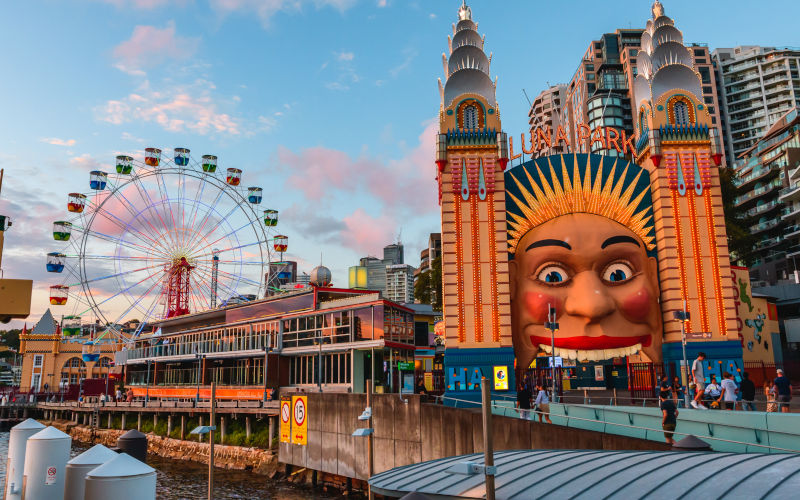
A chapter in Helen Pitt’s ‘Luna Park’ revives claims that Neville Wran blocked a lease for personal reasons, but official tender records point elsewhere.
Helen Pitt’s history, Luna Park (Allen and Unwin 2026), devotes a chapter to an anecdote reported by The Sydney Morning Herald in 2007. The newspaper relied on a claim by Leon Fink, a property developer and restaurateur, that in 1976 he approached the newly elected Labor premier, Neville Wran, to lobby for a renewed lease of the fun fair. The lease had expired before Wran’s election.
“While my bum points to the ground, your partner will not get that lease”, Fink claims Wran told him. According to Fink, his business partner Nathan Spatt “had been overheard in a restaurant criticising Wran on his use of a private plane belonging to Sir Peter Abeles in the midst of an airline strike”. In May 1977 Wran and his wife Jill beat an air traffic controllers’ strike to return from a Noumea holiday by accepting seats on a TNT-chartered plane. Wran had publicly apologised.
Fink’s company did not get a renewed lease. Nor was it successful when the lease for the park was tendered after the deadly ghost train fire in June 1979.
Pitt should have examined the timeline. The Noumea trip was in May 1977, one year after Wran was elected in May 1976. If she accepts Fink’s version, the conversation must have occurred after May 1977. Given Fink claims he had already reached agreement with the previous government, it defies belief he waited more than a year to try to close the deal with Wran.
The reason for Wran’s anger is disputed. The more important issue is: did Wran allow his offence at criticism to interfere with public obligations? Was it the case, instead, as a spokesman for Wran said: “No financially acceptable proposal was put to the government during that period.”
Pitt accepts Fink’s claim that he had finished negotiations with the previous Coalition government “on good terms on both sides”. Strangely, she ignores an assessment of the tenders after the Luna Park fire by the NSW valuer-general, Frank Bird, which suggests these would not have been good terms for the state.
In a report of 4 July 1980, Bird regarded only three tenders to be financially credible and viable. He ranked the Fink/Spatt tender third in terms of attractiveness to the government.
Bird described the Fink/Spatt tender as “a conservative upgrading of the existing improvements with a consequential slow increase in annual turnover”, meaning rental prospects were “not encouraging”. He also found “new improvement expenditure is the lowest of all tenders”.
Bird noted that “until turnover rental operates the tender proposes a site rental of $100,000, which is much less than that offered by Tenders 1 and 2. The initial site rental of $50,000 per annum is the lowest of all tenders.”
The valuer-general’s recommendation was: “Having regard to all the circumstances, as presented, I recommend that, on economic grounds (if not for other reasons as well), Tender No. 1 be preferred.” Tender No. 1 was the tender by Australasian Amusements Associates Pty Ltd, which subsequently changed its name to Harbourside Amusement Park Pty Ltd.
This tender was ultimately recommended by the tender assessment committee comprising six senior NSW government officials (including the valuer-general). The committee noted of the Fink/Spatt tender that “the return to the Government is less than that of other tenderers who propose a more extensive modernisation of the area. The admission charge of $4.50, including 10 rides, is higher than that proposed by another tenderer.”
The committee’s recommendation was accepted by the Wran government. Pitt writes “there remains much mystery and controversy around this choice”. There is no ‘mystery’ to anyone who bothers to read the valuer-general’s report, and the subsequent report of the senior bureaucrats’ committee, neither of which Pitt thought necessary to reveal to her readers.
There is no ‘controversy’ for anyone who has read the later report of the extensive inquiry by the Corporate Affairs Commission, tabled in the NSW Parliament, into the ownership of the new lessee. These investigators, who included the National Crime Authority, found crime figure Abe Saffron had no controlling or beneficial financial interest in the company.
The Minister for Public Works, Jack Ferguson, announcing the decision, revealed the rent prior to the reopening would be $75,000 per year. After the park’s reopening the rent would be “10 per cent of the land value or 5 per cent of the gross turnover, whichever is the greater, with a guaranteed return to the government after the initial development stage of $250,000 a year”.
Pitt reports that in 1976 the Fink/Spatt company was paying “about $30,000 a year in rent to the state government”. We know from the valuer-general’s report that in 1980, in its tender, the company was proposing an initial rent of only $50,000 a year, which would increase to $100,000 a year until it began paying turnover rent.
A reasonable assumption can therefore be made that the rent the Fink/Spatt company was proposing in 1976 in its negotiations for a renewed lease was no more than $50,000 a year. In 1980, after the market had been assessed, the successful tenderer was offering an initial rent of $75,000 a year, increasing to $250,000 a year when the park was fully operational.
The valuer-general’s report supports the claim by Wran’s spokesman that no financially acceptable proposal was put to the government during the negotiations.
It is useful to consider the counterfactual. What if the Wran government had reached agreement with Leon Fink for a new lease for 30 years without holding a public tender? We now know from the subsequent tender process that the agreed rent would have been well below market rates. Fink was, at the time, friendly with Wran and many other Labor figures. Fink admits to Pitt that he was lobbying Wran and these contacts for a renewed lease. Wran would undoubtedly have been crucified for such a ‘sweetheart deal’.
Pitt devotes a chapter to ‘the Spatt/Fink/Wran spat’ but pens not a word about the commercial outcome. The documentary evidence suggests NSW taxpayers would have been the poorer if Fink had been successful in his entreaties to the Wran government.
Milton Cockburn
Milton Cockburn is a former Editor of The Sydney Morning Herald. He is the author of The Assassination of Neville Wran (Connor Court2024)