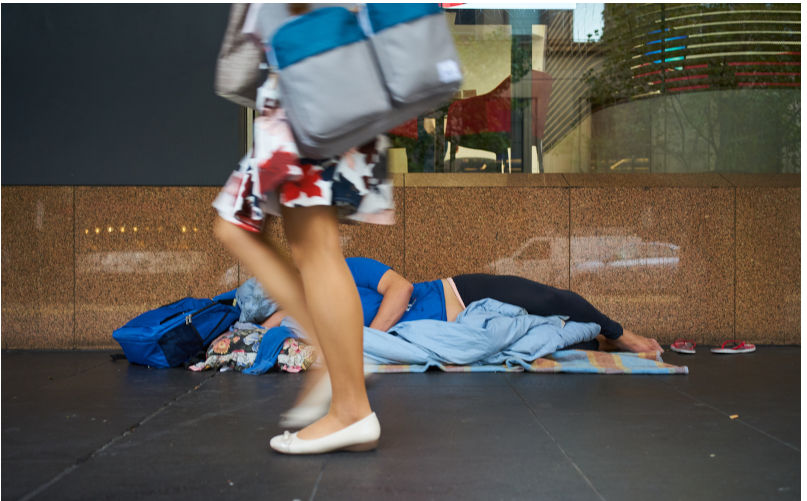
People seeking asylum and other non-residents face a double invisibility in Australia’s homelessness crisis, excluded from support systems just when they most need help.
Few things define us more than a sense of home. Our homes contain the family members we cherish. They host the meals we share. They grant us the security to restore ourselves overnight for the next day’s challenges.
But not for everyone.
National Homelessness Week, which runs from 3-9 August, highlights the hardships facing too many people today. We hear much about the nation’s housing shortage and the stresses that weigh down buyers and renters alike.
These are all too real for many, squeezing relationships and edging people towards homelessness and invisibility as we look past a rustling blanket in a car or a flashlight inside a nylon tent in the park.
However, for many, there are two levels of invisibility.
The first is the homelessness caused by economics, sometimes worsened by the consequential impact on a person’s mental health. The second concerns people whose uncertain visa status in Australia makes them more likely to fall into poverty, destitution and, ultimately, homelessness.
Increasingly, these two groups intersect in a Venn diagram of hardship.
Estimates on the breadth of this problem vary wildly, which is evidence of how little we understand homelessness.
At the Asylum Seekers Centre, we see the effects of this doubled hardship on the lives of people who have fled persecution because of their religion, their ethnicity and their identity.
We assist more than 4,600 people each year, including hundreds who need crisis help.
In the previous financial year, almost 50 per cent of our crisis referrals were for people who were homeless or on the cusp of becoming homeless.
This financial year, that has soared to 85 per cent.
A survey by our partner organisation, the Jesuit Refugee Service, found 55 per cent of people seeking asylum have experienced homelessness at some point. Another survey, by the City of Sydney and a collection of organisations, estimated one-fifth of the people in Sydney who sleep rough are non-residents.
Without intervention, more people would fall into the chasm that led to the tragic death of Bikram Lama, a young man from Nepal, whose story was the focus of a shocking investigation by The Guardian earlier this year.
Lama came to Australia from a Nepali village to study computer science. He arrived as a student but lost his visa status or failed to obtain permanent residency. As a consequence of this, he became homeless – unless you can call the entrance to Sydney’s St James station, where he slept, home.
Last year, as Christmas approached, 32-year-old Bikram Lama died, passed unnoticed for much of a week by an estimated 100,000 people who used the train station.
Sadly, Bikram Lama was no statistical outlier.
At the ASC earlier this year, we created a five-minute animation that told a similar story of the homelessness and hardship so many non-residents face in Australia today.
That was part of a five-film series we called Hidden Stories, and it concerned a man we called ‘Ayan’. He slept in a tunnel near a train station. After going 36 hours without food, Ayan entered a 7-Eleven and asked for a cup of coffee.
The response Ayan received was evidence of Australia’s generosity and what leads me to believe problems such as homelessness are solvable. The 7-Eleven attendant said, “yes”.
But Ayan’s story shows the resilience of individuals, another trait that defines the best of Australia, a trait we find beneath those two layers of invisibility.
Hidden stories like Ayan’s and, tragically, like Bikram Lama’s, must not fall under the radar of our politicians. While Australia’s housing crisis can affect us all in different ways, the measure of any resilient society is how we support those who are vulnerable when they most need help.
There is more that our politicians can and must do at federal level and at state level, including here in NSW.
Too often, people seeking asylum are barred from accessing crisis accommodation on account of the uncertainty of their visa statuses. Ensuring that access is granted creates opportunities to rebuild the lives of people who are rough sleeping and living in destitution.
Meanwhile, in NSW, many programs exist to help overcome the initial hurdles of acquiring a private rental property through financial assistance with bonds and initial rental payments. However, people seeking asylum are excluded from state-based housing support systems too.
Rather than create an underclass of visa holders and non-residents, our approach to the housing crisis should be grounded in humanity and based on need, not visa status.
It is time to remove the veils of invisibility that hide homelessness and replace them with blankets made of dignity and kindness.
