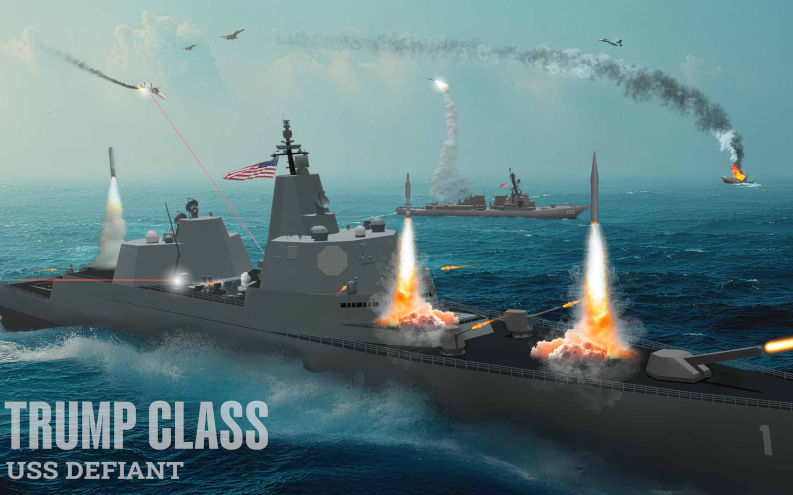
The planned nuclear-powered Trump-class battleship could place further pressure on already stretched US naval reactor supply chains, adding to doubts about Australia’s chances of receiving Virginia-class submarines.
The outsized ego of Donald Trump is the latest hurdle for AUKUS, specifically his desire to have a new class of battleship built, named in his honour.
That hurdle comes because the US Navy has confirmed that its planned Trump-class guided-missile battleship, whose lead ship would be USS Defiant, will now be nuclear-powered.
This propulsion decision could have consequences by placing additional pressure on US aircraft-carrier construction and the naval nuclear industrial base, but crucially for Australia – as Navy Lookout reports – has potential implications for the AUKUS submarine program.
When the Trump-class battleship was unveiled at the end of 2025, the US Navy’s initial concept was for conventional integrated electric propulsion using gas turbines and diesel generators. Now, however, it has been confirmed the battleship class will be nuclear-powered – the first US nuclear-powered surface ships since the Virginia-class cruisers were paid off in the 1990s.
This decision places increased pressure on the supply chain for the required nuclear technology. The industrial bottleneck is the naval reactor supply chain centred on BWX Technologies, the sole supplier of US naval reactor cores and key reactor components.
BWX is simultaneously supplying the Ford-class fixed-wing aircraft carrier program – each carrier, 10 of which are planned, needing two reactors – along with two major submarine programs, the Columbia and the Virginia classes. Adding the nuclear requirement to the battleship program, when there is no spare industrial capacity to draw upon, means intensified competition for nuclear-certified labour, dry-dock time and reactor components which are already committed years ahead.
It is highly likely there will just not be enough of these things to go around.
Construction of the Columbia-class SSBN programme, intended to replace the sea-based leg of the US nuclear deterrent, is already running late, while Virginia-class SSN construction is well below the rate the fleet requires – indeed, less than half the rate required. This greatly impacts Australia’s chances of receiving any of the planned Virginia-class submarines, new or second-hand, from 2032. A shortage of nuclear reactors only compounds the problem.
Turning to the UK and the proposed SSN-AUKUS class, both British and Australian, there are further problems in that it is possible there will be insufficient highly enriched uranium (HEU) to power them.
The last public figure in 2002 placed the UK’s HEU stockpile at 21.86 tonnes, with its present size, composition and availability for future naval fuel not publicly known. Over half of that stockpile was of US origin, and none of the stock can immediately be replenished, as domestic UK weapons-grade enrichment ended in 1962.
It is uncertain, then, if there is sufficient HEU for both the currently in-construction four SSBN Dreadnought-class submarines and the planned 12 Royal Navy SSN-AUKUS-class submarines, along with the five planned for Australia.
While the UK has committed £1.7 billion (A$3.3 billion) to a Nuclear Fuels Program to explore re-establishing domestic enrichment to reduce dependence on the US in the long run, building sovereign enrichment capability will take 15 to 20 years.
It may well be that the Trump-class battleships will be shelved as a vanity project following the end of Trump’s term in office. The US Congress has strongly supported the US Navy’s continued development of the large, but less demanding, conventionally powered next-generation guided-missile destroyer program as an alternative.
Perhaps the UK will source HEU from the US, though the US itself is stretched in supplying its own needs.
Still, both the Trump-class battleship program, with its further strain on the reactor supply needed to power the Virginia-class SSNs, and the shortage of British HEU present further problems for the SSN-AUKUS boats.
One wonders at the fascination Australian politicians and much of the military and security establishment have with AUKUS. It increasingly is coming to look like a form of cargo cult.
John Queripel is a Newcastle-based historian, theologian, social commentator and published author of four books. His latest book, ‘In Wisdom and in Passion: Comparing and Contrasting Buddha and Christ’. His examination of the Easter events, ‘On the Third Day: Re-looking at the Resurrection’ has just been re-printed. His blog may be found at www.johnqueripelblog.com.Substack / https://johnqueripel.substack.com’