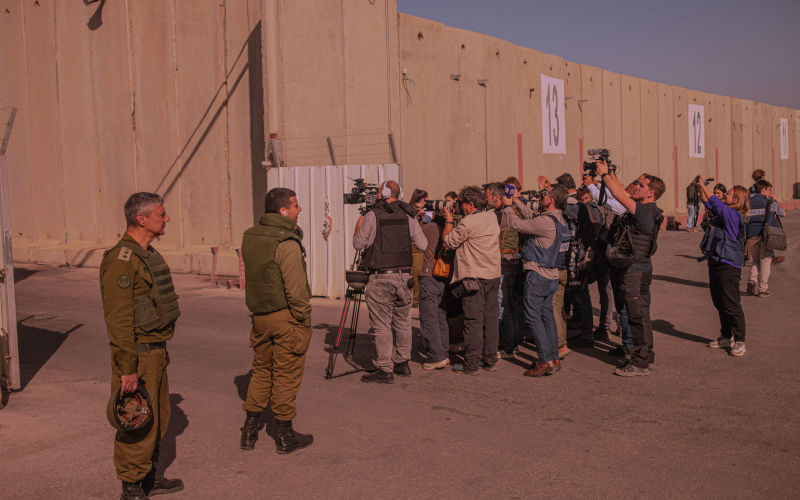
Foreign journalists face visa denials, intimidation and violence, while Israeli reporters and filmmakers are increasingly threatened for exposing what the government would rather keep hidden.
When I write about what Israel is doing in Gaza and the West Bank, I don’t have to ask whether my next article will cost me the right to live and work in Israel. But many of my foreign colleagues do. I am protected by my Israeli citizenship – for now.
My foreign colleagues depend on the good graces of the Netanyahu government. A European colleague on a work visa told me that reporting from the West Bank means worrying about more than physical safety. She and other foreign reporters fear that Israeli authorities will see them as giving more space to Palestinian stories than Israeli ones.
Israeli-backed intimidation campaigns in their home countries have already targeted colleagues reporting from here. Even criticising Prime Minister Benjamin Netanyahu has sometimes felt like going too far; calling for any kind of sanctions crosses a red line. Simply having to think twice about what they write, she said, shows how dangerous the situation has become.
The Israeli government threatens foreign reporters; settlers attack them in the West Bank. The aim is the same: to silence those who expose what Israel fights to conceal.
That’s why Israeli journalists must stand in solidarity with our foreign colleagues, and that solidarity must extend well beyond Haaretz. We also must not leave them to fear expulsion or nearly fatal violence and assume our turn will never come.
Washington Post photojournalist Heidi Levine was doing her job in the West Bank last Friday, documenting the olive harvest and the settler violence that routinely makes targets of Palestinians and anyone helping them. Then she became a target herself. She was assaulted and hospitalised; according to her daughter, settlers broke one of her ribs and she nearly lost a finger.
While Isaac Herzog, Israel’s figurehead president, called Levine to apologise, Netanyahu disputed her account, alleging “open questions” about the attack and challenging the accounts of European diplomats who were also attacked by settlers the next day. Beyond the presidential damage control, Netanyahu’s response reveals that Israel prefers to stand with the violent settlers it grants impunity.
But if the Israeli government had its way, Levine would never have been in the West Bank. A foreign journalist documenting settler violence, let alone becoming a victim of it, makes that violence impossible for Israel to conceal.
The same week Levine was attacked, Israel used anti-democratic measures and bogus claims to keep foreign journalists out of the country or intimidate those it lets in.
Israel denied Serena Bilanceri of German newspaper taz a work visa over two opinion articles calling for sanctions against settler violence, falsely branding it a call to boycott the country. It revoked the entry permits of French journalist Sylvain Mercadier and Italian journalist Martina Stefanoni, both due to cover the election, without an explanation.
British Channel 4 News journalist Secunder Kermani was detained and questioned about whether he believed that Israel had committed genocide in Gaza before being admitted. Jewish American researcher Sophia Goodfriend was denied entry; she said she was questioned over a tweet saying “Israel should not kill 300 people in Gaza” and called “naive”.
Speaking on a podcast after being denied entry, Bilanceri described the move as “simply an attempt to make the work of critical journalists … more difficult, or impossible”.
“I feel that what I said is being exaggerated and turned on its head to fit an amendment to Israel’s law, so they can deny me entry,” she said, referring to a 2017 amendment banning supporters of a boycott against Israel from the country. “It says you cannot call for a boycott of Israel, but I haven’t done that.”
She said the government was making journalists out to be “supposed enemies of Israel”.
This crackdown is creeping towards Israeli journalists too – two in particular. Netanyahu has vowed to work – unlawfully – to revoke the citizenship of “NAZA” directors Yuval Abraham and Rachel Szor. His threat has fuelled a potentially fatal, government-backed incitement campaign against them, with his and Itamar Ben-Gvir’s henchmen seeking to prevent their return, or alternatively, waiting for them to set foot back in Israel.
The government would seemingly be happy to outlaw Haaretz too. At the end of 2024, it came as close as it could by imposing sanctions on us, which were ultimately deemed unlawful. This fuels incitement against us over our reporting, which has already spread widely among the Israeli public. As the space for criticism shrinks, the government is working to turn us from critics into dissidents.
For me, this is what this week’s election is about: will Israel become a full autocracy, or will there still be room to expose its destructive policies? My ability to continue living and working here as a journalist hangs on the answer. Israel’s imperfect democracy itself hinges on foreign reporters’ ability to report freely and voice their opinions without facing punitive, unexplained or unlawful measures.
So if anyone in the Israeli government is reading this: come and get me. Revoke my citizenship too, stop me at the border and don’t let me in next time. The right to express my opinions is not a prize for good behaviour. What is citizenship worth in a country that won’t let us show the truth and tell the world what it is trying so hard to hide?
Republished from Haaretz
David Issacharoff
David Issacharoff is the news editor at Haaretz English edition. He studied political science and history at the Hebrew University of Jerusalem and Humboldt University in Berlin. In 2024, he is a visiting fellow at Der Spiegel through the International Journalists’ Program (IJP).