Beef and crop production remain major sources of greenhouse gases, but better farming practices can cut emissions substantially. Plus, Snowy 2.0 faces another cost reckoning and Switzerland’s glaciers continue to disappear.
Is beef really a problem for climate change?
A few years ago it seemed clear that rearing and eating beef was bad for climate change (and the environment more generally). Cows disgorge methane at both ends and vast areas of forest are being cleared to expand beef production to meet the increasing demand of the developing economies. In addition, growing animal feed consumes lots of synthetic fertilisers, the production of which is energy intensive and relies heavily on fossil fuels. When fertilisers are applied to the soil, they release nitrous oxide, a potent greenhouse gas.
But now we are told that cows can be given foods and supplements that reduce the amount of methane they produce and beef production is becoming more efficient (and meat can be made synthetically). So where do things stand?
The World Resources Institute has provided evidence-based answers to six questions:
- How does beef production cause greenhouse gas (GHG) emissions?
- Is beef more resource-intensive than other foods?
- Why are some people saying beef production is only a small contributor to emissions?
- Can beef be produced sustainably?
- Do we need to stop eating beef in order to curb climate change?
- Would eating less beef be bad for jobs in the food and agriculture sector?
My synopses of the WRI’s already succinct answers are:
- See above regarding GHG production but to put beef’s influence on global warming into perspective, the industry is responsible for 5–10 per cent of all current annual GHG emissions.
- Yes, beef is much more resource intensive than all other common farm products except lamb in terms of land use and GHG emissions per tonne of protein consumed.
- Mostly because they are ignoring the land use change.
- The emissions intensity of beef production varies greatly across the world but yes, it will always be resource intensive.
- No, but rich, high-meat consuming countries do need to reduce their meat consumption by, say, a quarter to a half – a trend that is already occurring in many places. Eating less red meat, particularly processed red meat, is healthier anyway.
- Not necessarily bearing in mind the growing demand for beef in emerging economies.
So, to answer my opening question: yes, a big problem: “Beef is more resource-intensive than most other foods and has a substantial impact on the climate. Food producers and consumers alike have a role to play in reducing beef’s emissions as the global population continues to grow.”
What about crops?
In 2020, croplands were responsible for about 5 per cent of all global GHGs, about the same as the emissions produced by the annual destruction of tropical primary forests and more than global shipping. So not an insignificant amount of emissions. But what is equally remarkable is that the crops’ emissions problem is very specific to particular crops, places and farming practices.
Of all the hundreds of crops that are grown around the world, just four – rice (43 per cent), corn, wheat and palm oil (9, 8 and 7 per cent respectively) – are responsible for two-thirds of the emissions. Only three practices are responsible for over 90 per cent of crops’ emissions: draining peatlands, flooding fields for rice cultivation (both 35 per cent) and synthetic nitrogen fertilisers (23 per cent), much of which isn’t even absorbed by the crops.
Six countries account for 61 per cent of crop emissions but three stand out: China, Indonesia and India (23, 15 and 12 per cent respectively).
The same crop produces different amounts of emissions depending on not only the local soil and climate conditions but also historical legacies related to, for instance, cultural practices, colonial trade routes, government subsidies and infrastructure investments, and dietary preferences.
No one is saying we shouldn’t grow crops associated with high emissions. They are essential in many ways, especially with a growing world population and increasing prosperity: human nourishment (rice produces almost half of all crop emissions but provides 28 per cent of Asia’s calories), animal feed, industrial products, biofuel, etc. But it is possible to examine both farming methods and the uses being made of the crops to look for ways of reducing their emissions. For instance:
- Constant flooding of rice fields could be replaced with alternate wetting and drying and other changes to reduce emissions by nearly half.
- Nitrous oxide emissions from fertiliser use could be lowered by up to 50 per cent by matching fertiliser type to crop needs: using the right fertiliser, at the right rate, at the right time, in the right place (4R approach).
- Raising the water level on peatlands being used for crops reduces CO2 emissions.
Growing ‘food’ for fuel seems particularly problematic. The UK aims to supply 22 per cent of its jet fuel needs by 2040 with sustainable aviation fuel (it’s currently 2 per cent). Meeting this with crop-based biofuels (e.g., soybean, wheat, rapeseed, grasses) would require over a third of the UK’s current cropland. And the US’s corn for ethanol for fuel program beggars belief on many levels.
Cost and timeline blowouts for Snowy 2.0
In 2017, Malcolm Turnbull announced Snowy 2.0, a pumped hydro project that would increase by 50 per cent the capacity of the Snowy Mountains Hydro-electric Scheme. The stated goal was to provide large-scale, reliable renewable energy to the National Electricity Market that serves the eastern states. Unstated was the Commonwealth government’s desire to undermine the credibility of South Australia’s big battery. The cost of the project, excluding additional power lines, was originally estimated to be $2 billion and it was expected to start operating during 2024–2026.
Snowy 2 is now expected to cost $20 billion, or possibly $40 billion if interest and transmission costs are included. Delivery is not expected until 2028 at the earliest.
I don’t think that there is much doubt that the project will be able to deliver the additional power once it is functional but, notwithstanding Turnbull’s unwavering support for Snowy 2, whether it is the best and most cost-effective way of providing reliable renewable energy to eastern Australia and whether the planning and construction have been well-managed seem to be questionable.
Why do governments repeatedly underestimate the cost and timeline of major infrastructure projects? Perhaps because, as with Snowy 2, the decision was made hastily with little examination of the issues or alternatives. I suspect that the private sector is just as bad but we don’t hear about it to the same extent – possibly because only business-page journalists and shareholders care when a company experiences a delay in delivering (or writes off) a significant investment.
That all said, construction of Snowy 2 is proceeding, including building a hydroelectric station the size of Sydney Opera House almost a kilometre underground.
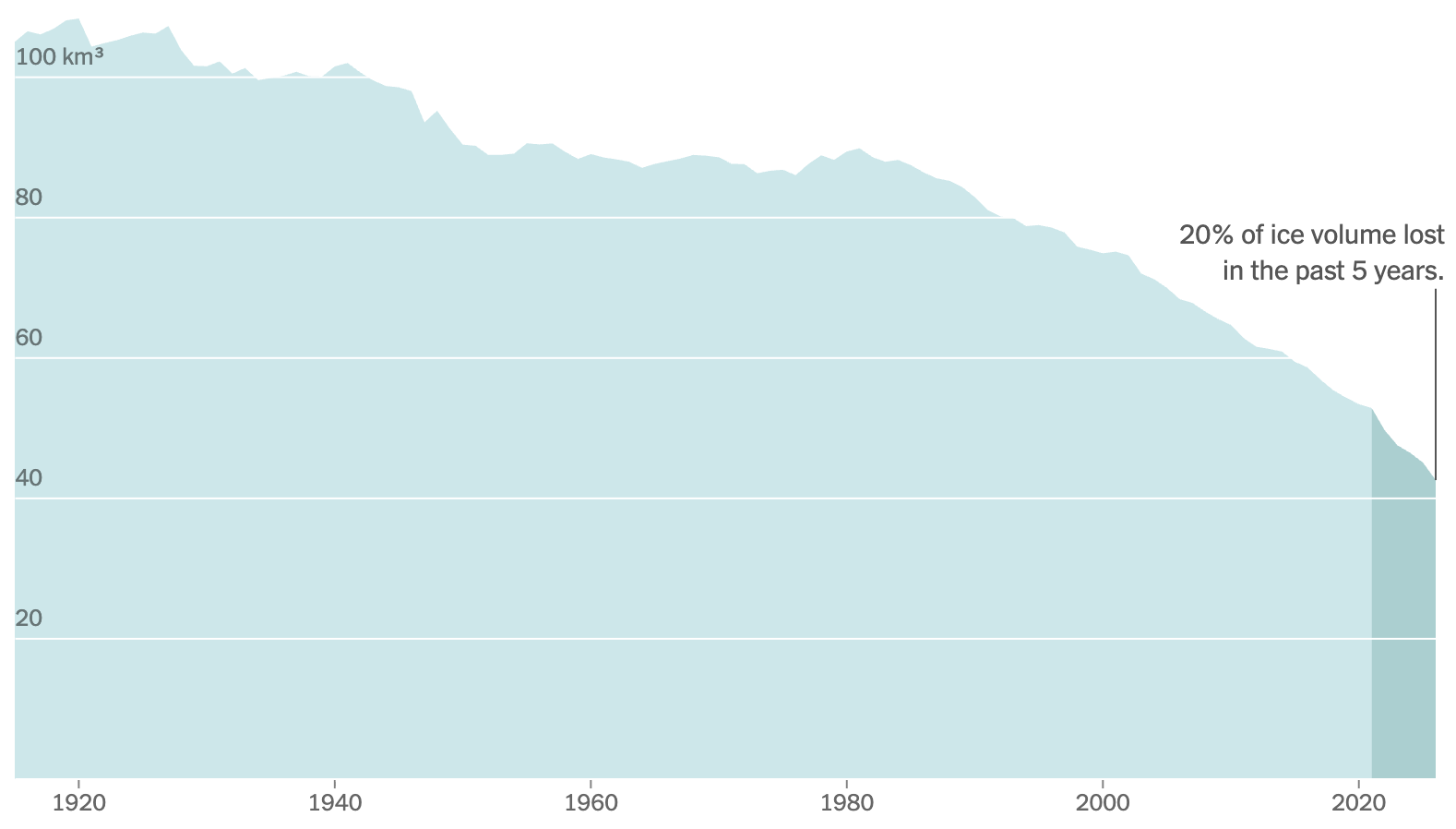
Swiss glaciers perform century-long disappearing act
… losing over half their volume. And it’s accelerated since 1980: 20 per cent lost in the last five years.

Peter Sainsbury is a retired public health worker with a long interest in social policy, particularly social justice, and now focusing on climate change and environmental sustainability. He is extremely pessimistic about the world avoiding catastrophic global warming.