Xi’s latest terms for the American relationship, Trump’s post-summit verbal meandering, cybercrime operations’ new base, the west’s dominance is an historical ‘aberration’, and the Modi government’s all-veg banquets.
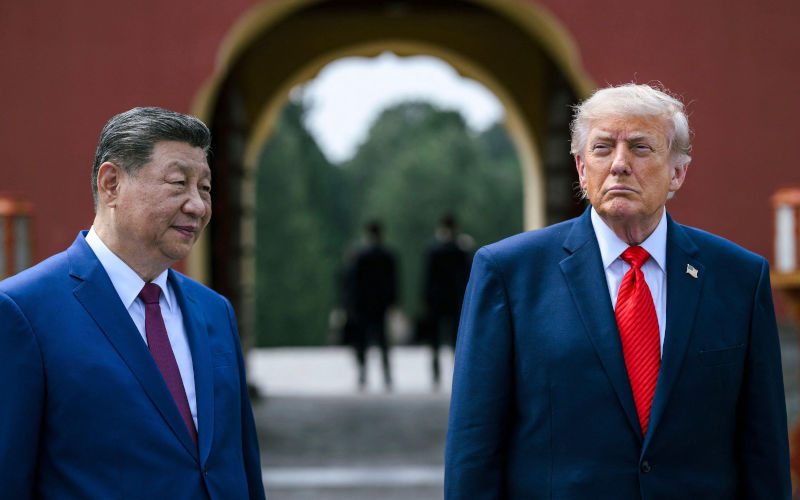
Xi Jinping and Donald Trump had different aims when they met in Beijing last week. Trump was looking for tangible wins but Xi was pursuing something bigger: to redefine the two countries’ relationship in terms China can live with.
Xi wanted US acceptance of what he has called a ‘constructive, strategic and stable relationship’.
The phrase matters far more than it sounds, says Tan Dawn Wei, s senior columnist with Singapore’s The Straits Times. Tan, the paper’s former China bureau chief, says Chinese diplomacy places enormous weight on formal definitions and political formulations.
“Once elevated into official discourse by the top leadership, they become organising principles,” she says…”[T]hey are not semantic exercises but attempts to establish the political terms of engagement.”
For years, Beijing resisted Washington’s view of the relationship as fundamentally competitive, seeing it as a way to contain China’s rise. Beijing’s new tack is to concede that rivalry is structural and will continue, Tan says, but it is trying to shape the terms of that competition.
“In Beijing’s view, ‘constructive strategic stability’ means rivalry that remains bounded and predictable,” Tan says. “China is signalling that it can live with economic, technological and geopolitical competition as long as both sides avoid pushing the relationship into outright confrontation.”
Tan’s colleague, Bhagyashree Garekar, the paper’s US bureau chief, says Beijing’s freshly minted phrase is now being parsed in Washington.
She quotes Yun Sun, a Chinese specialist at the Stimson Centre, a Washington think-tank, as saying US Secretary of State Marco Rubio, in a meeting last year with Wang Yi, his Chinese counterpart, said the US and China should aim for some type of strategic stability.
“The new (phrase) ‘constructive and strategic stability’ implies some level of parity has been reached between the two,” Garekar says.
Global Times, one of China’s official newspapers, published a commentary in the form of a long interview with Wu Xinbo, dean of the Institute of International Studies at Shanghai’s Fudan University. Wu says the formulation ‘a constructive relationship of strategic stability’ dilutes the narrative of China-US competition and improves expectations surrounding bilateral ties.
“If both sides continue working towards this goal, it would mean the two countries have found a new paradigm of major-country relations for the 21st century and can avoid the ‘Thucydides Trap’,” Wu says.
Xi met Trump last week and hosted Vladimir Putin this week. The South China Morning Post says Trump’s visit was framed around managing risks but Xi and the Russian President reached a raft of agreements and pledged deeper co-operation, including declaring they would push for a multipolar world order.
Anger over Trump talk of Taiwan bargaining chip
Donald Trump said nothing had changed on US policy towards Taiwan following his summit with Xi Jinping but some Asian media commentators didn’t quite believe him. His verbal meandering on the issue has sown confusion and anxiety.
Xi warned Trump that if the Taiwan issue were mishandled, the US and China could collide or even come into conflict.
Trump said later: “China is a very powerful, big country. That’s a very small island.
“It (China) is 59 miles away. We’re 9,500 miles away. That’s a bit of a difficult problem.
“They have someone there (in Taiwan) now that wants to go independent. Well, that’s a risky thing. They want to go independent because they want to get into a war and… they figure they have the United States behind them. I’m not looking to have somebody go independent.”
He said he was considering a pending US$14 billion (A$19.6 billion) arms package for Taiwan but said it provided leverage for his dealings with Xi – a “very good negotiating chip”.
The headline on a commentary in The Indian Express said Trump was openly questioning America’s role in protecting Taiwan.
An analysis in The Japan Times said his ‘nothing’s changed’ remark belied a shifting reality on the ground. It said Trump had broken with precedent by warning the government in Taipei against any move toward formal independence.
Ryan Hass, a China expert at the Brookings Institution think-tank, was quoted as saying Trump’s openness to negotiating with Beijing over Taiwan would serve as “the diplomatic equivalent of a matador waving a red flag in front of a bull”.
The Korea Times said in an editorial Trump’s suggestion that arms sales to Taiwan could be a negotiating chip with Beijing had sent a tremor through the strategic architecture of East Asia.
“The potential consequences extend far beyond Taiwan,” the editorial said. “At stake is the credibility of America’s alliance system across Asia.”
The Asahi Shimbun newspaper made a similar point in an editorial. Making Taiwan the subject of deals between the US and China could damage trust in American diplomacy, it said.
Trump also said he would like to speak to the person who is running Taiwan, presumably referring to the President, William Lai Ching-te.
Trump had caused some anxiety in Taiwan, the Taipei Times said. It reported Deputy Foreign Minister Chen Ming-chi as saying Taiwan would welcome an opportunity to speak to Trump. But the paper noted a conversation between Lai and Trump would be a major break in US policy and would risk a rupture with China.
Sri Lanka ‘paradise’ for shifting crime syndicates
Authorities in Colombo are concerned that international crime syndicates are shifting online scam operations to Sri Lanka.
A series of raids last week led to the arrest of almost 200 foreign nationals suspected of engaging in cybercrime offences, Sri Lanka’s The Sunday Times reported.
It said in a long and detailed report police seized 83 computers, 198 mobile phones, a car, an SUV and Rs 750,000 (about A$3,050) in cash. Arrests continued during the week, the paper said.
It said the arrests brought to more than 500 the number of foreigners taken into custody so far this year for suspected cybercrime offences. The total of foreign nationals arrested this year for various criminal offences was 600.
“Police sources observed that the number of arrests related to cybercrime offences has skyrocketed during the first five months of this year, compared to the entirety of last year,” the story said.
“The raids reflect growing alarm within government circles.”
The government believed scammers started to move to Sri Lanka after last year’s crackdown by Myanmar’s rulers on scam-centre complexes along the Myanmar-Thailand border.
The story said visa-control failure contributed to the ease with which transnational criminals could set up scam centres in Sri Lanka. “One senior law enforcement officer… went so far as to describe Sri Lanka as having become a ‘paradise’ for international crime syndicates,” it said.
A news story in South China Morning Post said the networks operating in Sri Lanka targeted victims across Asia but there were concerns that Sri Lankans could be next.
It said authorities were also investigating whether foreign syndicates were involved in a recent cyberattack on the Sri Lanka Treasury that resulted in losses of about A$3.5 million.
Authorities in Cambodia were struggling to end the scourge of scam compounds, while also dealing with shootouts along the border with Thailand, said a story in ucanews.com, the Catholic Asian news site.
A body called the Commission Against Technology-based Fraud last weekend arrested 103 foreigners from seven countries for cyber scam activities and seized 800 mobile phones, 77 desktop computers and 36 laptops.
But the story said Cambodia had missed a self-imposed deadline to rein in organised crime by the end of April and there remained a list of Cambodian tycoons who had been sanctioned by the US and other countries but whom authorities in Phnom Penh continued to defend.
Asian societies regain cultural confidence
When Singapore statesman Kishore Mahbubani was growing up, he assumed that the west was, and would remain, superior to Asian societies. No longer.
“Asian societies are shedding the sense of inferiority that they had developed during the era of western dominance,” he said in a speech this month. “As they regain their cultural confidence, they are embracing their own heritage, traditions and ways of thought – and the rest of the world is following suit.”
Mahbubani, 77, was twice Singapore’s Permanent Representative to the United Nations. He is now a distinguished fellow at the Asia Research Institute of the National University of Singapore. He spoke at the 10th anniversary Emerging Markets Inspiration Conference, hosted by Stockholm University, and South China Morning Post published an opinion article based on his speech.
Mahbubani said western civilisation had been extraordinarily successful over the past two centuries but it was a mistake to believe this represented the historical norm.
“When one surveys the larger sweep of human history, it becomes abundantly clear that those two centuries were an aberration,” he said. “From the year 1 to 1820, the two largest economies on Earth were always those of China and India.”
When Asian societies began to modernise, most western observers assumed they would inevitably become more westernised, he said. They conflated modernisation with westernisation.
“They are, in fact, very different processes,” he said. “Both China and India are modernising without westernising. They are discovering their own civilisational roots and are becoming less western in many respects.
“The defining new reality of the 21st century is, therefore, not a world of emerging markets but of re-emerging civilisations.”
Mahbubani said the assumption that the world was becoming homogeneous was outdated. Western economists, for instance, tended to scoff at five-year plans, yet China’s five-year plans had been central to its extraordinary rise.
“China’s success also reflects the fact that the appropriate balance between state and market must differ from western norms,” he said. “Why? Because the state has played a commanding role in Chinese life for more than 2,000 years.”
The Anglo-Saxon world and its institutions were no longer seen as the universal default.
“A telling moment in this transition came when director Bong Joon-ho, whose film Parasite became the first non-English language film to win the Academy Award for Best Picture, remarked in 2019: ‘The Oscars are not an international film festival. They’re very local’,” Mahbubani said.
“That observation struck at something profound.”
Gaza support would ‘rile’ Netanyahu
BRICS foreign ministers met in New Delhi last week but failed to produce a joint statement. Al Jazeera said this was because of divisions over the US/Israel war against Iran.
India had said there were differing views among some members.
Al Jazeera referred to statements outside the meeting by Iran (that it did not target ‘a certain country’ but only hit American bases on its soil) and the UAE (that Iran was trying to justify ‘terrorist attacks’ on its territory and that of other Gulf states).
BRICS, an alliance of major developing economies, brings together Brazil, Russia, India, China, South Africa, Ethiopia, Egypt, Iran, Indonesia and the United Arab Emirates.
While the meeting did not agree on a declaration, India produced a 63-point chair’s statement and outcome document that was published on its External Affairs Ministry’s website.
A commentary in Pakistan’s Dawn newspaper said the foreign ministers all expressed support for an independent Palestinian state. This was a major development, the article said.
The significance was twofold. It was India’s first clear statement on Palestine since Prime Minister Narendra Modi visited Israel just before the war started and promised his complete solidarity with the state, and it verified the UAE’s support for Palestine even after Benjamin Netanyahu’s reported secret visit to Abu Dhabi while the war was still “hot”.
The article, by Jawed Naqvi, Dawn’s Delhi correspondent, said the ministers had called on all parties to ensure the maintenance of the Gaza ceasefire and of unhindered humanitarian access the Gaza Strip. “This would rile Netanyahu,” Naqvi said.
The ministers expressed full support for UN membership for the state of Palestine, with East Jerusalem as its capital, to achieve the vision of two states living in peace and security.
Naqvi said the statement read almost like a Chinese or Russian draft resolution that India had taken up as part of the chair’s document.
“To have India and the UAE on board with a resolution starkly targetting Israel is a feat of sorts, more so when it occurs in New Delhi,” he said.
Stuffed broccoli tops state dinner menu
Vietnamese President To Lam was a guest this month at Rashtrapati Bhavan, India’s presidential palace. The meal at the dinner in his honour was fully vegetarian and included stuffed broccoli, sauteed baby potatoes and rice cooked with green peas. Journalist Debarshi Dasgupta said the offering was insipid.
Many Indians, he said, would think thrice before ordering a similar meal from a restaurant.
People were wondering if their country was living up to the traditions of Indian hospitality, summed up by the phrase Atithi Devo Bhava, meaning the guest is the equivalent of God, he said. Recent state banquets for visiting heads of state had been all-vegetarian.
“President To Lam did not come to India expecting to be served a gold-leaf-coated steak – something he enjoyed when he visited London,” said Dasgupta, the India correspondent for The Straits Times. “But neither did he possibly expect to return home without sampling a meat dish in a country whose best-known culinary exports include tandoori chicken and where, more importantly, more than two-thirds of its citizens are non-vegetarian.”
In a recent opinion piece Dasgupta told a story, attributed to an opposition MP, about a state banquet in honour of Emmanuel Macron. The French President, it was said, went back to his hotel and ordered bread, cheese and cold cuts. The reason? The meal was all-veg and he couldn’t eat anything.
“Increasingly, the Bharatiya Janata Party-led Indian Government is choosing to feed its state guests solely vegetarian good, as if India has only vegetarian fare worth putting on the high table,” he said. “And as if meat were something radioactive that Indians would rather not even touch with a bargepole.”
He quoted Indian food historian Pushpesh Pant as saying vegetarianism had increasingly been forced on people under BJP’s rule. There were many instances of BJP governments banning meat from the vicinity of Hindu religious places and barring its sale during Hindu festivals.
Yet, Dasgupta said, year after year the dish most often ordered on food delivery apps was chicken biryani.
Note: Indian Prime Minister Narendra Modi is a vegetarian.

David Armstrong is the Editor-in-Chief of Pearls and Irritations. David is one of Australia’s best respected reporters, editors and media executives, with more than five decades of experience in Australia and Asia. A contributor for more than 10 years, David writes a regular column on Asian media.