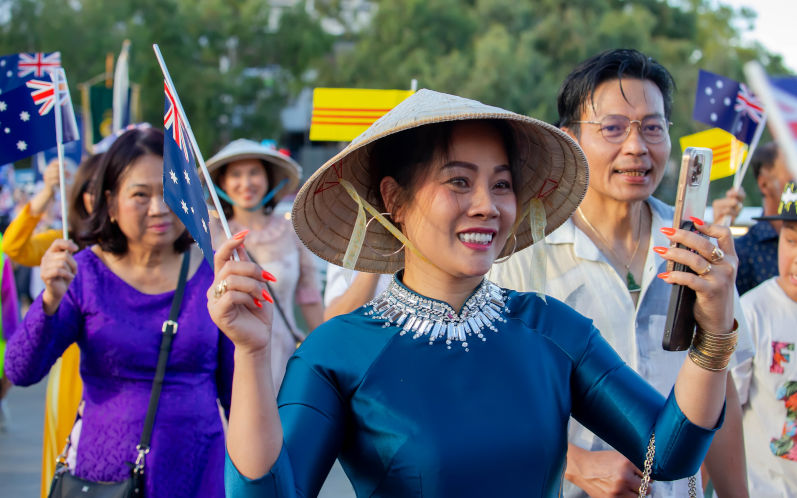
Fifty years after the end of the Vietnam War, Vietnamese Australians are marking survival, settlement and contribution with a world-first museum in Melbourne dedicated to the refugee journeys that helped reshape multicultural Australia.
When the last helicopter left South Vietnam in 1975 – signalling the end of a long and brutal war – almost 20 million people were left behind. Frightened and with little desire to live in a communist one-party state, many started plotting an exit strategy.
Up to half of the daring 800,000 who risked all by boat would perish at sea, but many did find asylum in the west, an embarrassment for communist Hanoi, where leaders were trying to convince a skeptical world that South and North Vietnam were one and at peace.
Those who made it say the risks were worth the rewards and half a century later, this is proving a cause for celebration in Melbourne with the launch of the world’s first museum dedicated to South Vietnam’s refugees, spearheading commemorations.
“It is to tell the story of the refugees, why they fled, and then their boat journey, and then their settlement here,” said Tammy Nguyen, chief executive officer for Vietnamese Museum Australia.
“But it’s also to showcase the contributions that the community has made to the fabric of Australia in the last 50 years of settlement here.”
Thousands of stories will be told when the three-storey Vietnamese Museum, costing about US$14 million, opens in mid-October in Sunshine, a suburb of Melbourne’s west, after delays due to the Covid pandemic – which meant last year’s 50th anniversary of the war’s end was missed.
“We’re an industrious bunch. But people who had every intention to support, fund and contribute to the project all of a sudden found their business in absolute dire straits. Quite a few businesses closed down, some struggled to bounce back,” Tammy said.
But the timing will also coincide with another half-century marker; 2 July, 1976, when South Vietnam was formally annexed by the communists in Hanoi as part of modern Vietnam, after a 14-month occupation by North Vietnamese troops.
That day was remembered this week with the unveiling in an inner suburban corner park of the Mythical Crane Boat, a powerful artwork symbolising the perilous journeys in boats hardly fit for purpose on the high seas.
The bronze marker was welcomed by Aboriginal communities with the traditional Welcome to Country and smoking ceremonies – an inhaling of burning eucalypt leaves to cleanse and ward off bad spirits while fostering a better future.
Among the survivors was Duy Quang Nguyen, now president of the Victorian chapter of the Vietnamese Community in Australia, whose family life in Vietnam was dominated by famine, poverty and a fear of being thrown into a communist re-education camp.
Soon after the communist takeover, a cousin had built a boat and Duy was offered a place with a crew of about 30 people – all relatives. He declined and all of them perished at sea.
But as life got harder, he followed his mother’s advice, saying, “There was no way to live in this country, Vietnam.” He spent 12 days at sea before landing at a Malaysian refugee camp, where he was interviewed and accepted by Australia.
He found learning Australian English as difficult as the food served up on his arrival in Tasmania as a 24-year-old in 1989, and understanding Australian football rules after a youth spent playing soccer.
“You call that soccer. We called that football,” he said good-naturedly, with a smile. “But our kids, they now enjoy Australian football, but I tell you what I observed with football – that support comes from the family,” he said.
He says family and community networks are what made Australian life important for the 335,000 ethnic Vietnamese who call Australia home, alongside acceptance and political participation that he adds were bereft in Vietnam after 1975.
Just a few feet from the Mythical Crane Boat, the Australian, Aboriginal and Torres Straits islander flags fluttered alongside the red and yellow stripes of the former South Vietnam, a flag that remains officially loathed in Hanoi.
But communist dictums are scorned in equal doses here, by the crowd of perhaps 400 mainly Catholic Vietnamese who remember the harshness of communist troops when they first marched into Saigon.
“We left because we don’t want to be communist. They don’t care about human rights, they want total control of everything – your home, your money, your job,” said 61-year-old Kim Le. “They put my brother and sister in jail.”
At 21, in 1989, she escaped through Nha Trang, spent seven days in a boat, and 14 months in a refugee camp on Palawan in the Philippines, where she was granted refugee status, settled in Adelaide and spent five years at university before a career as an insurance broker.
“We were heartbroken and there is a deep sorrow among all of us, Catholics and Buddhists. My father died in Vietnam. My brother … he escaped. Both were soldiers. I love the South Vietnam flag,” she said, flanked by veterans who fought alongside Australian soldiers in the Vietnam War.
Her sentiments were echoed by Quang Dung Vu. Now 85, he survived seven years in a communist prison before being released in 1982 when he fled Saigon by boat to Thailand.
“The first years in Australia were difficult. I worked hard in a factory. Long hours and menial work while studying at university to become an interpreter, but Australia was very good to us. Australians opened their hearts, and no one here will say a bad word about Australians.”
The Vietnamese Museum will be one of six multicultural galleries to be built in Australia and will open amid far-right pressure – most notably from Pauline Hanson, leader of the One Nation party – for a sharp cut in immigration numbers.
Hanson recently faced a public backlash across the country after calling for multiculturalism to be replaced by a “monoculture,” which was dismissed as incomprehensible by the Asian, Aboriginal and European Australians who christened the Mythical Crane Boat.
“She says she’s a proud Australian yet wants to upend what it means to be Australian,” said an ethnic Irish-Australian. “My family has five generations on this land and what? We’re being told by a bush politician what to eat, how to dress and what language to speak. Her uniform?
“People fled that type of political behaviour and she’s just another politician with a fantasy devoid of the reality about how Australians live. That’s very un-Australian,” he said. “Communists or fascists, they’re all totalitarians.”
Perhaps more importantly, the museum will also commemorate the 60,000 Australian soldiers who served in South Vietnam and the 521 who died.
It will also pay tribute to Malcolm Fraser, the former Australian prime minister, revered for his unflinching efforts in providing a refuge for those who fled South Vietnam by boat, of different faiths and ethnicities.
“It’s multi-faith,” Tammy Nguyen said, adding the museum’s advisory board includes the Bishop of Parramatta, Father Vincent Long Van Nguyen, and venerable Thích Phước Tấn and Thích Nguyên Tạng from the Buddhist clergy.
“We hope that the museum is an inclusive space. We really hope that it is a place of education, a place of inclusivity, that people can come to learn about the plight of the Vietnamese refugees and the struggles that they experienced,” she said.
Republished from UCASNews

Luke Hunt
Luke Hunt, a journalist of more than three decades of experience, is an expert on East Asia’s socio-political issues. A columnist, author, and academic, he covers Cambodia and beyond for UCA News.